

Cathay Pacific to operate less than 50% of pre-pandemic capacity in 2021

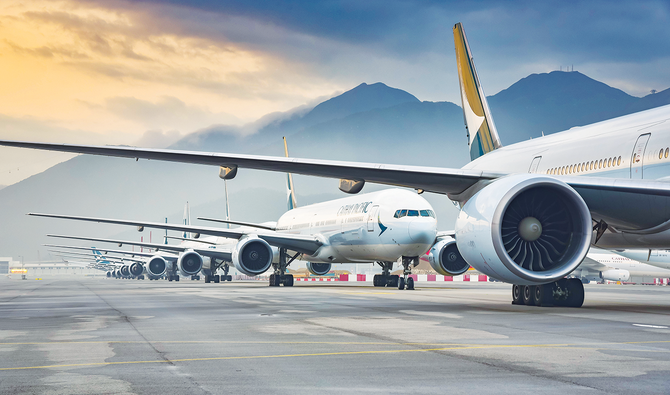
Aircraft fleet parked on taxiway of Hong Kong International Airport. (Shutterstock)
Short Url
Updated 20 October 2020
Follow

Cathay Pacific to operate less than 50% of pre-pandemic capacity in 2021

  • The airline said it planned to operate around 10 percent of its pre-pandemic capacity for the remainder of 2020

SYDNEY: Hong Kong’s Cathay Pacific Airways Ltd. said on Monday it expects to operate less than 50 percent of its pre-pandemic passenger flight capacity in 2021 as it nears completion of a strategic review that could lead to major job losses.

The airline said it planned to operate around 10 percent of its pre-pandemic capacity for the remainder of 2020, with most borders remaining closed.

The airline industry has been hard hit by the coronavirus pandemic as many countries imposed travel restrictions to contain its spread. Many of the curbs still remain in place.

“Among the multiple scenarios studied, this one is already the most optimistic that we can responsibly adopt at this moment,” Cathay said in the release of its monthly traffic figures to the stock exchange.

The airline said it assumed it would be operating well below 25 percent of pre-pandemic capacity in the first half of 2021 but that there would be a recovery in the second half if vaccines currently under development proved effective and are widely adopted in its key markets by the middle of 2021.

In September, the airline’s passenger numbers fell by 98.1 percent compared with a year earlier, though cargo carriage was down by a smaller 36.6 percent.

Cathay had in June said it was reviewing its strategy in light of the travel downturn, with “tough decisions” to be announced during the fourth quarter.

The South China Morning Post reported on Monday the Cathay board was expected to back a restructuring plan this week that included staff redundancies and pay cuts, citing unnamed sources.

In response, Cathay told Reuters it declined to comment on speculation.

Singapore Airlines Ltd. has announced plans to cut around 20 percent of positions, while Australia’s Qantas Airways Ltd. has said it will cut nearly 30 percent of its pre-pandemic staff, but Cathay has so far refrained from major job cuts.

Cathay has sent around 40 percent of its passenger fleet to less humid locations outside Hong Kong for storage.


Saudi Arabia lifts property sale ban to spur AlUla development

Updated 6 sec ago
Follow

Saudi Arabia lifts property sale ban to spur AlUla development

RIYADH: The Royal Commission for AlUla has lifted the suspension on land and property sales in central and southern AlUla, paving the way for renewed real estate activity in the region.

According to an RCU statement, the move aligns with the commission’s commitment to sustainable and inclusive development aimed at enhancing residents’ quality of life.

It also supports Saudi Vision 2030’s tourism objectives, with AlUla projected to contribute a cumulative SR120 billion ($31 billion) to the Kingdom’s gross domestic product by 2035, Phillip Jones, RCU’s Chief Tourism Officer, told Arab News in 2024.

“Lifting the suspension on land and property sales opens wider pathways for urban development and expands residential and investment options, reinforcing AlUla’s position as a prime destination for living and investment,” the statement said.

The decision is also designed to unlock significant opportunities for investors and developers in Saudi Arabia’s real estate sector, strengthen stability in the rental and ownership markets, and support diverse residential and commercial projects. Additionally, it aims to enrich AlUla’s urban identity by blending modern development with the city’s cultural and historical heritage.

Speaking at the TOURISE conference in Riyadh last November, Jones noted that AlUla has expanded its aviation capacity to 30 weekly flights and plans to double its hotel rooms to 2,000. He emphasized that these efforts aim to create a scalable, self-sustaining ecosystem that improves access while preserving the region’s heritage and landscapes.

Jones described AlUla as “a year-round destination,” with peak tourism from October to April driven by festivals, events, and concerts. Increased visitor numbers are already contributing to Saudi Arabia’s economy, in line with Vision 2030 goals.

Located in the northwest of the Kingdom and spanning approximately 22,000 sq. km, AlUla also has a thriving agricultural sector that underpins its economic development. Guided by social, economic, and ecological principles, the RCU has developed a strategic roadmap for AlUla, aiming to diversify the national economy beyond oil and boost GDP growth.