Pakistani chain store owners expected to visit Saudi Arabia next  month — trade authority 

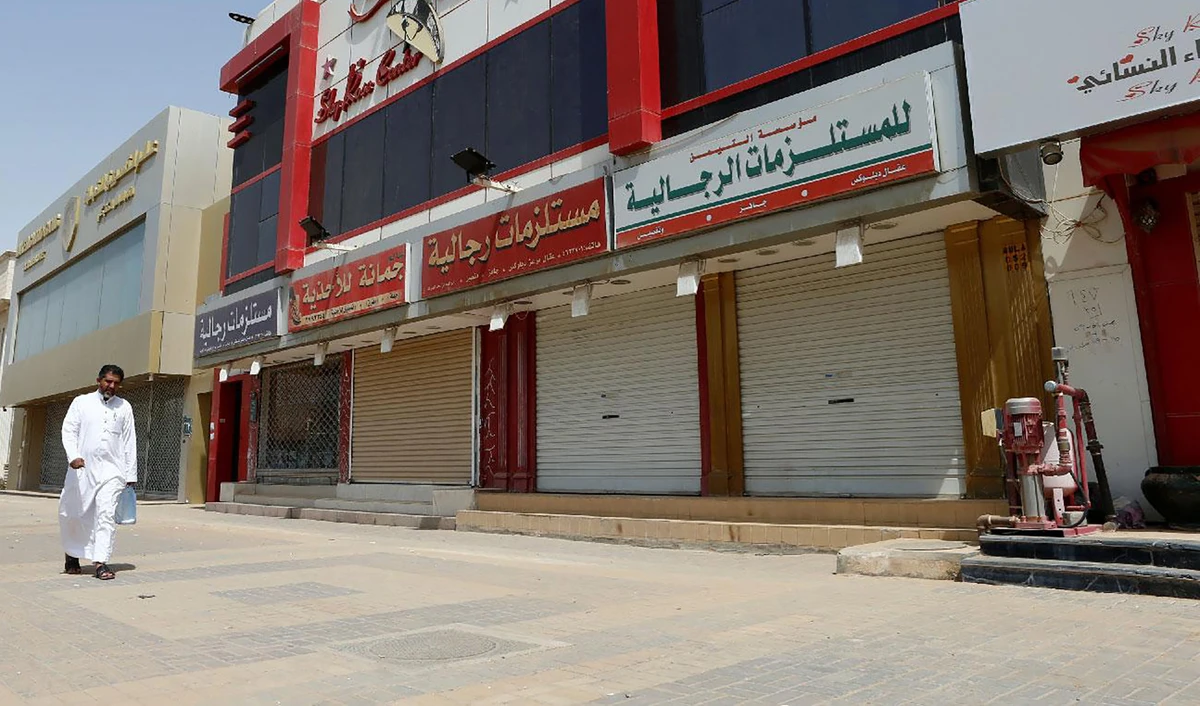
A man walks next to closed shops in Riyadh on July 12, 2018. (REUTERS/File)
Short Url
Updated 02 March 2021
Follow

Pakistani chain store owners expected to visit Saudi Arabia next  month — trade authority 

  • Trade minister at Pakistan embassy in Riyadh says “huge potential” for Pakistani chain stores in Saudi Arabia
  • Says Pakistani brands can give ‘tough competition’ to at least eight Indian chains based in the kingdom

KARACHI: A delegation of Pakistani chain store owners and representatives will likely visit Saudi Arabia by next month to explore opportunities to set up shop in the kingdom, an official at the Trade Development Authority of Pakistan (TDAP) said on Monday.
A virtual meeting was held last week between officials of TDAP, the trade ministry at the Pakistan embassy in Riyadh and the Chain Store Association of Pakistan to explore opportunities in Saudi Arabia.
Another meeting will be held within two weeks, Zulfiqar Ali Langah, a deputy director at the TDAP, told Arab News.
“After that the delegation will visit, expectedly by next month,” he added.
Azhar Ali Dahar, the minister for trade and investment at the Pakistan embassy in Riyadh, said there was “huge potential” for Pakistani chain stores in Saudi Arabia.
“Pakistani chain stores can give tough competition to around eight Indian chain stores,” he added.
“The participants [of last week’s meeting] were informed about the existing huge potential for the chain store business and legal requirements for entering the Saudi market,” Dahar said. “They were informed that they will have no tough competition because there are no European or western competitors and this is big opportunity for Pakistan.”
Pakistani products have struggled to find a place at major super markets around the world and other regional competitors have dominated the Saudi market despite long-term diplomatic and economic relationship between the countries.
“At present procurements are being made by Indians,” Daher said. “There is no shelf life for Pakistani goods.”
He added: “The vacuum in the Saudi market needs to be filled by Pakistani companies. Pakistan’s chain stores should see it as an opportunity to fill this vacuum through joint ventures and individual investments.”


A post shared by Arab News Pakistan (@arabnewspk) on


Possible locations for Pakistani chain stores could be Jeddah and Damam, the minister said, since they were home to a large number of Pakistani expats.
Pakistani chain store representatives say they are actively pursuing opportunities and seeking more information about the Saudi market.
“There is definitely a huge potential in the Saudi market but the actual challenges is how to set up stores,” said Asfandyar Farrukh, senior vice chairman at the Chainstore Association of Pakistan. “We have sought further information and after that a delegation will visit the kingdom to check the ground realities and possible location for setting facilities.”
Farrukh said it would take at least nine months from the time of entering  the Saudi market to setting up stores.

Bangladesh leader pushes for SAARC revival after meeting Indian, Pakistani dignitaries

Updated 5 sec ago
Follow

Bangladesh leader pushes for SAARC revival after meeting Indian, Pakistani dignitaries

  • Muhammad Yunus met Pakistan’s parliamentary speaker, Indian FM at Khaleda Zia’s funeral on Wednesday
  • SAARC has been dysfunctional since 2016, after India withdrew following a militant attack it blamed on Islamabad

ISLAMABAD: Bangladesh Chief Adviser Muhammad Younus this week pushed for reviving the South Asian Association for Regional Cooperation (SAARC) platform after meeting dignitaries from India, Pakistan and other parts of the region. 

SAARC has been effectively dysfunctional since 2016, when its planned Islamabad summit collapsed after India withdrew following a militant attack it blamed on Pakistan. Islamabad denied involvement, but New Delhi’s decision prompted Afghanistan, Bangladesh and Bhutan to pull out, leading to the indefinite postponement of the summit.

Younus met Pakistan’s National Assembly Speaker Ayaz Sadiq and Indian External Affairs Minister Subrahmanyam Jaishankar at former Bangladesh premier Khaleda Zia’s state funeral in Dhaka on Wednesday. The funeral also saw a handshake between the Indian and Pakistani representatives, the first high-level contact between officials of the two countries since their conflict in May. 

“During the meetings, Professor Yunus repeatedly emphasized the need to revive the South Asian Association for Regional Cooperation (SAARC),” Yunus’ account on social media platform X said.

“We witnessed a true SAARC spirit at the funeral yesterday,” the account quoted Yunus as saying. “SAARC is still alive. The SAARC spirit is still alive.”

The Bangladesh leader said apart from Jaishankar and Sadiq, representatives from South Asia who attended the funeral included Nepal’s Foreign Minister Bala Nanda Sharma, Sri Lanka’s Minister of Foreign Affairs, Employment and Tourism Vijitha Herath, and Maldives Minister of Higher Education and Labor Ali Haider Ahmed. 

Yunus said he tried to convene an informal gathering of SAARC leaders on the sidelines of the UN General Assembly in New York last year.

His statement to revive SAARC follows that of Pakistan’s Prime Minister Shehbaz Sharif, who earlier this month also called for reviving the South Asian platform. 

Sharif’s message last month came as the bloc marked the 40th anniversary of its founding charter. The Pakistani premier stressed the importance of deeper economic collaboration and collective responses to shared regional challenges such as poverty, climate-induced natural disasters, food and energy insecurity, and public-health vulnerabilities.