

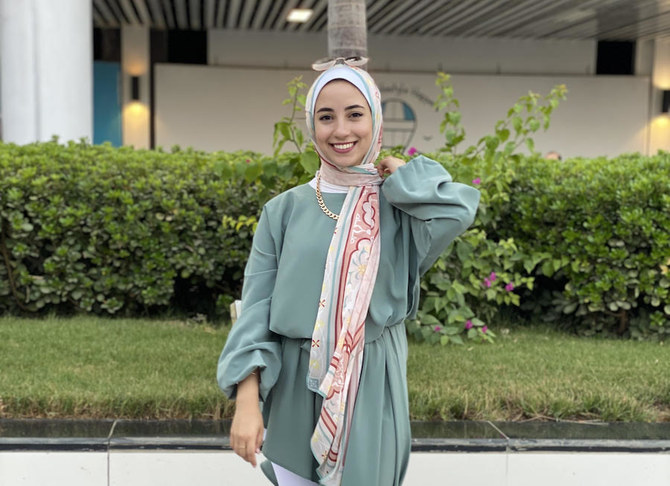
Meet the hijabi fashion blogger redefining modest style

Rana Ellithy boasts 94,000 Instagram followers. Supplied
Short Url
Updated 19 October 2020
Follow

Meet the hijabi fashion blogger redefining modest style

DUBAI: With their chic, modest style and unprecedented flair for makeup, a new crop of Instagram stars are irrevocably redefining the hijab. Rana Ellithy, who recently popped up on our radar, is certainly one to watch. 

The 21-year-old became an Instagram sensation in less than a year, garnering almost 100,000 followers in mere months after uploading a styling video on Instagram in April. “I was really not expecting that video to blow up like that,” she shared with Arab News. “I did it just for fun, but I got some really positive feedback,” she added, stating that some young women even messaged her to tell her they felt inspired to wear the hijab because of her video.


View this post on Instagram


Do I look tall?

A post shared by Rana Ellithy (@r_ellithy) on

Ellithy was born in Egypt and brought up in the UK. The business consultant, who graduated last year, now splits her time between London and Cairo. It was in the former where the stylist and influencer decided to take blogging more seriously. “I was bored during quarantine in London,” she explained. “So, I started taking more pictures and videos and uploading them on Instagram.”

The stylist believes the reason that her videos and photographs were able to resonate with so many people so quickly is because of her ability to effortlessly take readily-available pieces and basics from Zara and H&M and create chic outfits that her Gen Z followers can easily reinterpret.


View this post on Instagram


Rare pic without my sunglasses

A post shared by Rana Ellithy (@r_ellithy) on

“I always felt like there was a gap of modest bloggers around my age,” Ellithy shared. “Their fashion taste is very good, but it’s not personally what I would wear. I try to stick to everyday basics because that’s what girls my age like,” she said, adding that some of her go-to brands are Egyptian labels Emma, a headscarf brand, and Zoella. 


View this post on Instagram


Bright Bright

A post shared by Rana Ellithy (@r_ellithy) on

Fortunately, Ellithy’s foray into the world of social media has been smooth, with her only obstacle being balancing her full-time corporate job with blogging. “It’s really hard to balance the two,” she admits. “There’s a lot of expectation on me to post consistently, so I try to film as much content as I can on the weekends,” she said.

However, she revealed that she will eventually pursue her love for fashion full-time and even has plans to roll-out her very own online concept that focuses on everyday basics for modest dressers. 


Living Pyramid to bloom beyond Desert X AlUla

Updated 58 min 45 sec ago
Follow

Living Pyramid to bloom beyond Desert X AlUla

ALULA: Desert X AlUla officially closed on Feb. 28, but one of its most striking installations — the Living Pyramid —will continue to flourish. 

Tucked away within a lush oasis surrounded by ancient rock formations, Agnes Denes’ creation fuses art and nature, offering a living testament to resilience and connection.

Through her current rendition of The Living Pyramid for Desert X AlUla 2026, Denes seeks connection, likening it to bees constructing a new hive after disaster.

The pyramid structure is teeming with indigenous plants, forming layered patterns that echo the surrounding desert landscape. 

It blends harmoniously with the rocky backdrop while proudly standing apart.

“There is no specific order for the plants other than not to place larger plants on the very top of the pyramid and increase the number of smaller plants up there,” Iwona Blazwick, lead curator at Wadi AlFann in AlUla, told Arab News.

Native plants cascading down the pyramid include Aerva javanica, Leptadenia pyrotechnica, Lycium shawii, Moringa peregrina, Panicum turgidum, Pennisetum divisum, Periploca aphylla and Retama raetam. 

Aromatic and flowering species such as Thymbra nabateorum, Rhanterium epapposum, wild mint, wild thyme, Portulaca oleracea, tamarisk shrubs, Achillea fragrantissima, Lavandula pubescens, Salvia rosmarinus, and Ruta graveolens form distinct layers, adding color, texture and subtle fragrance to the pyramid.

“Each Living Pyramid is different. The environment is different, the people are different. I’m very interested in the different societies that come together on something so simple,” Denes said in a statement.

“Connection is what’s important; connection is what the world needs. I keep comparing us to a lost beehive or an anthill. And I wrote a little poem: This. And this is. Bee cries out. Abandon the hive. Abandon the hive,” she said.

Denes was born in Budapest, Hungary, in 1931 and is now based in New York. While the 95-year-old has not made it physically to the site in Saudi Arabia, she designed this structure to cater to the native plants of the area.

Her Living Pyramid series has certainly taken on reincarnations over the past decade. 

It debuted at Socrates Sculpture Park in New York in 2015, was recreated in Germany in 2017, appeared in Türkiye in 2022, and then London in 2023. 

In 2025, she showcased a version at Desert X 2025 in Palm Springs, California, and Luxembourg City. 

Most recently, in 2026, at Desert X AlUla.

While officially part of Desert X AlUla, the Living Pyramid stands apart and is housed separately, a short drive away from the other art works.

“The (Living Pyramid) artwork will stay for around a year, to showcase a full year’s effect on the plants throughout the different seasons,” Blazwick said.

After the year is up, it won’t go down. The plants will continue its metamorphosis beyond the pyramid. 

“The plants will be replanted and will have a new home within an environment that will suit their needs,” Blazwick concluded.