

Idled by pandemic, Pakistani truck artist finds unexpected success in everyday design

Siyar Khan is decorating a kettle with truck art designs at his shop in Sarband on the outskirts of Peshawar on Oct. 16, 2020. (AN photo)
Short Url
Updated 18 October 2020
Follow

Idled by pandemic, Pakistani truck artist finds unexpected success in everyday design

  • Siyar Khan was one of many artisans painting the traditional bright trucks that add color and humor to the landscape of Pakistani roads
  • One of his life-changing orders came from the house of Peshawar Corps Commander, which he was asked to decorate with truck-art motifs

PESHAWAR: A truck artist from northwestern Pakistan who was put out of business after the coronavirus outbreak, has seen his prospects change with a little bit of artistic innovation.
For the past 25 years, Siyar Khan was one of many artisans painting the traditional bright trucks that add color and humor to the landscape of Pakistani roads. But when the pandemic came and virus-related restrictions ensued, small workshops like his were forced to shut down — and Khan was forced to look beyond the canvas of trucks.
“Coronavirus almost ruined my small earnings when the truck stands closed,” Khan told Arab News at his small shop in Sarband on the outskirts of Peshawar.
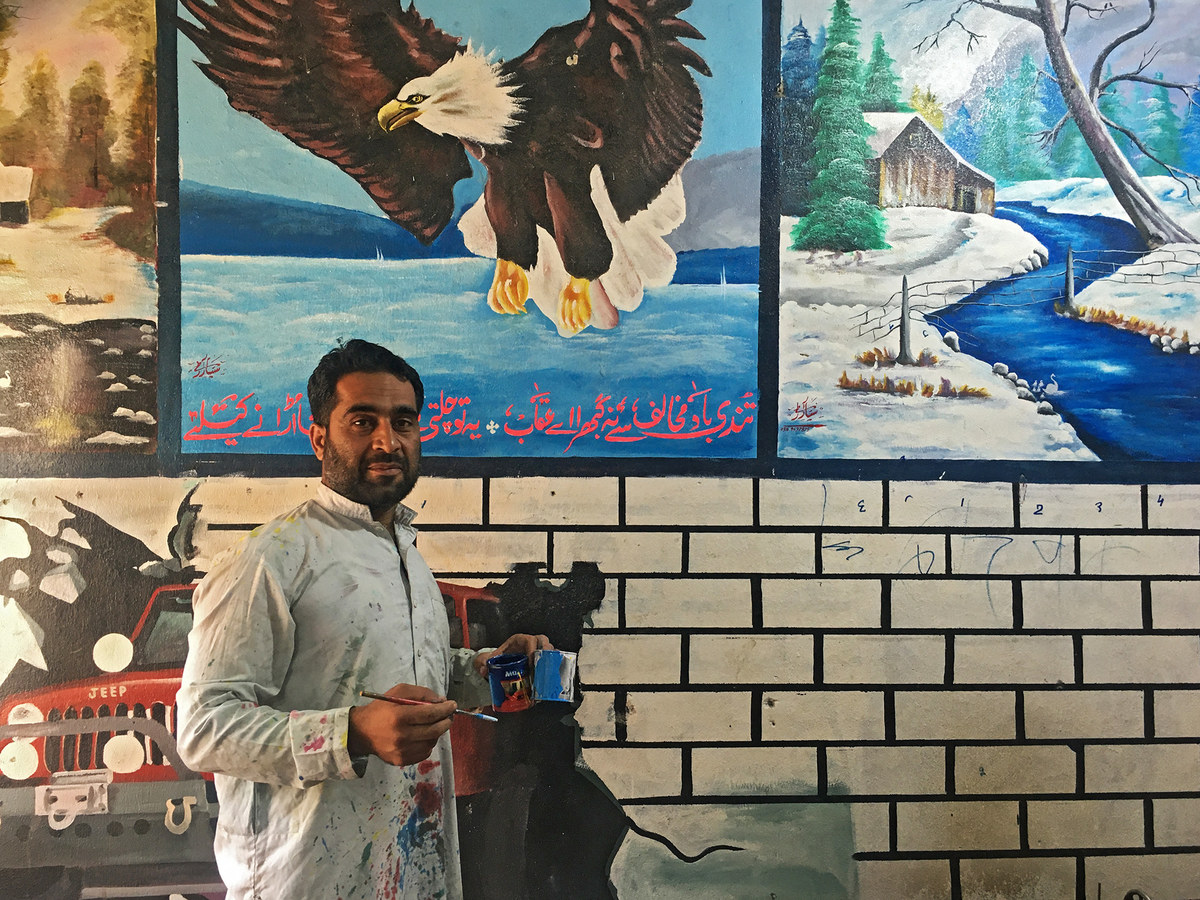


Truck artist Siyar Khan shows his work at a shop in Sarband on the outskirts of Peshawar on Oct. 16, 2020. (AN photo) 

“During that very hard time, one day I painted teacups, a kettle and also children’s shoes and posted on social media. I got immense response and orders.”

One of the orders came from the home of the Peshawar Corps Commander, where Khan was asked to decorate the walls of a guest hall with truck-art motifs. Recently, the artist completed an assignment at Peshawar’s Pearl Continental Hotel and is now receiving requests to decorate other properties.
Middlemen have also started to approach Khan for projects in Islamabad and Lahore.
“I recently painted a rickshaw for an American restaurant and a motorcycle for a German diplomat, a bicycle for another customer and dozens of kettles. More orders are pending” he said.
“I can paint each and everything that exists in this world.”
Khan learnt the traditional craft when he quit school after the seventh grade and his uncle brought him to a truck artist’s on Peshawar’s Ring Road.
“For nine years, I was an apprentice with the truck artist and then, with his permission, I began my own truck art profession in a small shop,” he said.



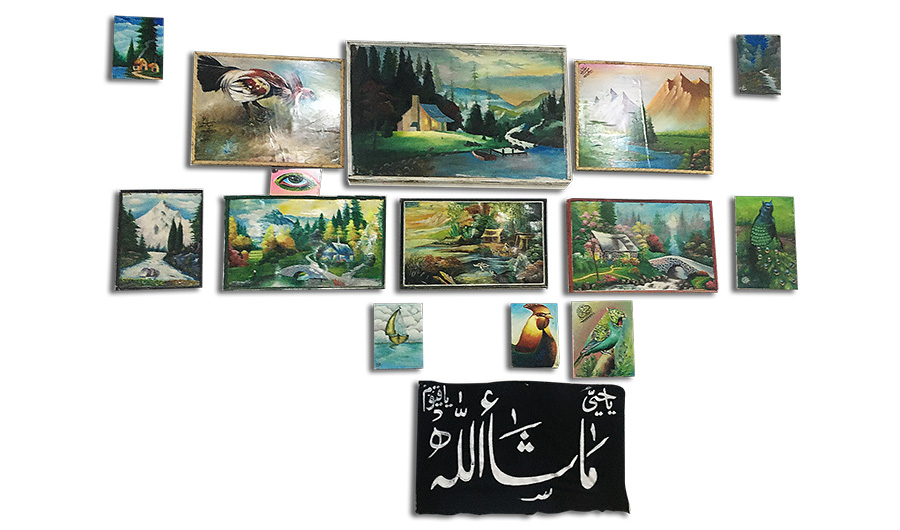
Siyar Khan's ornamental work on lanterns, kettles and teacups is on display at his workshop in Sarband on the outskirts of Peshawar on Oct. 16, 2020. (AN photo) 

“For years, I was earning a meagre amount and I would paint a truck every two or three days. It was hard to spend toward a better life and admit kids in a good school.”
For each truck, Khan used to earn about Rs4,000 ($25). But with his new projects, he said, he can make up to Rs10,000 in a single day, which allows him to pay for his children’s school.
For Khan, the pandemic came as a blessing in disguise.
“It was an opportunity in the toughest challenge. I coped successfully and now I am very happy ... and also very busy.”


Pakistan accuses India of manipulating Indus waters, warns of risks to regional peace

Updated 58 min 57 sec ago
Follow

Pakistan accuses India of manipulating Indus waters, warns of risks to regional peace

  • India announced in April it was putting the Indus Waters Treaty in abeyance over a gun attack in disputed Kashmir it blamed on Pakistan
  • Islamabad says it has witnessed ‘unusual, abrupt variations’ in the flow of Chenab river, accusing New Delhi of ‘material breaches’ of treaty

ISLAMABAD: Pakistan on Friday accused India of manipulating flows of Indus waters in violation of a 1960 water-sharing treaty, warning that unilateral actions over the transboundary waters could heighten tensions and pose risks to regional peace.

The Indus Waters Treaty (IWT), mediated by the World Bank, divides control of the Indus basin rivers between the two nuclear-armed neighbors. India said in April it was holding the treaty “in abeyance” after a gun attack in Indian-administered Kashmir killed more than 26 tourists. New Delhi blamed the assault on Pakistan, Islamabad denied it.

The treaty grants Pakistan rights to the Indus basin’s western rivers — Indus, Jhelum, and Chenab — for irrigation, drinking, and non-consumptive uses like hydropower, while India controls the eastern rivers — Ravi, Beas, and Sutlej — for unrestricted use but must not significantly alter their flow. India can use the western rivers for limited purposes such as power generation and irrigation, without storing or diverting large volumes, according to the agreement.

Speaking to foreign envoys in Islamabad, Pakistani Deputy Prime Minister Ishaq Dar accused New Delhi of “material breaches” of the IWT that may have consequences for regional stability, citing “unusual, abrupt variations” in the flow of Chenab river from April 30 to May 21 and from Dec. 7 to Dec. 15.

“These variations in water flows are of extreme concern for Pakistan as they point to unilateral release of water by India into River Chenab. India has released this water without any prior notification or any data- or information-sharing with Pakistan as required under the treaty,” he said.

“India’s most recent action clearly exemplifies the weaponization of water to which Pakistan has been consistently drawing attention of the international community.”

There was no immediate response from New Delhi to the statement.

Dar said this water “manipulation” occurs at a critical time in Pakistan’s agricultural cycle and directly threatens the lives and livelihoods as well as food and economic security of its citizens.

He shared that Indian actions prompted Indus Water Commissioner Mehar Ali Shah to write a letter to his Indian counterpart, seeking clarification on the matter as provided under the Indus Waters Treaty.

“We expect India to respond to the queries raised by Pakistan’s Indus water commissioner, refrain from any unilateral manipulation of river flows, and fulfill all its obligations in letter and spirit under the Indus Waters Treaty provisions,” the Pakistani deputy premier said.

Dar also accused India of consistently trying to undermine the IWT by building various dams, including Kishenganga and Ratle hydropower projects, which he said sets “a very dangerous precedent.”

“Alarmingly, India is now subverting the treaty’s own dispute resolution mechanism by refusing to participate in the Court of Arbitration and neutral expert proceedings. India is pursuing a deliberate strategy to sabotage the well-established arbitration process under the treaty provisions,” he said.

The South Asian neighbors have been arguing over hydroelectric projects on the shared Indus river system for decades, with Pakistan complaining that India’s planned hydropower dams will cut its flows.

In August, the International Court of Arbitration rendered an award on issues of general interpretation of the IWT, explaining the designed criteria for the new run-of-river hydropower projects to be constructed by India on the western rivers of Chenab, Jhelum and Indus, which Islamabad said vindicated its stance.

In its findings, the Court of Arbitration declared that India shall “let flow” the waters of the western rivers for Pakistan’s unrestricted use. In that connection, the specified exceptions for generation of hydro-electric plants must conform strictly to the requirements laid down in the Treaty, rather than to what India might consider an “ideal” or “best practices approach,” according to the Pakistani foreign office.

“Pakistan would like to reiterate that Indus Waters Treaty is a binding legal instrument that has made an invaluable contribution to peace and stability of South Asia,” Dar said.

“Its violation, on the one hand, threatens the inviolability of international treaties and on the other, it poses serious risks to regional peace and security, principles of good neighborhood, and norms that govern inter-state relations.”