ISLAMABAD: Pakistani Prime Minister Imran Khan on Saturday lashed out at opposition leader Nawaz Sharif over his recent comments against the country’s top military leadership, saying it would now be his ‘utmost effort’ to bring the former prime minister back to Pakistan to face jail.
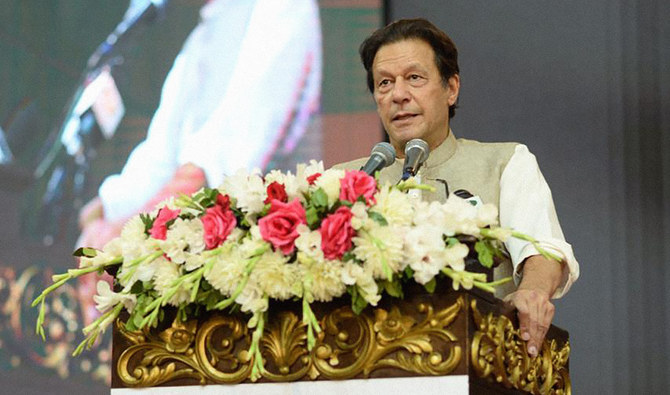
Khan was addressing a convention of the Tiger Force, a one-million-strong task force of young volunteers set up to facilitate official coronavirus relief efforts which has now been put to work in aid of multiple other Pakistan government departments.
At a protest rally in the eastern city of Gujranwala in the early hours of Saturday, Sharif, who addressed tens of thousands of people via video link from London, accused the army chief of “packing up” his government. The military has consistently denied meddling in politics.
Sharif’s second term as PM ended when his government was toppled in a military coup in 2000. He was prime minister for a third term from 2013 to 2017, when he was removed by the Supreme Court amid corruption revelations over his personal wealth.
He was subsequently convicted of graft but says the accusations are politically motivated. On October 25 last year, Sharif was granted bail and got court clearance to leave the country for medical treatment in London.
“From today it will be my utmost effort that you [Sharif] be brought back to this country,” Khan said to a charged crowd. “And you will be kept in a regular jail, not a VIP jail … You come back and I’ll see how we keep you.”
Addressing Sharif’s remarks against the military, Khan referred to two separate attacks on military convoys this week, in which 20 people, including 13 soldiers, were killed.
“Attacks are being carried out against our soldiers, our soldiers are sacrificing their lives,” he said.
“Why are they sacrificing their lives? It’s for us and this country. And this jackal [Sharif], who ran from here, is sitting there [in London], used this language against our army chief and the DG ISI [intelligence chief],” Khan said, as the crowd rang out in angry cheers.
“The opposition is going to see a different Imran Khan now,” the PM added, dismissing the Gujranwala rally as a ‘circus.’
Last month, nine major opposition parties formed the Pakistan Democratic Alliance (PDM) to launch countrywide protests aimed at forcing Khan to resign and call early elections. The first rally was held in Gujranwala on Friday evening. Rallies are also planned for Karachi and Quetta later this month.
PM Khan’s PTI party swept to power in August 2018 after defeating all major opposition parties. The opposition alliance says the party won a rigged election, which Khan’s government denies.
The next general election is scheduled for 2023.

My 'utmost effort' to bring Nawaz Sharif to Pakistan to face jail — PM Khan
https://arab.news/9tws9
My 'utmost effort' to bring Nawaz Sharif to Pakistan to face jail — PM Khan
- Prime minister addresses Tiger Force convention, responds to former premier’s comments blaming army top leaders for ousting his government
- Sharif is in London on medical bail from a seven-year-prison sentence, Khan says he will be returned to Pakistan to serve the rest of his sentence in a regular prison
Islamabad dismisses claims about paying up to 8 percent interest on foreign loans as ‘misleading’
- Pakistan has long relied on external loans to help bridge persistent gaps in public finances and foreign exchange reserves
- Pakistan’s total external debt, liabilities stand at $138 billion at an overall average cost of around 4 percent, ministry says
KARACHI: Pakistan’s finance ministry on Sunday dismissed as “misleading” claims that the country is paying up to 8 percent interest on external loans, saying the overall average cost of external public debt is approximately 4 percent.
Pakistan has long relied on external loans to help bridge persistent gaps in public finances and foreign exchange reserves, driven largely by a narrow tax base, chronic trade deficits, rising debt-servicing costs and repeated balance-of-payments pressures.
Over the decades, successive governments have turned to multilateral and bilateral lenders, including the International Monetary Fund, the World Bank and the Asian Development Bank, to support budgetary needs and shore up foreign exchange reserves.
The finance ministry on Sunday issued a clarification in response to a “recent press commentary” regarding the country’s external debt position and associated interest payments, and said the figures required contextual explanation to ensure accurate understanding of Pakistan’s external debt profile.
“Pakistan’s total external debt and liabilities currently stand at $138 billion. This figure, however, encompasses a broad range of obligations, including public and publicly guaranteed debt, debt of Public Sector Enterprises (both guaranteed and non-guaranteed), bank borrowings, private-sector external debt, and intercompany liabilities to direct investors. It is therefore important to distinguish this aggregate figure from External Public (Government) Debt, which amounts to approximately $92 billion,” it said.
“Of the total External Public Debt, nearly 75 percent comprises concessional and long-term financing obtained from multilateral institutions (excluding the IMF) and bilateral development partners. Only about 7 percent of this debt consists of commercial loans, while another 7 percent relates to long-term Eurobonds. In light of this composition, the claim that Pakistan is paying interest on external loans ‘up to 8 percent’ is misleading.
The overall average cost of External Public Debt is approximately 4 percent, reflecting the predominantly concessional nature of the borrowing portfolio.”
With respect to interest payments, public external debt interest outflows increased from $1.99 billion in Fiscal Year (FY) 2022 to $3.59 billion in FY2025, representing an increase of 80.4 percent, not 84 percent as reported. In absolute terms, interest payments rose by $1.60 billion over this period, not $1.67 billion, it said.
According to the State Bank of Pakistan’s records, Pakistan’s total debt servicing payments to specific creditors during the period under reference were as follows: the IMF received $1.50 billion, of which $580 million constituted interest; Naya Pakistan Certificates payments totaled $1.56 billion, including $94 million in interest; the Asian Development Bank received $1.54 billion, including $615 million in interest; the World Bank received $1.25 billion, including $419 million in interest; and external commercial loans amounted to nearly $3 billion, of which $327 million represented interest payments.
“While interest payments have increased in absolute terms, this rise cannot be attributed solely to an expansion in the debt stock,” the ministry said. “Although the overall debt stock has increased slightly since FY2022, the additional inflows have primarily originated from concessional multilateral sources and the IMF’s Extended Fund Facility (EFF) under the ongoing IMF-supported program.”
Pakistan secured a $7 billion IMF bailout in Sept. 2024 as part of Prime Minister Shehbaz Sharif’s efforts to stabilize the South Asian economy that narrowly averted a default in 2023. The government has since been making efforts to boost trade and bring in foreign investment to consolidate recovery.
“It is also important to note that the increase in interest payments reflects prevailing global interest rate dynamics. In response to the inflation surge of 2021–22, the US Federal Reserve raised the federal funds rate from 0.75-1.00 percent in May 2022 to 5.25–5.50 percent by July 2023. Although rates have since moderated to around 3.75 percent, they remain significantly higher than 2022 levels,” the finance ministry said.
“The government remains committed to prudent debt management, transparency, and the continued strengthening of Pakistan’s macroeconomic stability,” it added.


