RAWALPINDI: Pakistan bowler Umar Gul, who earned the nickname “Gul-dozer” for his rattling of stumps, has called time on his 17-year cricket career.
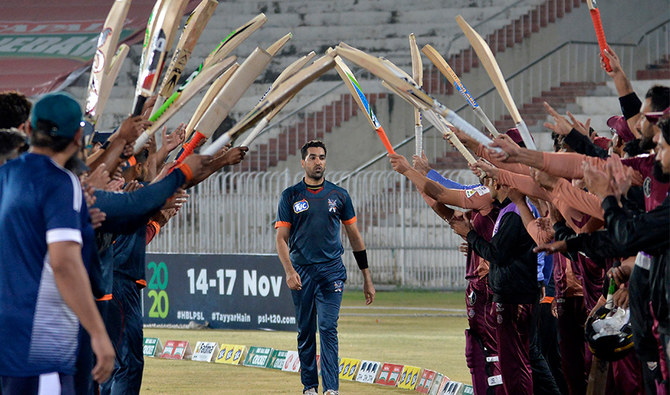
With no crowds to bid farewell to the national hero because of coronavirus restrictions, the Twenty20 World Cup winner bowed out to a guard of honor from teammates and opponents after his final match — a disappointing defeat — in Rawalpindi on Friday.
“I want to be remembered as someone who tried his best for the country and it’s flattering that I was called ‘Gul-dozer’ during this memorable journey in cricket,” the 36-year-old told AFP.
It was a topsy-turvy journey for Gul, whose affair with cricket began on the crowded streets of Peshawar.
He entered the international arena exactly a month after the legendary pace duo of Wasim Akram and Waqar Younis retired following Pakistan’s disastrous 2003 World Cup.
It was like the baton of swing bowling had been passed from one generation to another, Gul recalled.
“It was tough to fill those shoes but I tried my best and it was great to lead Pakistan to the final of the Twenty20 World Cup in 2007 and then to the title two years later,” he said.
He finished with 163 Test and 179 ODI wickets, but he achieved his greatest success in Twenty20 cricket, the start of his career coinciding with the launch of the shortest format in 2003.
Gul was at his destructive best in England in 2009, finishing as the top wicket taker of the Twenty20 World Cup with 13. That included a mesmerizing five wickets for just six runs in the semifinal win over New Zealand.
“Winning the World Cup was the highest point of my career,” he said. “I remember those were very tough days and there was unrest in our country so our win brought smiles back on the faces.”
At the time, Pakistan’s military was fighting an insurgency from militants in the northwestern region of the country.
Gul attributes his Twenty20 skills to the early days of his love for the game.
“I grew up playing 20-20-over matches in the streets and then Ramadan cricket where you look for wickets in a 20-over innings,” he said.
But his baptism was in Test cricket, where he became an instant hero in 2004.
In only his fifth Test, Gul destroyed a star-studded Indian batting order in a Lahore Test with figures of 5-21. His victims included the great Sachin Tendulkar, Rahul Dravid, Virender Sehwag and VVS Laxman.
The feat almost halted a burgeoning career, causing a stress fracture in his back.
He later featured in the inaugural Indian Premier League in 2008, topping the chart for the Kolkata Knight Riders with 12 wickets in six games — the only time Pakistan players were allowed to feature in the world’s most lucrative league.
But the 2011 World Cup semifinal against India — in the one-day format — turned out to be the most bitter of his career.
He was targeted by the top order and finished with figures of 0-69 in eight overs for the match in Mohali, India.
“Before that match I was the top wicket taker for my team so India targeted me and to add to that we lost that match,” Gul reminisced.
With his playing years now behind him, next for Gul is a move into coaching: “I will try to make new Bulldozers for my country ... it is my duty to the nation.”


Pakistan’s ‘Gul-dozer’ calls time on cricket career
https://arab.news/286qn
Pakistan’s ‘Gul-dozer’ calls time on cricket career

- Bowler Umar Gul bowed out to a guard of honor from teammates and opponents after his final match on Friday
- He achieved his greatest success in Twenty20 cricket, the start of his career coinciding with the launch of the shortest format in 2003

Pakistan assembly speaker warns opposition against anti-state remarks in parliament
- Ayaz Sadiq says criticism of judiciary and armed forces will not be allowed on assembly floor
- He calls violence during protests unacceptable, vows neutrality as National Assembly speaker
ISLAMABAD: Pakistan’s National Assembly Speaker Sardar Ayaz Sadiq said on Saturday that opposition lawmakers would not be allowed to speak against Pakistan, the judiciary or the armed forces on the floor of parliament, calling such remarks unacceptable.
Speaking to reporters during a visit to the eastern city of Lahore, Sadiq said parliamentary debate must remain within constitutional and legal limits, while reiterating his commitment to act impartially as speaker.
“No one will be allowed to speak against Pakistan, the judiciary or the armed forces on the floor of the National Assembly,” Sadiq said. “Negative or controversial remarks about judges or the armed forces are unacceptable.”
His comments come amid heightened political tensions after opposition groups held protests in the past, criticizing state institutions and targeting government and military properties.
The speaker said peaceful protest was a democratic right but drew a sharp line at violence and vandalism.
“Protest is the right of every citizen in a democratic society, but it must remain peaceful and within the bounds of the constitution and the law,” he continued, adding that arson, damage to property and the use of sticks or weapons in the name of protest were “unacceptable” and posed a threat to the rule of law.
“No opposition lawmaker will be allowed to speak on the National Assembly floor if they speak against Pakistan,” Sadiq said.
The speaker also noted the country’s economic indicators were gradually improving, citing an increase in foreign exchange reserves, and said Pakistan had further strengthened relations with countries including the United States, China, Russia, Türkiye and Saudi Arabia.