BEIRUT: The Lebanese pound had seen a significant improvement in its dollar exchange rate following an announcement last week by Saad Hariri, the leader of the Future Movement, that he is the “natural candidate” to head the next government.
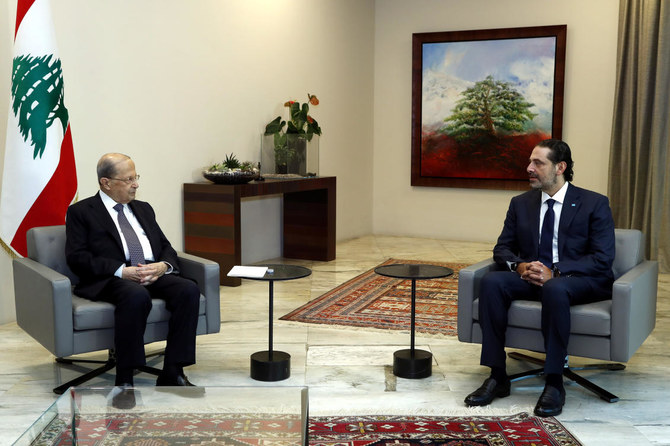
However, the rate jumped to over LBP8,000 to the dollar on the Lebanese black market on Thursday — having dropped by LBP1,200 over the previous two days — after President Michel Aoun announced that the binding parliamentary consultations to designate Lebanon’s new prime minister, which were scheduled for Thursday, were to be postponed for a week.
Questions were raised about Aoun’s unilateral decision, and about the message he is sending to the international community and the Lebanese people, who are hopeful that the rapid installation of a new government might alleviate some of the economic and social ills that the country currently faces.
Parliament Speaker Nabih Berri said he was against postponing the consultations “even for one day.”
The leader of the Marada Movement, Suleiman Frangieh, said, “Postponing the consultations is forbidden under the circumstances the Lebanese are experiencing.”
A majority of Lebanon’s parliamentary blocs had announced that they would back Hariri as the new prime minister during the parliamentary consultations. Aside from his own party, Hariri has the support of Hezbollah, the Amal Movement, the Progressive Socialist Party (PSP), the Marada Movement, and Armenian MPs, giving him a total of at least 70 votes — a clear majority among the 120 currently serving MPs. The Free Patriotic Movement (FPM) and the Lebanese Forces will reportedly not support him.
FPM leader Gebran Bassil — who is also the president’s son-in-law — launched an attack on Hariri on Tuesday, widening the political divide. However, presidential palace sources said there was “no personal reason” behind Aoun’s decision to postpone the consultations. In 2018, Aoun blocked the formation of a government led by Hariri, stipulating that Bassil had to be given a ministerial position.
The palace statement said that Aoun took his decision “at the request of some parliamentary blocs, after the emergence of difficulties that require … solutions.”
Former MP Fares Souadi said simply: “We are headed down to hell.”
A source close to Aoun told Arab News the president is “keen to provide the largest (possible amount) of parliamentary support for the PM who will form the Cabinet, given the importance … of the tasks required of the government in the next phase, which needs a broad national consensus and not division.”
Several politicians pointed out that governments had been formed without unanimous consensus in the past, including those of Hassan Diab and Najib Mikati.
There is concern among parliamentarians that Aoun has postponed the consultations in order to force Hariri not to nominate himself as PM. However, Hussein Al-Wajeh, Hariri’s adviser for media affairs, told Arab News: “Postponing the consultations will not change the position of Hariri, who is holding on to the French initiative and government of specialists. The French initiative was, and still is, the only — and last — chance to stop the collapse and to reconstruct Beirut. The postponement will not change that, and disruption was never a solution for Lebanon and the Lebanese.
“If the president abides by legitimacy, that should be reflected while forming a government, not while assigning the person who will form the government”, he added.
French President Emmanuel Macron visited Lebanon two days after the Aug. 4 Beirut port explosion that devastated the city, and returned three weeks later to check on the status of the reforms he specified as a condition for international support.
The ‘French initiative’ Macron laid out for debt-ridden Lebanon included a two-week deadline for the formation of an independent government of experts that would only stay in office a few months.
Also on Thursday, US Assistant Secretary of State for Near Eastern Affairs David Schenker met with Berri and PSP President Walid Jumblatt on the second day of his visit to Lebanon, after attending the opening session of the Lebanon and Israel negotiations in Naqoura.
Schenker also met with Maronite Patriarch Bechara Al-Rahi, whose media office said: “Schenker showed particular interest in Al-Rahi’s talk about neutral Lebanon. He stressed the US’s (desire to see) an effective and transparent Lebanese government that provides basic services for the Lebanese people, regardless of (who its leader is), and reiterated America’s ongoing support for Lebanon.”


![]()

Lebanese MPs criticize delay of consultations to choose new prime minister
Short Url
https://arab.news/c7tcu
Lebanese MPs criticize delay of consultations to choose new prime minister
- A majority of Lebanon’s parliamentary blocs had announced that they would back Hariri as the new PM during the parliamentary consultations
- FPM leader Gebran Bassil launched an attack on Hariri on Tuesday, widening the political divide


Latest updates





© 2026 SAUDI RESEARCH & PUBLISHING COMPANY, All Rights Reserved And subject to Terms of Use Agreement.