

A Karachi teacher posted her students’ questions to NASA on Twitter. Scientists replied

Short Url
Updated 29 March 2021
Follow

A Karachi teacher posted her students’ questions to NASA on Twitter. Scientists replied

  • When Aimun Faisal posted her students’ queries about the solar system online, never did she imagine she would get responses or her post would go viral
  • Speaking about what inspires her teaching style, Faisal credited her mother and three teachers she met at “three important moments” in her life

KARACHI: When Pakistani teacher Aimun Faisal posted her students’ questions to NASA on Twitter on Wednesday, never did she imagine scientists and astronauts would respond -- and her post would go viral.

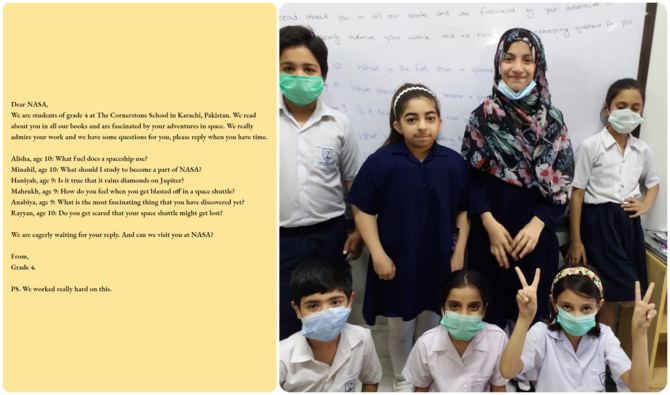
It all began with a class activity where the fourth grade teacher at Karachi’s Cornerstones School asked her students to write down questions about the solar system. Once students had submitted their questions, the class voted to select the best queries.

On Wednesday, Faisal posted six selected questions and the names and photos of the students who had asked them on Twitter.

“These fourth graders have some questions for you,” said the post, in which NASA astronauts and other scientists were tagged. The tweet went viral.


To Faisal’s surprise and joy, astronauts and scientists replied.

Astronaut Chris Hadfield said to a student called Rayyan who had asked if he ever felt “scared” his space ship would get lost in space:

“Rayyan - I wasn't scared we'd get lost. We had the Earth nearby, and used the stars to steer. I felt especially comforted when I flew over home. Here's a photo I took of Karachi - can you find your school?”


To Haniyah, who asked if it was true that it rained diamonds on Jupiter, Emily Calandrelli, an American science communicator and the host of Xploration Outer Space and Emily’s Wonder Lab, wrote:

“Haniyah -It's definitely possible!! The same physics and chemistry that creates diamonds here on Earth (putting Carbon under super high heat/pressure) exists on planets like Jupiter, so some scientists hypothesize that it's raining diamonds there! Wouldn't it be fun to see that?!”


There were several other replies, which Faisal collected, printed out and put into envelopes that she took to class the next day, Thursday. There was a “stunned silence,” she said, when she told the students scientists had replied to their queries.

Faisal once again took to Twitter to describe her students' responses:

“As I started calling out names for the kids to collect their envelopes, there was a quiet whisper, "we all got separate letters?" And after a lull in momentum when one student Anabiya received her letter she cynically remarked "This is not from NASA, this is ma'am's handwriting. So, I asked little miss Sherlock to open her letter.”


“Haniya kept staring at her letter with her mouth agape even as I tried to give her a background on who these people were that had written back to her,” Faisal wrote.


“Shy Muhammad who wanted all the answers but was too hesitant to ask any questions, went around showing his letter which told him he is a star and we will make sure he shines the brightest one day. (We're working on that. Send prayers. I saw him laugh for the first time today.)"


Speaking about what had inspired her teaching style, Faisal said her mother had worked “very hard” in her early years, using puzzles, crosswords and books to keep her interested in her studies.

Then, she said, she met three teachers at “three important moments in life” - Miss Tampal, a principal at Karachi's Mama Parsi school, Zeenat Farookee, her economics teacher in high school, and Ali Raza, a history instructor at university.

“Thankyou everyone who made this go viral! The kids don't know how this happened but I am sure they would be very grateful to all of you if they did,” Faisal wrote on Twitter on Thursday evening. “This is a wrap on the live coverage of the NASA Saga. May Grade 4 continue to have questions, always!”

The students, who had low expectations about getting responses to their queries, Faisal said, were “currently planning a ‘field trip’ to NASA.”


Pakistan urges diplomacy on Iran nuclear issue, warns sanctions would hurt civilians

Updated 10 sec ago
Follow

Pakistan urges diplomacy on Iran nuclear issue, warns sanctions would hurt civilians

  • Pakistan warns the situation has become more complex since Israel’s attack on Iran and US bombing of nuclear sites
  • It cautions against invoking the snapback mechanism, saying sanctions will further deepen mistrust, derail diplomacy

ISLAMABAD: Pakistan demanded on Tuesday that diplomacy be given a chance in addressing all issues related to Iran’s nuclear program, warning the United Nations Security Council that sanctions would hurt ordinary Iranians, as tensions remain heightened following this year’s war between Israel and Iran.

Pakistan’s comments came amid renewed debate at the Security Council over Iran’s nuclear program and the future of the Joint Comprehensive Plan of Action (JCPOA), which sought to limit Tehran’s nuclear activities in exchange for sanctions relief.

The conflict in June was dubbed the Twelve-Day War and erupted after Israel carried out a surprise attack on Iranian military and nuclear facilities while international diplomacy was still underway. The strikes derailed negotiations, with the United States later bombing Iranian nuclear sites and declaring that the attacks had substantially degraded Iran’s nuclear capabilities.

Addressing the Security Council, Pakistan’s Acting Permanent Representative Ambassador Usman Jadoon said Islamabad believed that “diplomacy and dialogue should be the guiding principles for the resolution of all outstanding issues concerning Iran’s nuclear program in accordance with the rights, obligations and responsibilities of the parties concerned.”

“Coercive measures would not help in bringing the parties closer and only exacerbate the trust deficit,” he said. “Sanctions directly hurt ordinary people the most, impact trade, affect economic development and diminish the prospects of regional connectivity.”

Jadoon said the council last met on the issue in September following developments related to the JCPOA’s “snapback” mechanism — a provision that allows the automatic re-imposition of UN sanctions on Iran in cases of alleged non-compliance — adding that Pakistan opposed what it viewed as a rushed move and cautioned against hasty action.

He said Pakistan’s stance was grounded in the belief that disputes over Iran’s nuclear program should be resolved through dialogue, with more time allowed for diplomacy to succeed, while preserving the JCPOA framework until a successor arrangement is reached.

The ambassador said divisions within the council had widened in recent months, further complicating efforts to resolve the issue.

While acknowledging that the JCPOA was not implemented as intended, Jadoon said the agreement had nonetheless provided an essential framework rooted in international law and mutual respect, and could still prove useful if there was a shared willingness to move forward in a spirit of compromise.

He stressed the need to revive the agreement’s underlying principles and restore trust in diplomatic engagement that had been damaged in recent months, urging all parties to avoid confrontation and work toward a solution-oriented approach.