

‘Long COVID’ could be 4 syndromes: UK study

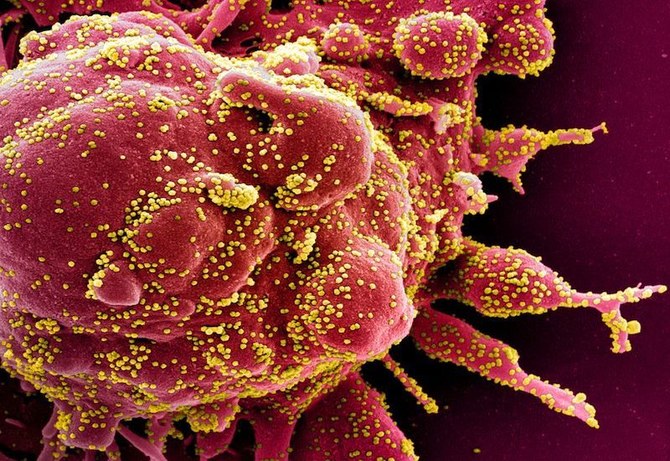
“Long COVID” refers to people suffering from recurring symptoms months after they first contracted the coronavirus. Pictured, a colorized scanning electron micrograph of apoptotic cell infected with novel coronavirus. (NIAID/File Photo)
Short Url
Updated 15 October 2020
Follow

‘Long COVID’ could be 4 syndromes: UK study

  • Term refers to people suffering from recurring symptoms months after initial infection
  • ‘The list of symptoms is huge and covers every part of the body and brain’

LONDON: The phenomenon known as “long COVID” could be a combination of four different syndromes affecting the body at the same time, according to a study by the UK’s National Institute for Health Research (NIHR). 

“Long COVID” refers to people suffering from recurring symptoms months after they first contracted the virus. The NIHR study said some 60,000 people could be living with “long COVID” in the UK.

Researchers say those still suffering from symptoms after seven months of infection could be under the grip of post-viral fatigue syndrome, post-intensive care syndrome, permanent organ damage and long-term COVID syndrome.

There is no evidence to suggest that children are exempt from “long COVID,” or that people who were asymptomatic or avoided serious health problems with the virus will not suffer the long-term complications. The symptoms of “long COVID” include “brain fog,” stress and anxiety.

The study’s author Dr. Elaine Maxwell said patients can experience a “rollercoaster of symptoms” that “move around the body.” 

She added: “The list of symptoms is huge and covers every part of the body and brain. We believe that the term ‘long COVID’ is being used as a capsule for more than one syndrome, possibly up to four. People without a clear diagnosis told us they’re often not believed by health services.”

She said there “are people who never had any support in hospital, never had a test, have no record of ever having had COVID, except their own personal history. They may be suffering far more than somebody who was ventilated for several weeks.”

Maxwell added that the number of people with long-term COVID-19 symptoms is likely to increase amid the return of heavy hospitalizations and a “second spike” of infections.

South Sudan officers face court martial over civilian massacre

Updated 17 sec ago
Follow

South Sudan officers face court martial over civilian massacre

  • The increasingly unstable country is seeing a surge of fighting between government and opposition forces

JUBA: South Sudanese soldiers, including two officers, will face a court martial over a civilian massacre last month, the army spokesman said Wednesday.

The increasingly unstable country is seeing a surge of fighting between government and opposition forces, much of it in eastern Jonglei state where at least 280,000 people have been displaced since December according to the UN.

At least 25 civilians, including women and children, were killed in Ayod County in Jonglei state on February 21, according to the opposition.

Army spokesman Lul Ruai Koang said that two officers, including a major, and several non-commissioned officers, had been arrested and would face charges in the capital Juba, “before they are arraigned before a competent military court martial.”

He said the deaths were attributed to “some elements” under Gen. Johnson Olony, who was filmed in January ordering troops to “spare no lives” in Jonglei.

Koang said the soldiers had “moved out without the knowledge or authorization of the division commander.”

He also said they had been part of a militia group allied to opposition forces, parts of which had not yet been fully integrated into the army.

Military integration was among the core principles of a peace agreement that ended South Sudan’s five-year civil war in 2018 between President Salva Kiir and his long-time rival, Riek Machar, but it was never implemented.

Koang said the army regretted the loss of lives, adding: “We would like to once again remind our forces that their mandate is to protect civilians and their property, not to do the opposite.”

It followed an impassioned plea from the Sudan and South Sudan Catholic Bishops’ Conference on recent civilian killings — in Ayod, and also in Abiemnom County near the Sudan border where at least 169 people were killed on Sunday.

“We implore you to deploy resources to protect vulnerable populations and foster a climate of dialogue and reconciliation instead of violence and revenge, consoling the bereaved and supporting the afflicted,” it said in a statement.