

Lahore High Court summons foreign office over Pakistanis imprisoned in Iran

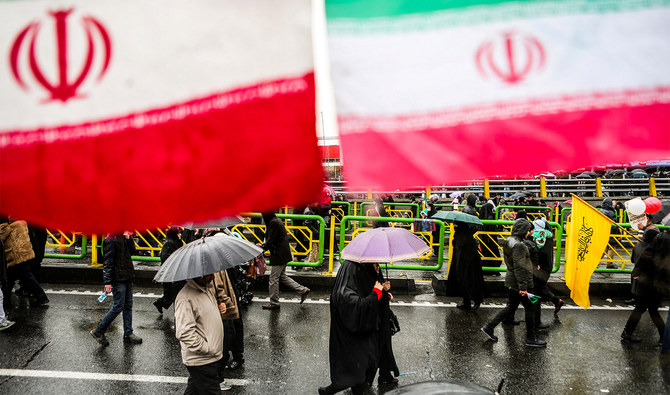
This file photo shows people carrying umbrellas in Tehran on Feb. 11, 2019. (Tasnim News Agency via Reuters)
Short Url
Updated 15 October 2020
Follow

Lahore High Court summons foreign office over Pakistanis imprisoned in Iran

  • 174 Pakistanis currently detained in Iran, 75% of them on charges of drug-trafficking
  • “These are Pakistani citizens and information about them cannot be withheld,” Justice Waheed says

ISLAMABAD: Lahore High Court Justice Shahid Waheed this week ordered the Pakistan Foreign Office to submit a list of Pakistanis imprisoned in Iran and for a relevant officer to appear in person before the court on the next hearing.   

Barrister Sarah Belal informed the court that according to the government, there were 174 Pakistanis currently detained in Iran, 75% of them on charges of drug-trafficking. She added that in 2017 Iran passed a law that enabled prisoners sentenced to death for narcotics offenses to have their sentences commuted to life imprisonment.

“The Iranian Courts will not review the death sentences automatically. Instead, the Government of Pakistan will have to ensure effective representation of its citizens before the concerned judicial authority,” Belal said, adding that it was the Pakistani government’s duty under the constitution to protect its citizens wherever in the world they may be.

“These are Pakistani citizens and the information about them cannot be withheld,” Justice Waheed said while hearing the petition filed by Justice Project Pakistan on behalf of Pakistanis imprisoned in Iran for alleged drug offences. The case was last heard over two years ago during which Justice Waheed had admonished the federal government for seeking more time to submit details of Pakistanis on death row in Iran.

In 2012, the Lahore High Court had set a precedent in a petition filed by JPP by seeking details of Pakistanis detained in the now defunct Bagram air base-turned-prison in Afghanistan that eventually led to the repatriation of 43 Pakistanis.

Pakistanis in foreign jurisdictions are particularly vulnerable and therefore might not be able to file reviews themselves. Despite being informed of the Amendment and the urgent need to file reviews, the Ministry of Foreign Affairs and the Pakistani Embassy in Tehran have not provided updates on the steps taken to facilitate Pakistani prisoners entitled to relief, JPP said.

The former federal information minister Fawad Chaudhary in a press conference in September 2018 had stated that the matter of Pakistanis on Iran’s death row was discussed in detail with Iran’s foreign minister Jawad Zarif during his two-day visit to Pakistan. In June, the Iranian deputy minister for human rights announced that Tehran was willing to extradite 44 Pakistani prisoners on humanitarian grounds due to the COVID-19 outbreak but was awaiting a response from Pakistani authorities.

Ali Haider Habib, spokesperson of Justice Project Pakistan, added: “Consular access is a human right which imposes distinct but complementary obligations on both prosecuting and home states. The failure of the home state to provide adequate consular assistance amounts to a violation of its responsibility to protect the right to life. The Pakistani government must follow the honourable court’s directives to provide the relevant records and adhere to its constitutional responsibility towards these prisoners who are particularly vulnerable amid a pandemic that has already claimed hundreds of lives in the jails of Iran.”


Kazakhstan president to explore trade, connectivity cooperation in first state visit to Pakistan tomorrow

Updated 12 min 19 sec ago
Follow

Kazakhstan president to explore trade, connectivity cooperation in first state visit to Pakistan tomorrow

  • Kazakhstan President Kassym-Jomart Tokayev to visit Pakistan from Feb. 3-4 with high-level delegation, says Pakistan’s foreign office
  • Kazakh president to meet Pakistani counterpart, hold talks with PM Shehbaz Sharif and address Pakistan-Kazakhstan Business Forum

ISLAMABAD: Kazakhstan President Kassym-Jomart Tokayev will explore bilateral cooperation with Pakistan in trade, regional connectivity, logistics and other sectors when he undertakes his first state visit to the country this week, Pakistan’s foreign office said on Monday. 

Tokayev will arrive in Pakistan leading a high-level delegation comprising senior cabinet ministers and high-ranking officials from Feb. 3-4, the Pakistani foreign office said in a statement. 

Tokayev is expected to meet his Pakistani counterpart President Asif Ali Zardari, hold talks with Prime Minister Shehbaz Sharif and address the Pakistan-Kazakhstan Business Forum during the visit, the foreign office said. 

“The visit will provide the two sides an important and timely opportunity to undertake a comprehensive review of bilateral relations, discuss new avenues for broadening cooperation, particularly in trade, logistics, regional connectivity, people-to-people contacts, and explore collaboration at regional and international forums,” the statement said. 

The foreign office said Tokayev’s visit reflects the strengthening bonds between Pakistan and Kazakhstan, their mutual commitment to transforming historic and cultural affinities into robust cooperation, as well as their common desire for peace and progress in the region. 

Relations between Pakistan and Kazakhstan are rooted in shared Islamic heritage and a growing strategic partnership, with Pakistan offering landlocked Central Asian republics access to southern seaports for global trade. Pakistan was among the first countries to recognize Kazakhstan when it gained independence in December 1991 and formally established diplomatic relations with it on Feb. 24, 1992. 

The two countries have held regular interactions over the past couple of years on the sidelines of the Shanghai Cooperation Organization (SCO) meetings and other international events. Kazakhstan’s Deputy Prime Minister Murat Nurtleu visited

Pakistan in September 2025 to discuss economic and trade cooperation with Islamabad. 

Islamabad and Astana engage with each other to promote business and political ties via three forums mainly, which are: Bilateral Political Consultations, the Intergovernmental Joint Commission on Trade, Economic, Scientific, Technological and Cultural Cooperation, and the Joint Business Council. 

According to the government of Kazakhstan, bilateral trade between the two countries amounted to $53.7 million in 2024. Pakistan’s main exports to Kazakhstan include citrus fruits, pharmaceutical products, garments, soap, sports equipment and gear and others.

Kazakhstan’s exports to Pakistan primarily include onions and garlic, dried leguminous vegetables, oats, buckwheat and other cereal grains, seeds and fruits of other oil-bearing crops, among others.