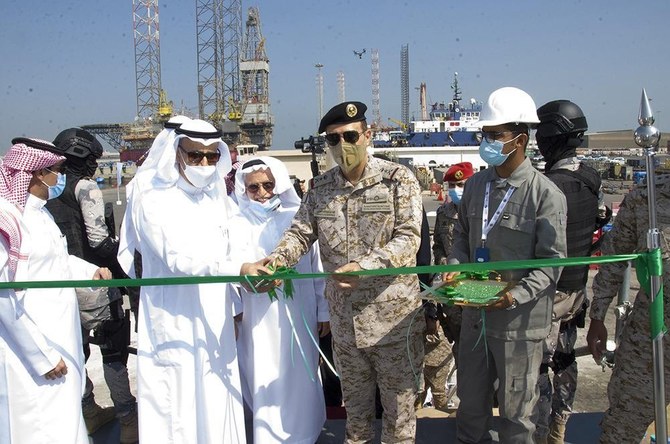
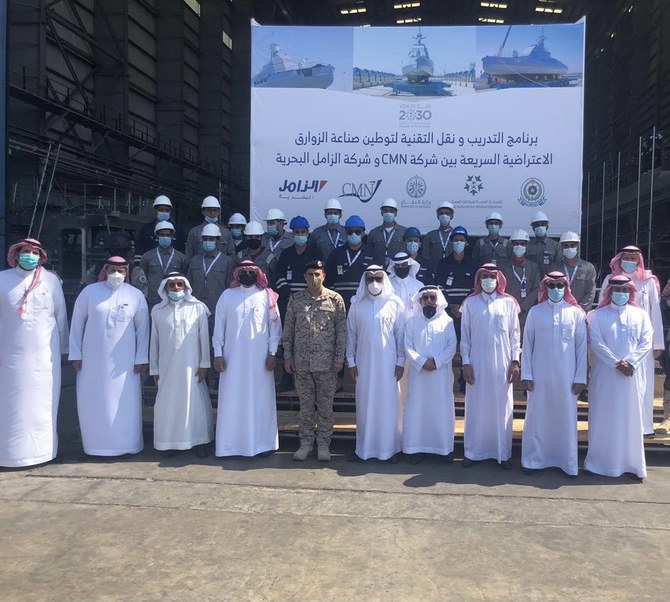
RIYADH: Saudi Arabia’s Ministry of Defense and the General Authority for Military Industries (GAMI) on Wednesday launched the first locally manufactured HSI32, a fast interceptor vessel, and the Kingdom’s first floating dock.
It is part of Saudi Arabia’s plan to localize its military industries. The project was carried out in cooperation with the French shipyard CMN, a part of Privinvest Shipbuilding Group, and Zamil Offshore Services Co.
In April 2018, Zamil Offshore Services finalized an agreement worth $480 million with French shipyard CMN for the construction of 39 HSI32 interceptors for the Saudi Naval Forces.
According to the agreement, 21 vessels were to be built by CMN in Cherbourg, France, and the remaining 18 to be assembled at the facilities of Zamil Offshore Services in Saudi Arabia.
Speaking on the occasion, GAMI Gov. Ahmed Al-Ohali said the project is a step forward in GAMI’s strategic goals to achieve localization of military industries in the Kingdom.
The Kingdom, he said, wants to empower local manufactures and strengthen the industry to achieve a prominent global position.
Al-Ohali said the HSI32 will help bolster the defense capabilities of the Saudi naval forces.
It will also strengthen the maritime security in the region and protect vital strategic interests in the Kingdom, GAMI chief said.
Saudi Arabia is taking measures to localize military industries by 50 percent by 2030.
The most important benefit of localization is to enhance the Kingdom’s strategic independence, national security, as well as its military and security readiness. The economic and social dimension will include building a sector worth more than SR30 billion ($8 billion) in 2030.
Gen. Fahd bin Abdullah Al-Ghufaili, commander of the Royal Saudi Naval Forces, said the project is the embodiment of the Kingdom’s Vision 2030.
Dr. Abdulrahman Al-Zamil, chairman of the board of directors of Al-Zamil Group, appreciate the official support offered to the local military industries.
He said the launch of the first locally manufactured HSI32 is an important step toward localization of the military industries.


![]()
![]()
![]()
![]()

Saudi Arabia launches first locally manufactured interceptor vessel


Short Url
https://arab.news/94ud7
Saudi Arabia launches first locally manufactured interceptor vessel
- 21 vessels were built in Cherbourg, France, and remaining 18 to be assembled at the facilities of Zamil Offshore Services in Saudi Arabia


Latest updates




© 2026 SAUDI RESEARCH & PUBLISHING COMPANY, All Rights Reserved And subject to Terms of Use Agreement.