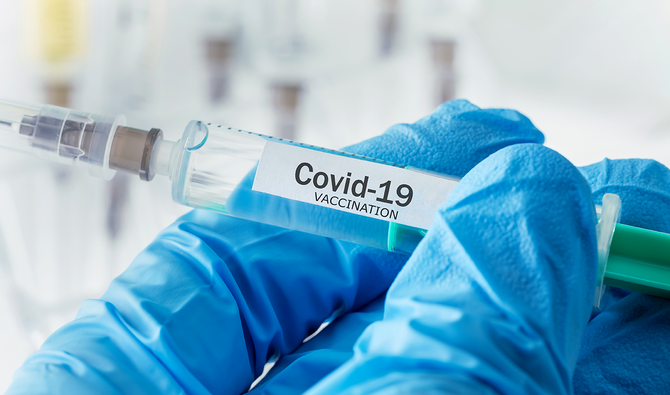

JEDDAH: Around 5,000 people from Saudi Arabia will undergo vaccine trials once a COVID-19 vaccine is approved by the country’s Food and Drug Authority, an infectious disease specialist in the Kingdom said.
“We will see results according to usage,” Dr. Wael Bajahmoom told Al-Ekhbariya in an interview. “In Saudi Arabia, we are part of the World Health Organization and we will use the vaccine that the country is looking for after the authorization of the Food and Drug Authority. Once approved by the Food and Drug Authority, approximately 5,000 from the Saudi community will be supervised for this vaccine trial.”
He discussed the decision of pharmaceutical firm Eli Lilly and Company to pause its trial of a combination antibody treatment for safety reasons, saying there were many factors to consider such as what it took to create a vaccine, was the dosage to temporarily slow down the rate of infection or were there certain goals to be met.
Bajahmoom also said that vaccines went through rigorous testing before they were released.
“In the medical field, we always stress that vaccines must be completely safe to use. To not cause any side effects or harm to users, and to protect people from the pandemic for a long time. What’s the use of creating a vaccine that will only protect us for a month or three? Another factor is that vaccines must be effective for special cases too - the elderly, those with immune system disorders - it must be effective. Most countries do not release vaccines early. They first must pass rigorous clinical testing.”
There were three important stages. The development stage was when scientists discussed the possibility of using the virus in the method of killing it, and using it in genetic modification or for patients in general.
Some of it was tested on animals in laboratories and specialists saw if the results were effective on animals or not.
“And in the final stage it is tested on humans in a limited way then, later, on a larger scale. Since the start of the pandemic, the Ministry of Health never allowed the use of any vaccine unless it has been tested and approved (safely) globally. This indicates that safety is first in the Kingdom.”
He explained there were some measures that countries used and adopted, such as emergency recognition of a vaccine. “This has been done in some neighboring countries. Vaccines are used under an emergency permit.”
Bajahmoom highlighted Saudi Arabia’s proactive role in finding a vaccine. “Research centers in the Kingdom are excellent and are a prime example for all developed countries internationally and medically.”
Saudi Arabia on Wednesday reported 21 new coronavirus-related deaths. The death toll now stands at 5,108.
There were 501 new cases, meaning 340,590 people have now contracted the disease. There are 8,662 active cases, and 830 of these are in a critical condition.
There have been 481 recoveries, taking the total number to 326,820.
Saudi Arabia has so far conducted more than 7.16 million PCR tests, with 51,849 carried out in the last 24 hours.