JERUSALEM: When Israel went into lockdown last spring, Jerusalem pub owner Leon Shvartz moved quickly to save his business – shifting to a delivery and takeaway model that kept him afloat throughout the summer. Then came the second lockdown.
With restaurants and shops shuttered again, Shvartz’s business is struggling to survive. He has laid off 16 of his 17 employees.
By contrast, Israeli software maker Bizzabo, which operates in the hard-hit conference-management sector, quickly reinvented itself last spring by offering “virtual events.” It has more than doubled its sales and is expanding its workforce.
Such tales of boom and bust reflect Israel’s growing “digital divide.”
Even before the pandemic, Israel had one of the largest income gaps and poverty rates among developed economies, with a few high earners, mostly in the lucrative high-tech sector, while many Israelis barely get by as civil servants, in service industries or as small business owners.
Those gaps have widened as the second nationwide lockdown, imposed last month, dealt a new blow to an economy already hit hard by the first round of restrictions.
The fallout from the pandemic has also deepened long-simmering divisions among Israeli Jews, pitting a largely secular majority against a powerful ultra-Orthodox minority.
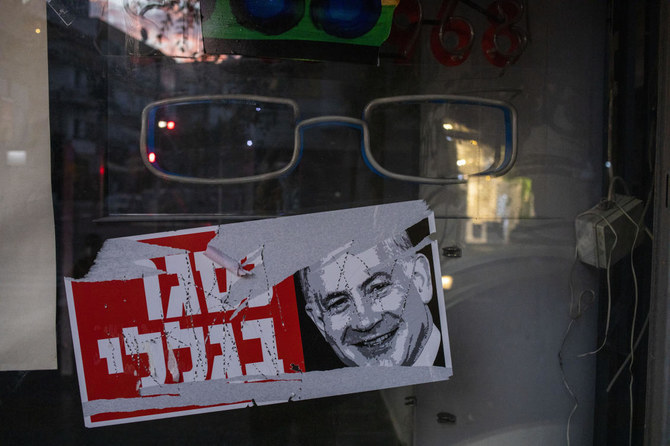
Prime Minister Benjamin Netanyahu, a target of months of mass protests over his perceived mishandling of the pandemic, has been seen as favoring his ultra-Orthodox partners at the expense of the greater good. In trying to contain the latest outbreaks, Netanyahu opted for an economically devastating blanket lockdown instead of targeted restrictions in infection hot spots, including many ultra-Orthodox communities, presumably to avoid upsetting his allies.
The deep tear in Israel’s social fabric prompted a warning from Israel’s figurehead president, Reuven Rivlin.
“I feel the air is full of gunpowder. I feel the fury on the streets,” Rivlin told parliament this week. “Israel’s tribalism is breaking out through the cracks, and accusatory fingers are pointed from one part of society to the other, one tribe to the other.”
Netanyahu initially won plaudits for his handling of the virus crisis, after he quickly sealed the border and imposed a lockdown, which appeared to bring the outbreak under control.
But the lockdown came at a great cost, pushing unemployment near 35 percent in April as hundreds of thousands were either laid off or furloughed, mainly in low-paying jobs such as retail, travel and hospitality.
Although most jobs gradually returned as the economy reopened, the caseload dramatically spiked in the fall, forcing the government to declare a second, open-ended lockdown last month. According to official figures, over 967,000 people, or almost a quarter of the work force, are again out of work.
Shvartz, who owns two bars and a craft beer company, Biratenu, managed to scrape by with his mail-order business until restaurants reopened over the summer. But safety regulations limited the number of customers he could serve, cutting sales.
Shvartz let a third of his staff go and cut his own salary. Then, the government announced its second lockdown. Now, he and his lone employee are again focused on the delivery business.
“It looks like a garage,” he said. He estimates business is down at least 60 percent from pre-pandemic levels.
Alon Alroy, a Bizzabo co-founder, faced a similar existential crisis in early March, when he realized the business of managing conferences was about to dry up. In what he described as “the toughest month we’ve ever had,” he let go a quarter of his workforce as his team scrambled to come up with a new strategy.
By the end of the month, they decided to focus on “virtual events.” The key, he said, was to go beyond standard Zoom calls and create an environment for engagement.
The software allows participants at large online gatherings to network or break away for private meetings, just as they would at an old-fashioned business conference.
“Everyone knew the events industry could disappear unless we invented, in a way, the event technology space,” he said, speaking from New York.
After its two strongest quarters on record, Bizzabo has rehired its laid-off workers and brought an additional 40 people on board. It now employs about 150 people at offices in Israel and New York.
While some Israeli high-tech firms have been affected by the economic downturn, the industry as a whole is experiencing perhaps its strongest year ever.
According to the nonprofit Start-Up Nation Central, Israeli firms are having little difficulty attracting investors. “Israeli tech companies raised $7.24 billion this year, which is a 30% increase over the same period last year,” said Uri Gabai, the group’s co-general manager.
Jon Medved, founder and chief executive of Israeli venture capital firm OurCrowd, said the strong Israeli tech scene, in contrast to the rest of the economy, is reflective of a global trend.
“It’s just more accentuated,” he said. “What we’ve noticed going on worldwide is that there really is a very strong two-tier-economy impact of the virus.”

Coronavirus lockdown 2.0 deepens divisions in Israel
https://arab.news/r4xhx
Coronavirus lockdown 2.0 deepens divisions in Israel
- Israel has one of the largest income gaps and poverty rates among developed economies
For Syria’s Kurds, dream of autonomy fades under Damascus deal
- “We made many sacrifices,” said Mohammed, spokesperson for the YPJ
- The YPJ is part of the Kurdish-led Syrian Democratic Forces that spearheaded the fight against Daesh
HASAKEH, Syria: At a military base in northeast Syria, Roksan Mohammed recalled joining the battle against Daesh group militants. Now her all-woman fighting unit is at risk after a deal with Damascus ended the Kurds’ de facto autonomy.
“We made many sacrifices,” said Mohammed, spokesperson for the Women’s Protection Units (YPJ), who stood with a gun slung over her shoulder.
“Thousands of martyrs shed their blood, including many of my close comrades,” the 37-year-old added.
The YPJ is part of the Kurdish-led Syrian Democratic Forces (SDF) that spearheaded the fight against Daesh in Syria with the help of a US-led coalition, leading to the militants’ territorial defeat in the country in 2019.
But Kurdish forces now find themselves abandoned by their ally as Washington draws closer to the new Syrian government of President Ahmed Al-Sharaa, who ousted longtime ruler Bashar Assad in 2024.
Under military pressure from Damascus, the Kurds agreed to a deal last month on integrating their forces and civilian institutions into the state. It did not mention the YPJ.
“The fate of female Kurdish fighters seems to be one of the biggest problems,” Mutlu Civiroglu, a Washington-based analyst and expert on the Kurds, told AFP.
“Kurds will not accept the dissolution of the YPJ,” he added, as “in their political system, women have an elevated status.”
“Each official position is safeguarded with a co-chair system which dictates that one must be a woman,” he said.
YPJ fighter Mohammed remained defiant.
“Our fight will continue... we will intensify our struggle with this government that does not accept women.”
- Disagreements -
Under the deal, Syria’s Kurds must surrender oil fields, which have been the main source of revenue for their autonomous administration.
They must also hand over border checkpoints and an airport, while fighters are to be integrated into the army in four brigades.
However, the two sides disagree on the deal’s interpretation.
Damascus “understands integration as absorption, yet Kurds see it as joining the new state with their own identity and priorities,” Civiroglu said.
“The issue of self-rule is one of the major problems between the two sides.”
For the Kurds, the agreement all but ended their de facto autonomy in Syria, which they established during the country’s 13-year civil war.
“Previously, our regions were semi-autonomous from Syria,” said Hussein Al-Issa, 50, who works for the Kurdish administration’s education department.
But “this is no longer the case,” he said, after the government drove Kurdish forces from wide areas of northeast Syria in January and the two sides agreed to the deal.
“Coupled with the loss of territory over the past month, the January 30 agreement appears to spell the end for Kurdish ambitions to establish a federal or decentralized system in Syria,” said Winthrop Rodgers, an associate fellow at Chatham House.
The decision by US President Donald Trump’s administration “not to intervene was a key factor, along with Arab and tribal defections from the SDF,” he added.
- ‘Not a single bullet’ -
The Kurds have not hidden their bitterness toward Washington, under whose leadership the anti-militant coalition had positioned bases in Kurdish-controlled areas.
A source with knowledge of the matter told AFP that during a meeting in Iraqi Kurdistan last month, US envoy to Syria Tom Barrack told SDF chief Mazloum Abdi that the United States “will not fire a single bullet against Damascus” for the Kurds.
Kurdish education department worker Issa said the US abandonment was “a major blow to the Kurds.”
“Their interests with us ended after we finished fighting Daesh,” he said.
He added that Turkiye, an ally of Washington and Damascus, had “applied pressure” to end the Kurds’ autonomy.
Barrack, who closely followed the negotiations, said last month that the SDF’s original purpose in fighting Daesh had “largely expired” after Syria joined the anti- Daesh coalition.
- Defections -
Sharaa is intent on extending the state’s authority across the country.
In early January, after a previous deal with the Kurds stalled for months, he went on the offensive, with government forces clashing with Kurdish fighters in parts of Aleppo province before pushing eastwards.
But he avoided the bloodshed that tarnished the early months of his rule, when hundreds of members of the Alawite minority were massacred on the coast in March, and after deadly clashes erupted with the Druze in the south in July.
A source close to Damascus told AFP that “authorities coordinated with Arab clans from SDF-controlled areas months prior to the offensive,” in order to secure their support and ensure government forces’ “entry into the region without bloodshed.”
Arab personnel had made up around half of the SDF’s 100,000 fighters.
Their sudden defection forced the SDF to withdraw from the Arab-majority provinces of Raqqa and Deir Ezzor with little to no fighting and to retreat to Kurdish areas.
- ‘No rights’ -
Sharaa issued a decree last month on Kurdish national rights, including the recognition of Kurdish as an official language for the first time since Syria’s independence in 1946.
The minority, around two million of Syria’s 20 million people, suffered decades of oppression under the Assad family’s rule.
“We lived under a political system that had no culture, no language and no political or social rights... we were deprived of all of them,” said Roksan Mohammed.
Issa, who teaches Kurdish, said he feared they would lose their autonomous administration’s hard-won gains.
“There is great fear for our children who have been doing their lessons in Kurdish for years,” he said.
“We do not know what their fate will be.”


