

Saudi Arabia's foreign minister to take part in US strategic dialogue

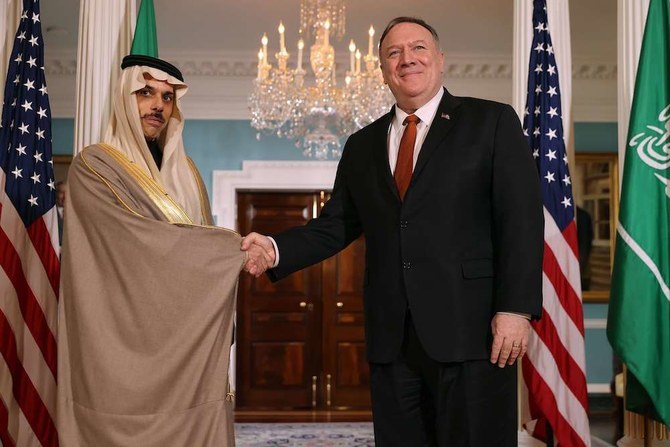
US Secretary of State Mike Pompeo and his Saudi Arabian counterpart, Foreign Minister Prince Faisal bin Farhan met in Washington in February. (AFP/File)
Short Url
Updated 14 October 2020
Follow

Saudi Arabia's foreign minister to take part in US strategic dialogue

  • Prince Faisal bin Farhan will meet Mike Pompeo in Washington
  • Dialogue will focus on regional security and economic development

RIYADH: Saudi Arabia’s foreign minister will take part in the first US-Saudi Strategic Dialogue in Washington on Wednesday.

Prince Faisal bin Farhan is to meet Secretary of State Mike Pompeo for the event.

The State Department said: “The dialogue will focus on our shared commitments to the furthering of regional security and prosperity, economic development, and the people-to-people exchanges that have underpinned our bilateral relationship since the seminal meeting between President Roosevelt and King Abdulaziz aboard the USS Quincy 75 years ago.”


CNN suggests ‘false information’ could be behind UAE-KSA tensions

Updated 06 January 2026
Follow

CNN suggests ‘false information’ could be behind UAE-KSA tensions

  • Abu Dhabi mobilized STC after being falsely informed that Riyadh asked for sanctions on UAE

RIYADH: Tensions between Riyadh and Abu Dhabi could have been sparked by false information provided to the UAE about the Saudi Crown Prince’s recent visit to Washington, CNN has reported.

The American news channels says it has learned from its sources that Saudi Arabia believes Abu Dhabi mobilized the separatist Southern Transitional Council (STC) forces, which it backs, in provinces bordering the kingdom after being falsely informed that Saudi Crown Prince Mohammed bin Salman had asked US President Donald Trump during a White House visit in November to impose sanctions on Abu Dhabi over its alleged support for a warring party in Sudan’s civil war.

CNN’s reporting also suggests that Riyadh has reached out to the UAE to explain that it made no such request.

Meanwhile, the American channel says the UAE official who spoke to it on the condition of anonymity didn’t directly address the matter when asked about the false information claims.

During the November visit, President Trump did publicly announce that he had instructed his government to intervene in a bid to resolve the ongoing, bloody conflict in Sudan, based on a request from the Saudi Crown

Prince. However, neither the statements of the president, the crown prince, nor any reports published by Saudi or US media made any reference to the UAE at the time.

On 30 December, Riyadh launched airstrikes on what it says was a UAE military equipment shipment to Yemen, which was uncoordinated with the Coalition.

The Kingdom also backed the Yemeni government’s call for UAE forces to leave the country, which Abu Dhabi has agreed to honor, issuing a statement that insinuates it has done so of its own will.

The UAE statement also claimed an unwavering commitment on the part of Abu Dhabi to Saudi Arabia’s security and sovereignty, rejecting any actions that could threaten the Kingdom or undermine regional stability.

Meanwhile, CNN said it also understands that further Saudi strikes targeting the STC remain on the table should the separatists not withdraw. After the UAE pulled its troops from Yemen last week, the STC moved toward secession, but under intense military pressure from Riyadh and its local allies, it lost territory, and it now claims it is happy to enter a dialogue with other Yemeni parties.

The Kingdom, for its part, has reaffirmed numerous times its belief that the Southern cause is a just one and has called for it to be discussed among the various parties at the negotiation table and away from the battlefield. Saudi Arabia has called for a dialogue to occur in Riyadh to discuss the Southern separation issue, and its call has been welcomed by the Yemeni government, various Yemeni factions — including the STC itself, as mentioned — and the majority of Arab and Muslim countries.

A problematic figure in the equation is Aidarous Al-Zubaidi, President of the STC, who is believed to have dual citizenship, and many Yemenis on social media have been posting images of his UAE passport and renouncing him as unfit for governing, claiming he serves a foreign agenda. Others also posted videos of him making statements that he would be happy to establish ties with Israel, should Southern Yemen gain its independence. Most recently as well, a post by Yemen’s Media Minister Moammar Eryani has accused the STC of allowing the theft and spread of weapons in Eastern provinces.

Eryani added that the STC has been deliberately causing chaos and “using Al Qaeda as a scarecrow to achieve its own political gains at the expense of Yemeni people”. CNN also says it has learned that

Saudi concerns extend beyond UAE involvement in Yemen and Sudan. Riyadh, according to the report, is also wary of the UAE’s policies in the Horn of Africa and in Syria, where it believes Abu Dhabi has cultivated ties with elements of the Druze community, some of whose leaders have openly discussed secession.

While no Saudi source was mentioned in the reporting, CNN’s narrative is in line with several public Saudi statements, which have objected to the recent Israeli recognition and endorsement of Somaliland’s separation from Somalia, Israeli attempts to undermine and attack the new Syrian government, and any attempt to impose a Southern Yemeni state by military means.

Israel maintains a close relationship with Abu Dhabi and an even closer one since the signing of the 2020 Abraham Accords, while Saudi Arabia has refused normalization with Tel Aviv until it recognizes a Palestinian State and adheres to a credible and irreversible path to achieving a Two-State Solution. This Saudi position has been reiterated yet again during the Crown Prince’s November visit to Washington.