Immigration impasse, pandemic clobber US crab industry

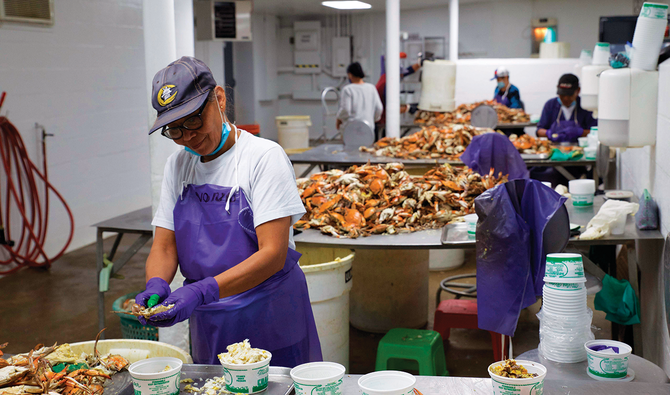
Processors rely on guest workers from Mexico and elsewhere in Latin America entering on temporary H-2B visas to extract the crabs. (AFP)
Short Url
Updated 12 October 2020
Follow

Immigration impasse, pandemic clobber US crab industry

  • The industry is at the mercy of weather — as well as regulations intended to protect crab habitats

HOOPERSVILLE, US: As crab season arrived in Hoopersville, Maryland, locals began asking where Jose Bronero Cruz was. For two decades, he had traveled from Mexico to the remote town to pick crab meat, but this spring, he did not arrive.

Nor did any of the other foreign workers Janet Rippons-Ruark relies on to process meat from the blue crabs Maryland is famous for, exacerbating a worker shortage that ballooned into a crisis for the eastern US state’s iconic industry.

“We’ve survived COVID-19. But we’re in an area where there is just not local help,” Rippons-Ruark said. A shortage of visas for foreign workers combined with disruptions caused by the pandemic paralyzed parts of Maryland’s crab industry this year, forcing two-thirds of the major seafood processors to scrape by on the few employees they could find, or close entirely.

A batch of visas issued at the start of October finally allowed Cruz and other guest workers to enter the country, but amid the prolonged deadlock over immigration policy in Washington that shows no sign of abating soon, crab industry leaders fret for their future.

“Whether we’ll survive the staffing thing ... That remains to be seen,” said Jack Brooks, president of the Chesapeake Bay Seafood Industries Association.

Blue crabs pulled from the waters of the Chesapeake Bay are perhaps Maryland’s best-known export, with the state the second-largest producer of the 2018 US harvest valued at $188.4 million, according to the National Oceanic and Atmospheric Administration.

The industry is at the mercy of weather — as well as regulations intended to protect crab habitats, but processors can also enjoy booms during years like 2020, when prices rose as the pandemic’s arrival seemed to increase crab’s popularity.

“We’re not in what you call a growth industry at this point, but we do have a domestic product that a lot of people want,” Brooks said.

Less desirable is the work of processing crab, which involves steaming them, cracking open their shell, removing their gills and picking out the meat for sale — a job industry leaders say few Americans want to do, particularly since workers are employed for only part of the year.

Processors rely on guest workers from Mexico and elsewhere in Latin America entering on temporary H-2B visas to extract the crabs, though migrant rights groups have also accused the industry of giving workers poor housing and insufficient health care access.

For Cruz, journeying all the way from Tabasco state in southern Mexico to Hoopersville, located on a dead-end road so low-lying that waves splash onto it, is better than trying to find work back home.

“In Mexico, you don’t make money,” Cruz, 46, told AFP.
“Here, you do.”

US law allows 66,000 H-2B visas to be issued each year and Brooks said the Maryland crab industry needs only around 450.

More than 99,000 requests for visas were received at the start of 2020, according to the Department of Labor.

But Brooks said a change in the procedure for allocating the visas caused disaster when only three processors were given the authorizations they needed as the season began in April.

The government in March said it would give out 35,000 more visas, but the plan was abandoned when the pandemic descended.

Diriyah Co. partners with Midad to develop Four Seasons hotel in Diriyah 

Updated 07 January 2026
Follow

Diriyah Co. partners with Midad to develop Four Seasons hotel in Diriyah 

RIYADH: Saudi Arabia’s sovereign wealth fund-backed developer, Diriyah Co., has signed a joint development agreement with Midad Real Estate Investment and Development Co. to construct the Four Seasons Diriyah Hotel and private residences. 

The partnership will strengthen collaboration between the two companies through the development of the luxury Four Seasons Diriyah, which will feature 159 rooms, alongside private Four Seasons residences, spanning approximately 235,000 sq. meters within Diriyah’s master plan. 

The project’s total value is projected at SR3.1 billion (approximately $827 million), encompassing both land acquisition and construction expenses. 

Midad is one of the Kingdom’s leading real estate developers, expanding its portfolio of high-end projects and maintaining numerous strategic partnerships with prominent global brands, reinforcing its reputation as a trusted name in luxury residential and hospitality development across Saudi Arabia. 

This partnership marks the first major collaboration between Diriyah Co. and Midad, supporting Diriyah’s plans to develop 40 luxury hotels across its two main projects: the 14-sq.-km Diriyah Project and the 62-sq.-km Wadi Safar Project, a premium destination that blends lifestyle, culture, and entertainment. 

Commenting on the agreement, Minister of Tourism and Secretary-General of Diriyah Co., Ahmad Al-Khatib, said: “The Kingdom continues to set new standards in developing tourism destinations, with Diriyah at the forefront.” 

He added that such partnerships enhance the world-class experiences Saudi Arabia offers and strengthen the Kingdom’s position as a leading destination in this sector. 

Diriyah Co. CEO Jerry Inzerillo commented that the Four Seasons Diriyah Hotel and Residences will be one of the Kingdom’s largest luxury hotels. 

“We are proud to announce this joint development with Midad, one of Saudi Arabia’s top real estate developers. This agreement reflects our ongoing commitment to enabling Saudi partners to contribute to Diriyah’s transformative journey and confirms Midad’s confidence in the opportunities the project presents,” Inzerillo added. 

Midad CEO Abdelilah bin Mohammed Al-Aiban said: “This project is a pivotal milestone for our company, allowing us to bring the Four Seasons experience to one of the Kingdom’s most prominent heritage destinations.” 

He added: “We are excited to deliver a project that embodies design excellence, world-class service, and sustainable value, while contributing meaningfully to Saudi Arabia’s tourism, cultural, and economic ambitions.” 

The collaboration comes amid rapid progress on the SR236 billion Diriyah project, which has awarded construction contracts worth more than SR101.25 billion to date. 

Diriyah is expected to contribute approximately SR70 billion directly to the Kingdom’s gross domestic product, create more than 180,000 jobs, accommodate 100,000 residents, and host around 50 million annual visitors. 

The development will feature contemporary office spaces accommodating tens of thousands of professionals across technology, media, arts, and education, complemented by museums, retail destinations, a university, an opera house, and the Diriyah Arena.  

It will also offer a diverse selection of restaurants and cafes, alongside nearly 40 world-class resorts and hotels distributed across its two primary master plans.