NICOSIA: Voters in the Turkish-held north of Cyprus, a breakaway state recognized only by Ankara, voted Sunday for a new leader amid charges of interference by Turkey’s President Recep Tayyip Erdogan.
The presidential vote in the self-proclaimed Turkish Republic of Northern Cyprus was held amid heightened tensions on the divided island and in the wider eastern Mediterranean.
The election in the TRNC pits the incumbent and favorite, Mustafa Akinci, who supports the eventual reunification of Cyprus as an EU member, against nationalist Ersin Tatar, who is backed by Erdogan.
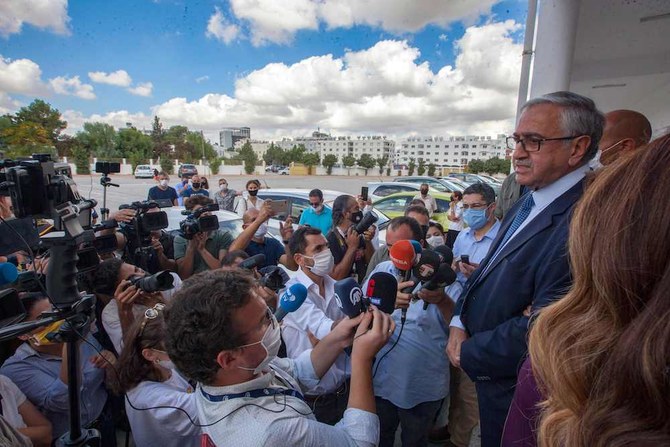
“This election is crucial for our destiny,” Akinci said after casting his ballot, likening the effect of alleged Turkish political meddling to the impact the COVID-19 pandemic has had on public health.
The vote comes three days after Turkish troops angered the Republic of Cyprus, an EU member, and many Turkish Cypriots by reopening public access to the fenced-off seaside ghost town of Varosha for the first time since Turkish forces invaded the north in 1974.
That move sparked demonstrations in the majority Greek-speaking Republic of Cyprus, which exercises its authority over the island’s southern two thirds, separated from the north by a UN-patrolled buffer zone.
Almost 200,0000 of the about 300,000 residents are registered to vote in the TRNC, which was established after the north of the island was occupied by Turkey in reaction to a coup to annex Cyprus to Greece.
One voter, Esat Tulek, aged 73 and a retired public servant, said the election was important because “we’re actually choosing the president who will be negotiating with the Greek Cypriots about the future of Cyprus.”
The election comes amid tensions in the eastern Mediterranean over the planned exploitation of hydrocarbons between Turkey on the one hand, and Greece as well as its close ally Cyprus on the other.
Erdogan announced on Tuesday, together with Tatar, the partial reopening of Varosha, a beachside resort that once drew Hollywood stars before it was abandoned by its Greek-Cypriot inhabitants during the Turkish invasion.
The move to allow visitors back into the abandoned and overgrown area was condemned by Akinci and other candidates, who saw it as Turkish interference in the election.
It was also heavily criticized by the Republic of Cyprus, the European Union and the United Nations, whose peacekeepers monitor the 180-kilometer (112-mile) buffer zone across the island.
Kemal Baykalli, founder of the non-government group Unite Cyprus Now, told AFP that “the main issue of this election is how we will define our relationship with Turkey.”
Eleven candidates are in the running, and the front-runner is Akinci, 72, a Social Democrat who favors loosening ties with Ankara, which has earned him the hostility of Erdogan.
“There are two situations that are not normal,” Akinci said after voting. “One is about our health, there is a pandemic.
“And the second one is our political health, communal health, and I’m talking here about the intervention of Turkey,” which he accused of using their facilities in TRNC “like an election office.”
The negotiations aimed at reunification stalled during Akinci’s term of office, notably on the question of the withdrawal of tens of thousands of Turkish soldiers stationed in the TRNC.
Turkey supports the nationalist Tatar, 60, currently “prime minister” of the breakaway north, who on Sunday insisted to reporters that “the TRNC and its people form a state.”
“We deserve to live on the basis of equal sovereignty,” Tatar said to applause from his supporters.
Yektan Turkyilmaz, a researcher at the Berlin-based Forum Transregionale Studien, said many Turkish Cypriots felt “wounded in their honor and identity” by what they considered to be interference from Ankara.
Another voter, Aysin Demirag, a 59-year-old yoga teacher, said the Varosha reopening, “under pressure from Turkey, organized as a show with days to go before the elections, was really a bad decision.”
The election is being held amid an economic crisis, deepened by the pandemic, which has largely shuttered the tourism sector and led to the closure of Ercan airport in north Nicosia and the crossing points to the south of the island.
Voting at 738 polling stations, held with precautions against the spread of COVID-19, was to close at 6:00 p.m. (1500 GMT), with result due to be released in the evening.
If no candidate wins at least 50 percent of the vote, the two leading candidates will face off in a second round on October 18.


![]()
![]()

Turkish Cypriots vote for new leader amid east Med tensions

Short Url
https://arab.news/yfc3v
Turkish Cypriots vote for new leader amid east Med tensions
- If no candidate wins 50% of the vote, they will face off in a 2nd round
- The vote comes 3 days after Turkish troops angered Cyprus


Latest updates


© 2026 SAUDI RESEARCH & PUBLISHING COMPANY, All Rights Reserved And subject to Terms of Use Agreement.