

Aden seaport authorities demand hire charge before dumping fertilizers

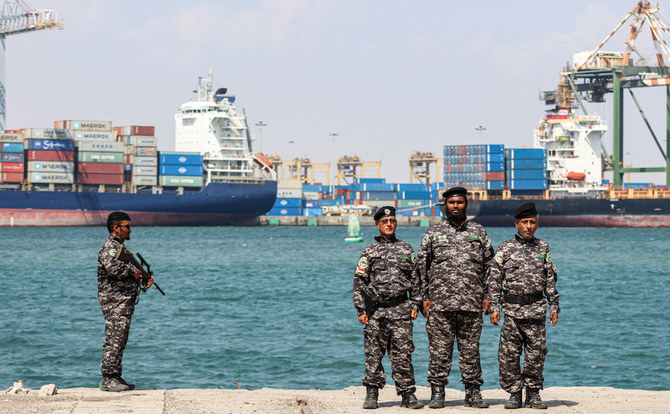
Yemeni members of the "Institution Protection Brigade" stand guard while on duty at the fishing port of Yemen's second city of Aden. (File/AFP)
Short Url
Updated 10 October 2020
Follow

Aden seaport authorities demand hire charge before dumping fertilizers

  • The story caused uproar and panic in Yemen, prompting lawmakers, government officials

AL-MUKALLA: Seaport authorities in Aden continue to store urea fertilizer despite an order to dump the hazardous material, government officials said Saturday.

In August, a committee assigned by Yemen’s attorney general to investigate reports of thousands of tons of ammonium nitrate being stored at the port found that the material was in fact a different fertilizer, urea. It ordered the seaport authority to get rid of it as it could explode if mixed with other materials.

The investigation followed a media report about ammonium nitrate gathering dust at the port that could cause a massive explosion, similar to the one that ravaged Beirut on Aug. 4. 

The story caused uproar and panic in Yemen, prompting lawmakers, government officials and the public into demanding a quick investigation.

When asked why the judiciary order had not been followed, Mohammed Amzrabeh, chairman of the Yemen Gulf of Aden Ports Corporation, told Arab News that the case was in court, without giving further details.

But, according to two local government officials familiar with knowledge of the case, seaport authorities are demanding that a local trader who imported the materials pay hundreds of thousands of dollars in hire charge for storing the urea.

“The seaport authorities seek a financial settlement with the trader,” one of the officials, who requested anonymity, told Arab News. “The materials have expired and no longer pose a threat to anyone.” 

The Saudi-led Arab coalition and the internationally recognized government have asked local traders to get permission before importing urea fertilizer, widely seen as an explosive material that could be used by the Houthis for military purposes. 

Last month, a busted arms ring that had supplied the Houthis with weapons from Iran confessed to importing tons of urea fertilizer for the rebels.

There has been fighting between government forces and the Houthis in the northern provinces of Jouf and Marib and the western province of Hodeidah for the second consecutive week, leaving dozens dead on both sides.

Yemen’s Defense Ministry said on Friday that coalition warplanes targeted a gathering of Houthi fighters in Marib, killing dozens of rebels and destroying vehicles. The rebels had been heading to battlefields in the province as reinforcement.

Coalition warplanes also hit Houthi military forces and equipment in Marib’s Serwah district.

Army troops and allied tribesmen on Friday announced seizing control of new areas in Khab and Sha’af district in Jouf, days after securing a strategic military base and neighboring areas. 

Backed by coalition air support, government troops in Jouf have been pushing forward to recapture Hazem, the provincial capital that fell to the Houthis in March.

Fighting subsided in Hodeidah on Saturday, days after government forces foiled Houthi attacks in Hays and Al-Durihimi districts and in contested districts in Hodeidah city.


Libya’s security authorities free more than 200 migrants from ‘secret prison’, two security sources say

Updated 6 sec ago
Follow

Libya’s security authorities free more than 200 migrants from ‘secret prison’, two security sources say

BENGHAZI: Libya’s security authorities have freed more than 200 migrants from what they described as a secret prison in the town of Kufra in the southeast of the country after they ​were held captive in inhuman conditions, two security sources from the city told Reuters on Sunday.
The security sources, speaking on condition of anonymity, said that the security authorities had found an underground prison, nearly three meters deep, which the sources said was run by a Libyan human trafficker.
One of the sources said this person had not yet been detained.
“Some of the freed migrants were ‌held captive up ‌to two years in the underground cells,” ‌this ⁠source ​said.
The ‌other source said what the operation had found was “one of the most serious crimes against humanity that has been uncovered in the region.”
“The operation resulted in a raid on a secret prison within the city, where several inhumane underground detention cells were uncovered,” one of the sources added.
The freed migrants are from sub-Saharan Africa, mainly from Somalia ⁠and Eritrea, including women and children, the sources said. Kufra lies in eastern Libya, ‌about 1,700 kilometers (1,000 miles) from the capital ‍Tripoli.
Libya has become a transit ‍route for migrants fleeing conflict and poverty to Europe via dangerous ‍routes across the desert and over the Mediterranean since the toppling of Muammar Qaddafi in a NATO-backed uprising in 2011.
The oil-based Libyan economy is also a draw for impoverished migrants seeking work, but security throughout the ​sprawling country is poor, leaving migrants vulnerable to abuses.
At least 21 bodies of migrants were found in a ⁠mass grave in eastern Libya last week, with up to 10 survivors in the group bearing signs of having been tortured before they were freed from captivity, two security sources told Reuters.
Libya’s attorney general said in a statement on Friday the authorities in the east of the country had referred a defendant to the court for trial in connection with the mass grave on charges of “committing serious violations against migrants.”
In February last year, 39 bodies of migrants were recovered from about 55 mass graves in Kufra. The town houses ‌tens of thousands of Sudanese refugees who fled the conflict that erupted in Sudan in 2023.