

In Pakistani city where libraries are scarce, select barbershops offer trimming of literature

Usman Ali, Ghosia Hair Dresser owner, arranges a bookshelf for his customers in Peshawar on Oct. 9, 2020. (AN photo)
Short Url
Updated 10 October 2020
Follow

In Pakistani city where libraries are scarce, select barbershops offer trimming of literature

  • To promote reading, over 900 books have been donated to barbers in Peshawar and nearby Charsadda by a secondary school student
  • Khyber Pakhtunkhwa province has just 18 public libraries, only two are still operating in Peshawar, according to Archives and Libraries Directorate

PESHAWAR: Classic poetry volumes and international fiction bestsellers are now waiting for those who visit Peshawar barbershops, as a small local initiative to promote reading has been welcomed by residents of the city that has only two public libraries.  

Over 900 books have been donated since September to barbers in the capital of Khyber Pakhtukhwa province and nearby Charsadda town by Omar Azam Khan, a student in the final year of secondary school, who was inspired by a similar initiative in India which recently made the rounds in social media.

“This is a pleasant change and I am a government employee and rarely read big stuff, but after reading parts of "Forty Rules of Love," later I bought the book and read it,'' Riaz Ghafur, a government employee who regularly comes to Ghusia Hair Dresser — one of the Peshawar barbers that have so far benefitted from the book initiative — told Arab News on Saturday.

“This idea is brilliant and the rest of the community members should also bring books to (put them on) barbershop shelves,” he said.

The whole province has just 18 public libraries. According to Zahir Ullah Khan, director of Khyber Pakhtunkhwa Archives and Libraries, in Peshawar only two are still operating — Main Archives and Library and Rehman Baba Complex Library.

“We have put forward the request to the government to establish at least one library in each district and later will drag the idea to the teshil/town level and at last we want to build a library in every union council,” he said.

But before the government project materializes, the civic initiative has already reached four barbershops in Peshawar and five in Charsadda.
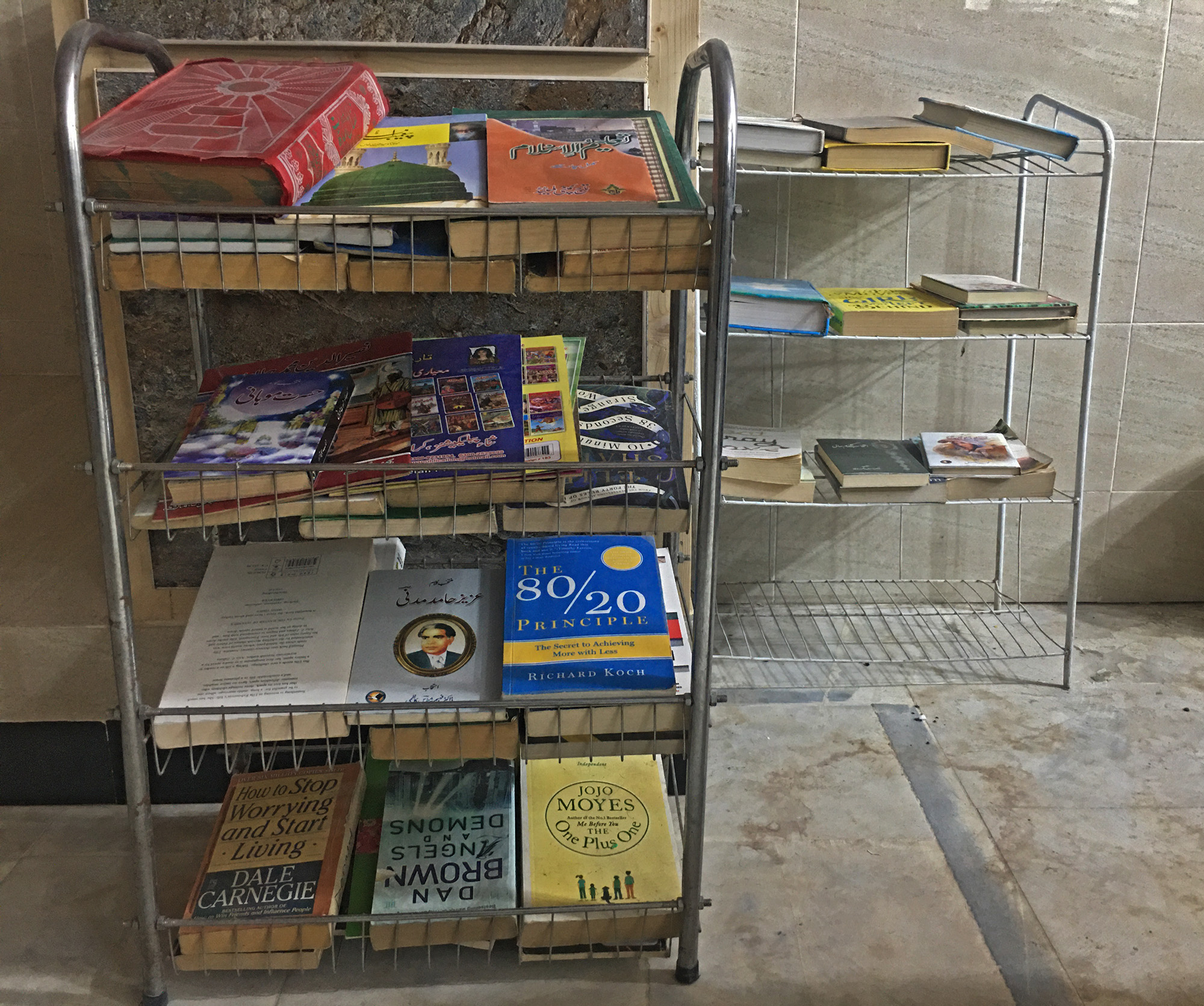


Books of all kinds, ranging from selected works of renowned poet Aziz Hamid Madani to international bestsellers by authors like Paulo Coelho, are waiting for Ghosia Hair Dresser customers in Peshawar on Oct. 9, 2020. (AN photo)

The books are of all kinds, ranging from selected works of renowned poet Aziz Hamid Madani, through Islamic literature, biographies, popular Urdu novels such as "Raja Gidh," to international bestsellers by authors like Paulo Coelho, Dan Brown and Dale Carnegie.

The young man behind the project says the books come from different parts of Pakistan. He said he asked his social media followers to donate literature instead of money if they wanted to support the initiative, in which also received help from his factory-owner father and social activist mother.  

“A moderate amount has been given to me by my father and also mother as both of them know my objectives of spreading the book reading habit," he said, adding that book reading is an activity that has been affected by the use cellphones for leisure.
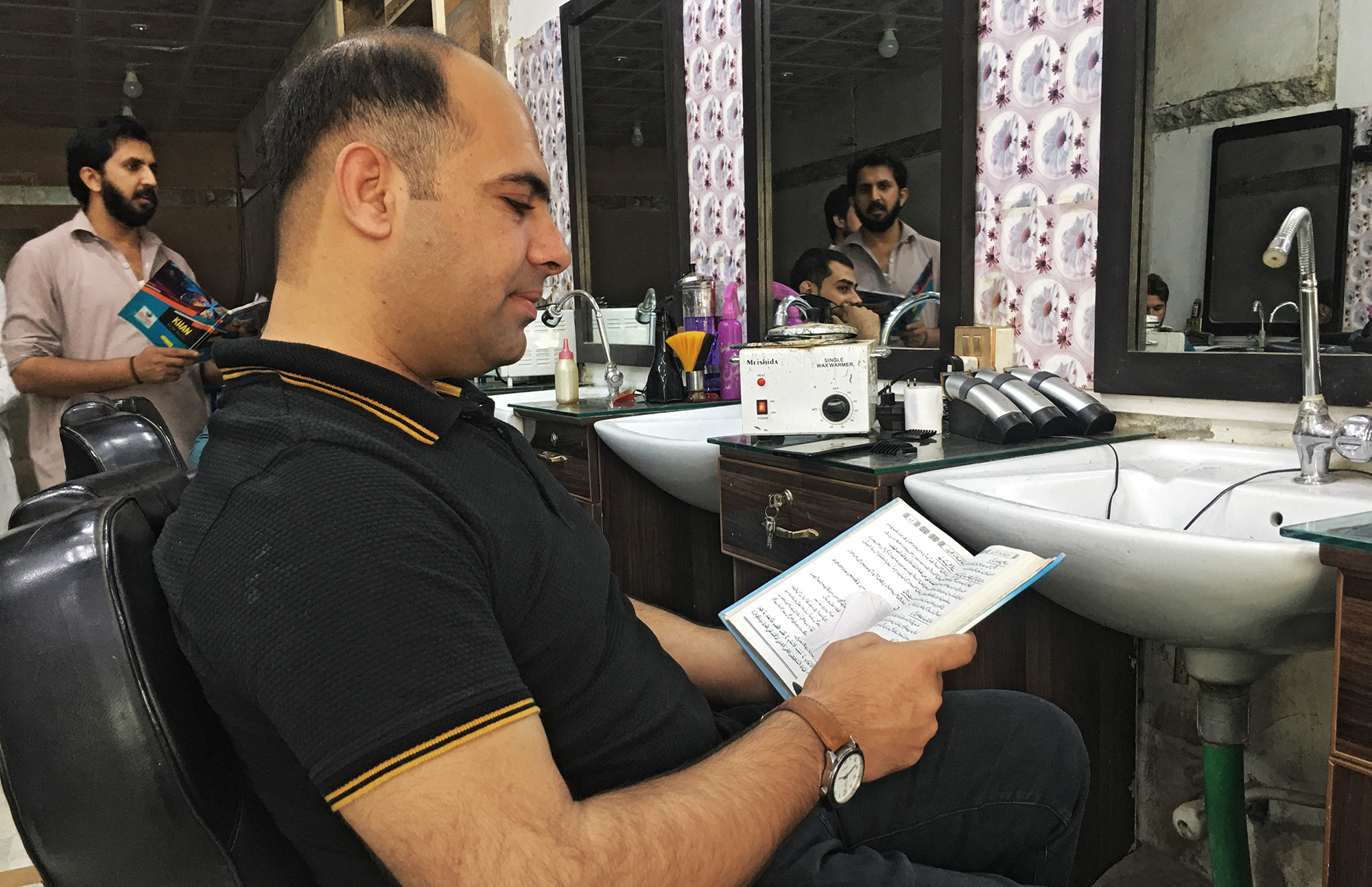


A customer is reading a book at Ghosia Hair Dresser in Peshawar on Oct. 9, 2020. (AN photo)

As waiting for one's turn at the barber's usually takes quite some time, he believes that is when customers can utilize it to read: "In Khyber Pakhtunkhwa haircutting is time consuming and that’s why we decided to keep books in this very important place for customers.”  

Ghusia Hair Dresser owner Usman Ali says he is already observing a positive change.

“Before these books, people would discuss none of their business-related things and in the time of elections it is always very hard for us to stop people on politics," he told Arab News. "But now, after these books, about 70 percent of clients remain busy reading poetry and fiction."


Pakistan, global crypto exchange discuss modernizing digital payments, creating job prospects 

Updated 05 December 2025
Follow

Pakistan, global crypto exchange discuss modernizing digital payments, creating job prospects 

  • Pakistani officials, Binance team discuss coordination between Islamabad, local banks and global exchanges
  • Pakistan has attempted to tap into growing crypto market to curb illicit transactions, improve oversight

ISLAMABAD: Pakistan’s finance officials and the team of a global cryptocurrency exchange on Friday held discussions aimed at modernizing the country’s digital payments system and building local talent pipelines to meet rising demand for blockchain and Web3 skills, the finance ministry said.

The development took place during a high-level meeting between Finance Minister Muhammad Aurangzeb, Pakistan Virtual Assets Regulatory Authority (PVARA) Chairman Bilal bin Saqib, domestic bank presidents and a Binance team led by Global CEO Richard Teng. The meeting was held to advance work on Pakistan’s National Digital Asset Framework, a regulatory setup to govern Pakistan’s digital assets.

Pakistan has been moving to regulate its fast-growing crypto and digital assets market by bringing virtual asset service providers (VASPs) under a formal licensing regime. Officials say the push is aimed at curbing illicit transactions, improving oversight, and encouraging innovation in blockchain-based financial services.

“Participants reviewed opportunities to modernize Pakistan’s digital payments landscape, noting that blockchain-based systems could significantly reduce costs from the country’s $38 billion annual remittance flows,” the finance ministry said in a statement. 

“Discussions also emphasized building local talent pipelines to meet rising global demand for blockchain and Web3 skills, creating high-value employment prospects for Pakistani youth.”

Blockchain is a type of digital database that is shared, transparent and tamper-resistant. Instead of being stored on one computer, the data is kept on a distributed network of computers, making it very hard to alter or hack.

Web3 refers to the next generation of the Internet built using blockchain, focusing on giving users more control over their data, identity and digital assets rather than big tech companies controlling it.

Participants of the meeting also discussed sovereign debt tokenization, which is the process of converting a country’s debt such as government bonds, into digital tokens on a blockchain, the ministry said. 

Aurangzeb called for close coordination between the government, domestic banks and global exchanges to modernize Pakistan’s payment landscape.

Participants of the meeting also discussed considering a “time-bound amnesty” to encourage users to move assets onto regulated platforms, stressing the need for stronger verifications and a risk-mitigation system.

Pakistan has attempted in recent months to tap into the country’s growing crypto market, crack down on money laundering and terror financing, and promote responsible innovation — a move analysts say could bring an estimated $25 billion in virtual assets into the tax net.

In September, Islamabad invited international crypto exchanges and other VASPs to apply for licenses to operate in the country, a step aimed at formalizing and regulating its fast-growing digital market.