

In Pakistani city where libraries are scarce, select barbershops offer trimming of literature

Usman Ali, Ghosia Hair Dresser owner, arranges a bookshelf for his customers in Peshawar on Oct. 9, 2020. (AN photo)
Short Url
Updated 10 October 2020
Follow

In Pakistani city where libraries are scarce, select barbershops offer trimming of literature

  • To promote reading, over 900 books have been donated to barbers in Peshawar and nearby Charsadda by a secondary school student
  • Khyber Pakhtunkhwa province has just 18 public libraries, only two are still operating in Peshawar, according to Archives and Libraries Directorate

PESHAWAR: Classic poetry volumes and international fiction bestsellers are now waiting for those who visit Peshawar barbershops, as a small local initiative to promote reading has been welcomed by residents of the city that has only two public libraries.  

Over 900 books have been donated since September to barbers in the capital of Khyber Pakhtukhwa province and nearby Charsadda town by Omar Azam Khan, a student in the final year of secondary school, who was inspired by a similar initiative in India which recently made the rounds in social media.

“This is a pleasant change and I am a government employee and rarely read big stuff, but after reading parts of "Forty Rules of Love," later I bought the book and read it,'' Riaz Ghafur, a government employee who regularly comes to Ghusia Hair Dresser — one of the Peshawar barbers that have so far benefitted from the book initiative — told Arab News on Saturday.

“This idea is brilliant and the rest of the community members should also bring books to (put them on) barbershop shelves,” he said.

The whole province has just 18 public libraries. According to Zahir Ullah Khan, director of Khyber Pakhtunkhwa Archives and Libraries, in Peshawar only two are still operating — Main Archives and Library and Rehman Baba Complex Library.

“We have put forward the request to the government to establish at least one library in each district and later will drag the idea to the teshil/town level and at last we want to build a library in every union council,” he said.

But before the government project materializes, the civic initiative has already reached four barbershops in Peshawar and five in Charsadda.
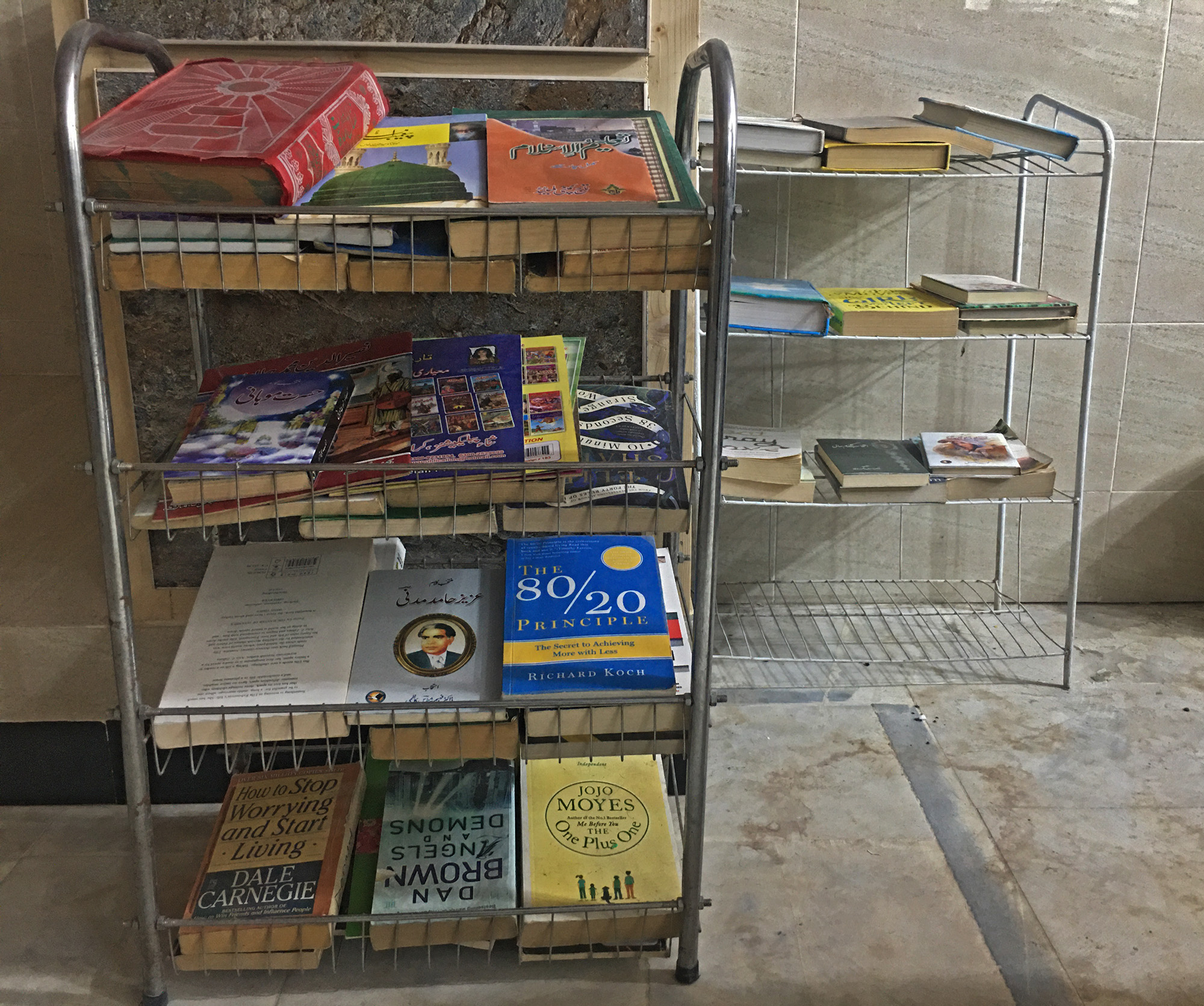


Books of all kinds, ranging from selected works of renowned poet Aziz Hamid Madani to international bestsellers by authors like Paulo Coelho, are waiting for Ghosia Hair Dresser customers in Peshawar on Oct. 9, 2020. (AN photo)

The books are of all kinds, ranging from selected works of renowned poet Aziz Hamid Madani, through Islamic literature, biographies, popular Urdu novels such as "Raja Gidh," to international bestsellers by authors like Paulo Coelho, Dan Brown and Dale Carnegie.

The young man behind the project says the books come from different parts of Pakistan. He said he asked his social media followers to donate literature instead of money if they wanted to support the initiative, in which also received help from his factory-owner father and social activist mother.  

“A moderate amount has been given to me by my father and also mother as both of them know my objectives of spreading the book reading habit," he said, adding that book reading is an activity that has been affected by the use cellphones for leisure.
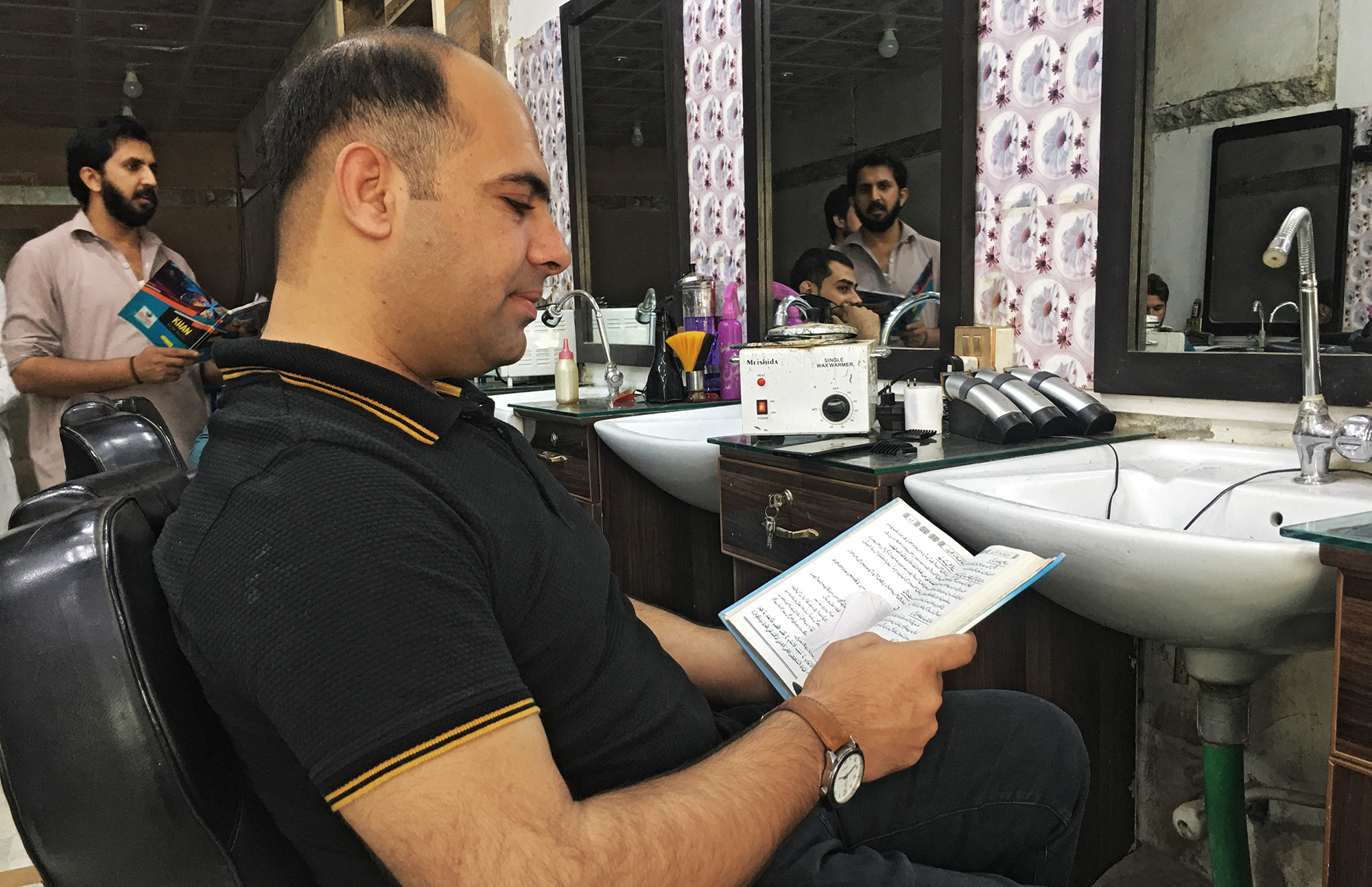


A customer is reading a book at Ghosia Hair Dresser in Peshawar on Oct. 9, 2020. (AN photo)

As waiting for one's turn at the barber's usually takes quite some time, he believes that is when customers can utilize it to read: "In Khyber Pakhtunkhwa haircutting is time consuming and that’s why we decided to keep books in this very important place for customers.”  

Ghusia Hair Dresser owner Usman Ali says he is already observing a positive change.

“Before these books, people would discuss none of their business-related things and in the time of elections it is always very hard for us to stop people on politics," he told Arab News. "But now, after these books, about 70 percent of clients remain busy reading poetry and fiction."


Pakistan’s OGDC ramps up unconventional gas plans

Updated 4 sec ago
Follow

Pakistan’s OGDC ramps up unconventional gas plans

  • Pakistan has long been viewed as having potential in tight and shale gas but commercial output has yet to be proved
  • OGDC says has tripled tight-gas study area to 4,500 square km after new seismic, reservoir analysis indicates potential

ISLAMABAD: Pakistan’s state-run Oil & Gas Development Company is planning a major expansion of unconventional gas developments from early next year, aiming to boost production and reduce reliance on imported liquefied natural gas.

Pakistan has long been viewed as having potential in both tight and shale gas, which are trapped in rock and can only be released with specialized drilling, but commercial output has yet to be proved.

Managing Director Ahmed Lak told Reuters that OGDC had tripled its tight-gas study area to 4,500 square kilometers (1,737 square miles) after new seismic and reservoir analysis indicated larger potential. Phase two of a technical evaluation will finish by end-January, followed by full development plans.

The renewed push comes after US President Donald Trump said Pakistan held “massive” oil reserves in July, a statement analysts said lacked credible geological evidence, but which prompted Islamabad to underscore that it is pursuing its own efforts to unlock unconventional resources.

“We started with 85 wells, but the footprint has expanded massively,” Lak said, adding that OGDC’s next five-year plan would look “drastically different.”

Early results point to a “significant” resource across parts of Sindh and Balochistan, where multiple reservoirs show tight-gas characteristics, he said.

SHALE PILOT RAMPS UP

OGDC is also fast-tracking its shale program, shifting from a single test well to a five- to six-well plan in 2026–27, with expected flows of 3–4 million standard cubic feet per day (mmcfd) per well.

If successful, the development could scale to hundreds or even more than 1,000 wells, Lak said.

He said shale alone could eventually add 600 mmcfd to 1 billion standard cubic feet per day of incremental supply, though partners would be needed if the pilot proves viable.

The company is open to partners “on a reciprocal basis,” potentially exchanging acreage abroad for participation in Pakistan, he said.

A 2015 US Energy Information Administration study estimated Pakistan had 9.1 billion barrels of technically recoverable shale oil, the largest such resource outside China and the United States.

A 2022 assessment found parts of the Indus Basin geologically comparable to North American shale plays, though analysts say commercial viability still hinges on better geomechanical data, expanded fracking capacity and water availability.

OGDC plans to begin drilling a deep-water offshore well in the Indus Basin, known as the Deepal prospect, in the fourth quarter of 2026, Lak said. In October, Turkiye’s TPAO with PPL and its consortium partners, including OGDC, were awarded a block for offshore exploration.

A combination of weak gas demand, rising solar uptake and a rigid LNG import schedule has created a surplus of gas that forced OGDC to curb output and pushed Pakistan to divert cargoes from Italy’s ENI and seek revised terms with Qatar.