

Pakistan's new textile policy to boost exports, create job opportunities

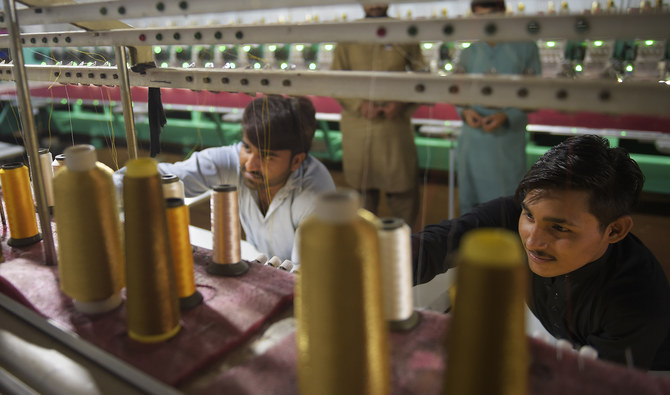
Workers supervise embroidery machines working on fabrics for wedding dresses at a small factory on the outskirts of Islamabad on Sept. 2, 2020. (AFP)
Short Url
Updated 09 October 2020
Follow

Pakistan's new textile policy to boost exports, create job opportunities

  • The policy is expected to be rolled out in next couple of months after consultation with stakeholder, says parliamentary secretary for textile
  • Pakistan is targeting $50 billion in exports by 2030 to bridge the current accounts deficit and boost foreign exchange reserves

ISLAMABAD: Pakistan plans to roll out a new textile policy in the next couple of months to boost exports, e-commerce, and create job opportunities for youth, a top government official said on Thursday, adding that the government was hoping to make the country part of the global value chain.
The textile industry is the single largest export earning sector of the country and eighth largest exporter of textile products in Asia. There are 423 textile industries working in the country, employing about 40 percent of the country’s total labor force.
The government has been struggling to boost the exports from the current $23 billion to $50 billion by 2030 to strengthen Pakistan’s economy, foreign exchange reserves and bridge the current account deficit by offering different tax incentives to the industry. Other than textiles, Pakistan exports food items, chemical and pharmaceutical products, leather and sports goods to different countries, including the Middle East and Europe.
“The consultation process [on the policy] is underway and its fine-tuning is being done with the help of public and private sectors,” Aliya Hamza Malik, parliamentary secretary for textile, commerce, industries and production, told Arab News in an interview.
She said the initial draft of the five-year policy was ready which would be presented to the Economic Coordination Committee of the Cabinet (ECC) for approval in the next couple of months.
“Our targets [for the industry] will be realistic and achievable,” she said. “We won’t make tall and fake claims.”
Malik said that Pakistan’s exports have registered a significant increase during the COVID-19 pandemic when exports of other countries in the region, including India and Bangladesh, were going down.
“We want to extend maximum benefit to our industry through this policy and are consulting all relevant stakeholders including economists and industrialists to make it more inclusive and comprehensive,” she said.
Pakistan’s textile industry is the fourth largest cotton producer and contributes 8.5 percent to the GDP.


Malik, however, said that her government was focusing beyond the raw material like cotton to boost value addition and export of end products. “We aren’t only focusing on market diversification but also making product and fiber diversification part of the policy.”
“Value addition is the future of textile … and textile is the backbone of our economy,” she said, adding that the government wanted to create more job opportunities for skilled and unskilled labor, boost e-commerce, small and medium enterprises and human resource development through its new policy.
The new policy would also help empower women entrepreneurs and skilled female workers as the government was laying focus on exports of the stitched materials.
“When I talk about value addition, it means we want to focus on stitching and when we will move to it we will need more training. This will help us encourage women participation,” she said.
The parliamentary secretary said that her government was also working on reducing the cost of doing business in Pakistan to make the industry competitive in the region. “Our textile industry is overbooked now … and our next goal is to make Pakistan part of the global value chain,” she said.


Pakistan reports current account surplus in Jan. owing to improved trade, remittances

Updated 17 February 2026
Follow

Pakistan reports current account surplus in Jan. owing to improved trade, remittances

  • Pakistan’s exports crossed the $3 billion mark in Jan. as the country received $3.5 billion in remittances
  • Last month, IMF urged Pakistan to accelerate pace of structural reforms to strengthen economic growth

ISLAMABAD: Pakistan recorded a current account surplus of more than $120 million in January, the country’s finance adviser said on Tuesday, attributing it to improved trade balance and remittance inflows.

Pakistan’s exports rebounded in January 2026 after five months of weak performance, rising 3.73 percent year on year and surging 34.96 percent month on month, according to data released by the country’s statistics bureau.

Exports crossed the $3 billion mark for the first time in January to reach $3.061 billion, compared to $2.27 billion in Dec. 2025. The country received $3.5 billion in foreign remittances in Jan. 2026.

Khurram Schehzad, an adviser to the finance minister, said Pakistan reported a current account surplus of $121 million in Jan., compared to a current account deficit of $393 million in the same month last year.

“Improved trade balance in January 2026, strong remittance inflows, and sustained momentum in services exports (IT/Tech) continue to reinforce the country’s external account position,” he said on X.

Pakistan has undergone a difficult period of stabilization, marked by inflation, currency depreciation and financing gaps, and international rating agencies have acknowledged improvements after Islamabad began implementing reforms such as privatizing loss-making, state-owned enterprises (SOEs) and ending subsidies as part of a $7 billion International Monetary Fund (IMF) loan program.

Late last month, the IMF urged Pakistan to accelerate the pace of these structural reforms to strengthen economic growth.

Responding to questions from Arab News at a virtual media roundtable on emerging markets’ resilience, IMF’s director of the Middle East and Central Asia Jihad Azour said Islamabad’s implementation of the IMF requirements had been “strong” despite devastating floods that killed more than 1,000 people and devastated farmland, forcing the government to revise its 4.2 percent growth target to 3.9 percent.

“What is important going forward in order to strengthen growth and to maintain the level of macroeconomic stability is to accelerate the structural reforms,” he said at the meeting.

Azour underlined Pakistan’s plans to privatize some of the SOEs and improve financial management of important public entities, particularly power companies, as an important way for the country to boost its capacity to cater to the economy for additional exports.

“This comes in addition to the effort that the authorities have made in order to reform their tariffs, which will allow the private sector of Pakistan to become more competitive,” the IMF official said.