

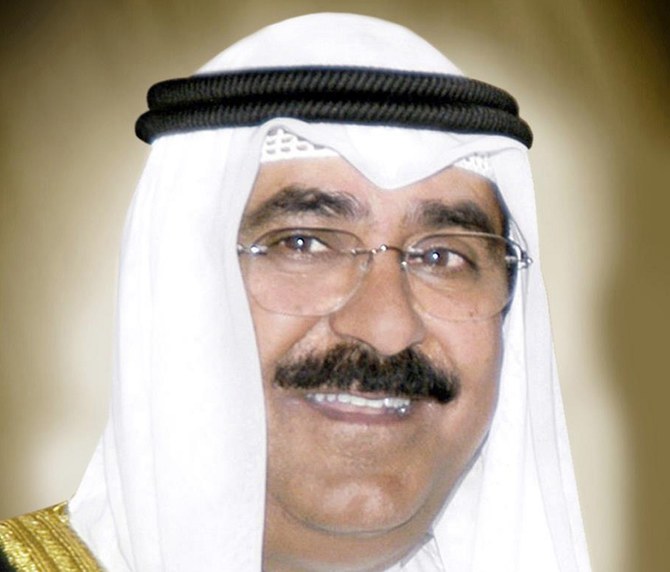
Kuwait’s new emir names anti-Islamist national guard chief as crown prince

Sheikh Nawaf Al-Ahmad Al-Sabah, the brother of Kuwait's new emir, who was appointed crown prince . (File/AFP)
Short Url
Updated 08 October 2020
Follow

Kuwait’s new emir names anti-Islamist national guard chief as crown prince

  • Sheikh Meshal, 80, has been deputy chief of the Kuwait National Guard since 2004

JEDDAH: Kuwait’s new emir, Sheikh Nawaf Al-Ahmad Al-Sabah, has named his half-brother Sheikh Meshal as crown prince. The appointment is expected to be confirmed in a parliamentary session on Thursday.
Sheikh Meshal, 80, has been deputy chief of the Kuwait National Guard since 2004. He is considered the most powerful man in the elite corps in charge of defending the emirate’s territory. The position of chief is symbolically held by Salem Al-Ali Al-Sabah, the eldest member of the ruling family.
“Sheikh Meshal is seen as part of the security apparatus,” said Cinzia Bianco, a research fellow at the European Council on Foreign Relations. He did not have good relations with Islamists and with the Muslim Brotherhood, Bianco said.

Opinion

This section contains relevant reference points, placed in (Opinion field)

The new crown prince spent many years in the Interior Ministry, where he rose through the ranks to head the department of general investigation from 1967 until 1980. Sheikh Meshal was widely credited with strengthening the department’s function as a state security service.
Sheikh Nawaf was sworn in as emir on Sept. 30 after the death of his half-brother, Sheikh Sabah Al-Ahmad Al-Sabah, who died at the age of 91 after two months in hospital in the US.
Sheikh Meshal, who was close to the late ruler and accompanied him to the US when he received treatment, is the seventh son of the 10th emir of Kuwait, Sheikh Ahmad Al-Jaber Al-Sabah.


UN rights chief shocked by ‘unbearable’ Darfur atrocities

Updated 19 January 2026
Follow

UN rights chief shocked by ‘unbearable’ Darfur atrocities

  • Mediation efforts have failed to produce a ceasefire, even after international outrage intensified last year with reports of mass killings, rape, and abductions during the RSF’s takeover of El-Fasher in Darfur

PORT SUDAN: Nearly three years of war have put the Sudanese people through “hell,” the UN’s rights chief said on Sunday, blasting the vast sums spent on advanced weaponry at the expense of humanitarian aid and the recruitment of child soldiers.
Since April 2023, Sudan has been gripped by a conflict between the army and the paramilitary Rapid Support Forces that has left tens of thousands of people dead and around 11 million displaced.
Speaking in Port Sudan during his first wartime visit, UN Human Rights commissioner Volker Turk said the population had endured “horror and hell,” calling it “despicable” that funds that “should be used to alleviate the suffering of the population” are instead spent on advanced weapons, particularly drones.
More than 21 million people are facing acute food insecurity, and two-thirds of Sudan’s population is in urgent need of humanitarian aid, according to the UN.
In addition to the world’s largest hunger and displacement crisis, Sudan is also facing “the increasing militarization of society by all parties to the conflict, including through the arming of civilians and recruitment and use of children,” Turk added.
He said he had heard testimony of “unbearable” atrocities from survivors of attacks in Darfur, and warned of similar crimes unfolding in the Kordofan region — the current epicenter of the fighting.
Testimony of these atrocities must be heard by “the commanders of this conflict and those who are arming, funding and profiting from this war,” he said.
Mediation efforts have failed to produce a ceasefire, even after international outrage intensified last year with reports of mass killings, rape, and abductions during the RSF’s takeover of El-Fasher in Darfur.
“We must ensure that the perpetrators of these horrific violations face justice regardless of the affiliation,” Turk said on Sunday, adding that repeated attacks on civilian infrastructure could constitute “war crimes.”
He called on both sides to “cease intolerable attacks against civilian objects that are indispensable to the civilian population, including markets, health facilities, schools and shelters.”
Turk again warned on Sunday that crimes similar to those seen in El-Fasher could recur in volatile Kordofan, where the RSF has advanced, besieging and attacking several key cities.
Hundreds of thousands face starvation across the region, where more than 65,000 people have been displaced since October, according to the latest UN figures.