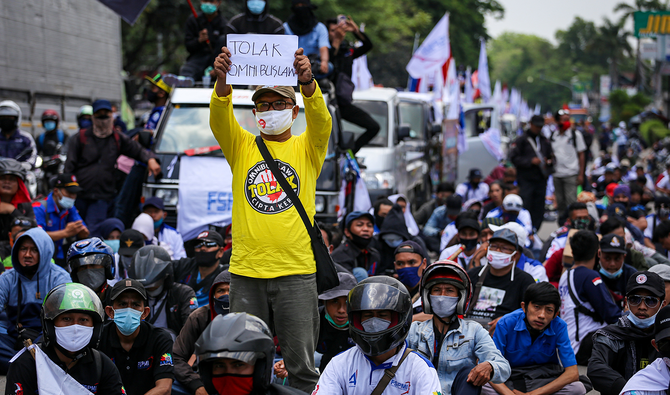

JAKARTA: Angry Indonesian activists took to the streets on Tuesday, a day after parliament rushed to pass into law the controversial Omnibus bill on job creation, which government officials say will lure more investments to the country, but protestors argue will promote a “contemporary form of slavery.”
“Both the House of Representatives and the government have lost their conscience and have not taken into account the fate of the people by passing the bill,” Nining Elitos, chairwoman of Indonesian Trade Union Congress Alliance (KASBI) Confederation, told Arab News.
Other activists slammed the Job Creation Law (JCL), reasoning that it would trigger job insecurity and deny workers their rights as guaranteed under the 2003 Manpower Law.
For months, trade unions have raised concerns that the new regulation will remove an obligation for employers to pay a severance package to employees who had been laid off and would enable companies to extend working contracts indefinitely, compared to a maximum of two annual extensions as per the previous law.
“KASBI members and other unions under the Gebrak coalition will continue to protest against the law,” Elitos said.
Meanwhile, Indonesian Legal Aid Institute Chairwoman Asfinawati told Arab News that the NGO and other civil society organizations were driving a motion of no confidence against parliament to reject the new legislation.
“We are taking a precedent set following the passing of Law No. 25 in 1997 on manpower. The law has never been effectively implemented due to a wide-scale public repudiation,” Asfinawati said on Tuesday.
After years of rejection by workers and employers, the 1997 law was eventually revoked in 2002 and replaced with the 2003 Manpower Law.
While admitting that the movement may not be successful, Asfinawati said that activists would continue to express their discontent against the JCL, which leaned toward a “contemporary form of slavery.”
“A judicial review to challenge the law with the Constitutional Court is an eventuality, but rights groups are in no rush to do so,” she added.
Demonstrators from Tangerang, Banten and Bekasi, West Java, were prevented from entering the capital Jakarta by police on Monday.
However, another Gebrak activist, Ilhamsyah, told Arab News on Tuesday that protests had broken out in several areas across the country, including in Indonesia’s busiest port, Tanjung Priok, in North Jakarta, and Batam, Riau Islands — a free-trade zone located an hour away on a boat from Singapore.
“The rallies will continue until Thursday,” Ilhamsyah added.
The JCL, which amends parts of 79 existing laws, including the Labor Law, was ratified three days ahead of schedule with Achmad Baidowi, deputy chairman of the House’s legislative body.
He justified the abrupt change of plan due to the rapid spread of the coronavirus disease (COVID-19) within the House of Representatives.
“We agreed that as the spread of COVID-19 in the parliament is accelerating, we must push forward the closing of current hearing sessions,” Baidowi told reporters in Jakarta.
During Monday’s meeting, Deputy Speaker Azis Syamsuddin said that 18 House lawmakers, staff and employees had contracted the disease, adding to the total of 307,120 cases and 11,253 deaths reported from across the country.
The JCL is one of President Joko “Jokowi” Widodo’s key priorities in his second and final term, with Coordinating Minister for the Economy Airlangga Hartarto saying on Monday that it would strengthen protection of workers and improve investment opportunities.
He added that it provides the legal basis for the government to increase its “contribution to the national employment insurance program and take measures to streamline business licensing procedures.”
Economists, however, are not so convinced.
Some expressed hesitation that the JCL is simply the panacea that the government needs to woo investors, particularly amid the pandemic.
“Tackling the pandemic should be the focus now…but the government was busy pushing for ratification of the Omnibus law. In the meantime, the pandemic has diminished Indonesia’s attractiveness as it reduced public purchasing power and disrupted mobility and production capacity,” Bhima Yudhistira Adhinegara, a researcher with the think tank Institute for Development of Economics and Finance, told Arab News on Tuesday.
He added that investors’ confidence in Indonesia is “currently very low” due to the government’s poor handling of the COVID-19 pandemic.
“The ratification of the law may already backfire and further bring down investors’ confidence as it leads to new uncertainties. It is likely that investors will prolong their wait-and-see stance as hundreds of regulations must be amended in accordance with the new legislation,” he said.
Others argue that the JCL could pose new risks to the country’s tropical forests.
On Tuesday, Arie Rompas, forest campaign team leader at Greenpeace Indonesia, highlighted the weaker penalties in the JCL for forest concession holders, which “cause land and forest fires and other issues surrounding a planned centralization of forest licensing, which is against Indonesia’s regional autonomy rules.”
In a strongly worded statement on Monday, rights watchdog Amnesty International (AI) Indonesia called it a “catastrophic” move.
“The passage of the Omnibus law exposes the authorities’ lack of commitment to human rights,” AI Indonesia Executive Director Usman Hamid said in a statement on Monday, adding that the “catastrophic law” would harm workers’ wallets, job security and their human rights.
He also added that the government failed to involve labor unions and civil society groups in the JCL’s drafting process.
“The law threatens human rights and will have a regressive effect on human rights in Indonesia, namely on the right to work and rights at work. This may amount to a breach of the prohibition of retrogression under the International Covenant on Economic, Social and Cultural Rights,” he said.