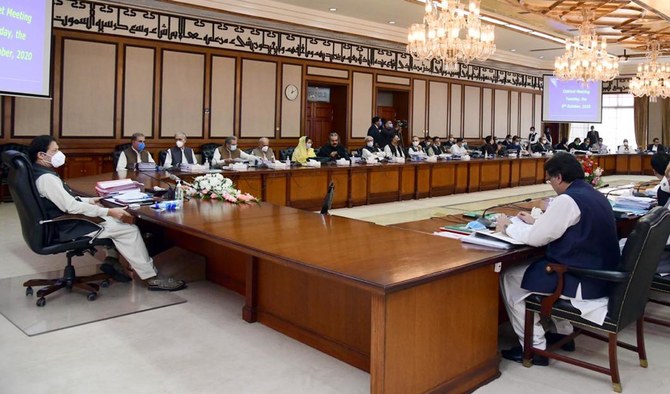
ISLAMABAD: Pakistan’s federal cabinet on Tuesday distanced itself from cases registered against ex-premier Nawaz Sharif, his daughter Maryam Nawaz and dozens of their leaders on charges of sedition, saying Prime Minister Imran Khan and his government were not behind the development.
The Punjab Police booked all these leaders on sedition charges on Monday, following a complaint by a private citizen who claimed that these Pakistan Muslim League-Nawaz (PML-N) politicians were “conspiring” against the country and state institutions.
However, the opposition termed the charges as part of the government’s “political victimization” campaign, with human rights bodies urging the ruling Pakistan Tehreek-e-Insaf (PTI) administration to withdraw the cases.
“Don’t bring Imran Khan and the government into it,” Senator Shibli Faraz, Federal Minister for Information and Broadcasting, told the media while briefing them about the cabinet meeting in Islamabad earlier in the day.
The minister said the Punjab government would investigate the matter to ascertain the complainant’s identity.
“Are all the FIRs in Pakistan registered with Prime Minister Imran Khan's approval,” he asked, adding that anybody can file a police case against anyone under the law.
The opposition, including Sharif’s PML-N party, convened a multiparty conference last month and formed the Pakistan Democratic Movement alliance to overthrow the government.
The conference also accused the country’s powerful military of meddling in politics and rigging the 2018 elections that brought Khan into power.
While the prime minister claimed that Sharif was getting India’s assistance to weaken Pakistan by criticizing its army, Faraz maintained that the government was not in the business of branding anyone a traitor.
“We don’t say who is a traitor and who isn’t,” he said. “We are saying that if you speak the language of the enemy, then there is no need to say that you are a patriot.”
Reiterating Khan’s claim, he accused the opposition of toeing the agenda of the country’s enemies like India that was trying to push Pakistan into the Financial Action Task Force’s (FATF) blacklist. “The opposition leaders are promoting the enemy’s narrative to protect its self-interest,” he said.
“I want to inform the public that let them [the opposition] do whatever they want since we don’t care about them and are focusing on public welfare projects,” he added.
The minister said the cabinet was given a detailed briefing on the performance of Pakistan International Airlines (PIA) whose liabilities had crossed over Rs400 billion. However, he informed that the airline’s revenue had increased for the first time by Rs7.8 billion despite the coronavirus pandemic and other challenges.
“Its overall performance has also improved,” he said. “The cabinet paid tribute to PIA management for repatriating 250,000 Pakistanis from different countries after virus-related lockdowns.”
The minister said the country had failed to achieve the target of wheat and cotton production due to torrential rains and floods.
“Unfortunately, we won’t be able to achieve the target of cotton production due to climate change,” he said, adding that torrential rains and floods had hit the cotton crop hard.


![]()

Pakistani cabinet distances itself from sedition charges against opposition leaders
Short Url
https://arab.news/yac5d
Pakistani cabinet distances itself from sedition charges against opposition leaders
- Police booked ex-premier Nawaz Sharif, his daughter and dozens of their party leaders for ‘conspiring’ against state institutions
- PIA revenue increased by Rs7.8 billion despite the pandemic and other challenges, says information minister
Latest updates


© 2026 SAUDI RESEARCH & PUBLISHING COMPANY, All Rights Reserved And subject to Terms of Use Agreement.