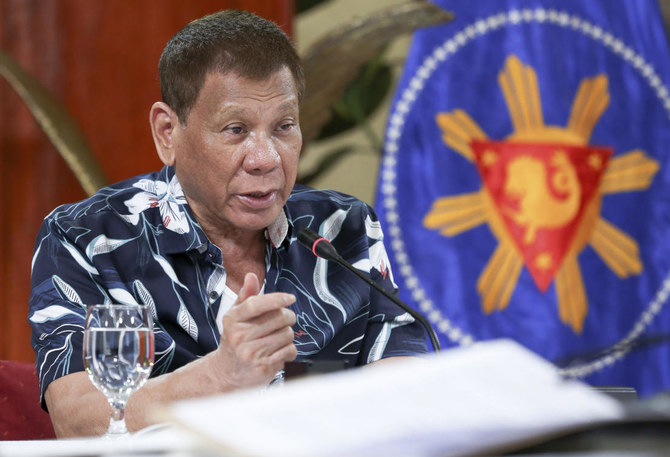
MANILA: Philippine President Rodrigo Duterte said that like his fierce critics, he has also suspected that extrajudicial killings may have happened under his drug crackdown that has killed thousands of people.
He said in televised remarks Monday night he had once inquired into the brutal deaths and was told some drug dealers may have been killed due to rivalry among syndicates or for stealing drug money.
More than 5,800 suspects have been killed and 256,000 arrested since Duterte took office in mid-2016. Human rights groups have alleged many of the killings were rub-outs, but Duterte and the police said that most were suspects who were gunned down when they fought back.
Western governments have called for an independent investigation into the killings, which have continued even during the coronavirus pandemic, but Duterte has dismissed such calls as meddling into his country’s affairs.
“This extrajudicial killing, they have been harping for many years. Truthfully, I also suspect, and there was a time when I conducted a discreet hearing,” the brash-talking Duterte said.
“What reached me is that, sometimes, there is a rivalry of the turf,” he said, adding that other drug dealers may have been killed by gangsters for running away with the drugs and the money.
“I know that, whether I like it or not, there is a war going on. I cannot stop the killings, the killing of criminals and the killing of my soldiers and policemen,” he said.
An International Criminal Court prosecutor has been examining complaints of crimes against humanity over the drug killings under Duterte but has not declared whether there is adequate evidence to start a formal inquiry.
Duterte also Tuesday ordered authorities to destroy large volumes of seized drugs in one week, citing past instances when seized drugs were resold by rogue officers. Only a small part of the confiscated drugs should be stored as evidence in ongoing drug trafficking cases, Duterte said, and expressed hope the courts would allow the move. He said he plans to inspect seized drugs stored in warehouses.
“Why do we have to put on our shoulder the burden of keeping a contraband or merchandise that can be stolen and used, and recycled? Duterte asked. “Because of the huge amount of shabu that we cannot guard every day, even one spoonful of it that gets lost, the government will get the blame.”
Shabu is the local name for methamphetamine, a prohibited stimulant widely trafficked in the Philippines. Since his crackdown started in 2016, more than 7,000 kilograms of methamphetamine, with a street value of $1 billion, have been seized, along with smaller quantities of cocaine, marijuana and party drugs, officials said.
Human rights lawyer Edre Olalia said Duterte’s remarks deflect public attention to the failure of his campaign to end the drug problem, which continues significantly, and the massive injustice over the killings of thousands of mostly poor suspects.
“It’s another one of those populist messaging that camouflages the dismal failure of the mailed-fist bloodbath on drugs,” Olalia said.


![]()

Philippine president Duterte suspected extrajudicial killings in drug crackdown
Short Url
https://arab.news/9hpzb
Philippine president Duterte suspected extrajudicial killings in drug crackdown
- More than 5,800 suspects have been killed and 256,000 arrested since President Rodrigo Duterte took office in mid-2016


Latest updates



© 2026 SAUDI RESEARCH & PUBLISHING COMPANY, All Rights Reserved And subject to Terms of Use Agreement.