

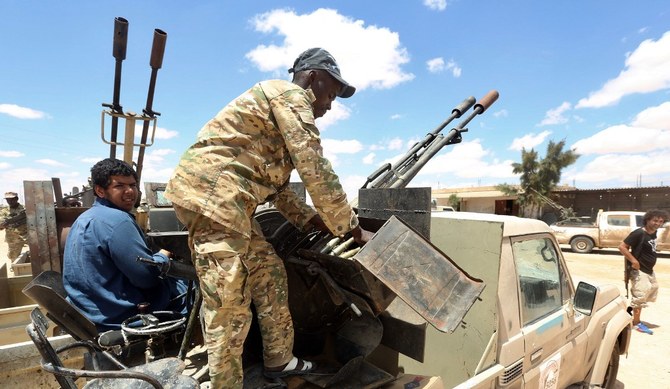

NEW YORK: UN Secretary-General Antonio Guterres has urged all those involved in the conflict in Libya to work toward a lasting ceasefire, and contribute to peace efforts “not only in words but in actions.”
He also called for the “full and unconditional implementation” of a Security Council arms embargo on the country, and said that it is “a scandal” that some nations are violating it by continuing to supply weapons and other military support.
Guterres was speaking on Monday at the start of a high-level summit on the crisis in Libya, which was co-hosted by the UN and Germany on the sidelines of the UN’s 75th General Assembly. The virtual meeting took place amid growing international pressure on both sides in the conflict to avoid an assault on the strategic city of Sirte.
The participants included the foreign ministers of countries that attended the Berlin Conference on Libya in January, senior members of key regional organizations, and representatives from neighboring countries, including Algeria, Chad, Niger, Sudan and Tunisia, as well as Morocco and South Africa.
Guterres noted that the truce in Sirte is holding, and said he is “encouraged” by the lull in fighting in recent months. Resolving the Libyan crisis is a top priority for the UN, he added.
The number of civilians killed during the conflict has fallen sharply. According to the UN Support Mission in Libya (UNSMIL), there were at least 19 civilian casualties between June and September 2020, compared with at least 358 between April and June.
Guterres welcomed recent peace overtures, including separate appeals by Prime Minister Fayez Al-Sarraj and the Speaker of the House of Representatives Aguila Saleh, for a ceasefire, the lifting of the oil blockade and a return to the political process.
Al-Sarraj, who has announced his intention to step down as PM by the end of this month, is head of the Government of National Accord, which is based in Tripoli. Eastern Libya and much of the south is controlled by rival administration the House of Representatives, which is backed by the Libyan National Army led by Gen. Khalifa Haftar.
Guterres called on all sides to participate in proposed meetings at the UN in Geneva in the coming weeks to discuss military issues.
“The conflict has been going on for far too long, and today we have an opportunity to recommit to its ending,” he said. The announcement by Al-Sarraj last month that he will resign and hand over power at the end of October provides an additional impetus for peace talks, the UN chief added. Such moves could help “carve out a process that will lead the country back to sustainable peace, stability and development,” he said.
Guterres added that while the Libyan factions should clearly be expected to “fully shoulder their responsibilities,” he also urged delegates to hear his call for “all outside parties with influence” to “put peace first.”
Stephanie Williams, the acting head of UNSMIL described the talks during the summit as being very candid discussions among major players. She added that weapons, mercenaries and equipment “are still pouring into Libya … on both sides.” This “risks miscalculations on the ground” and poses “a direct threat to Libya’s neighbors,” she added.
She also called for the immediate closure of migrant detention centers in Libya, which “remain abhorrent.”
“We continue to receive reports of arbitrary or unlawful detention, torture, enforced disappearances, extrajudicial killings and sexual violence in all places of detention,” Williams said after the summit.
According to UNSMIL, about 3,300 men, women and children, including unaccompanied minors, remain in detention in Libya. Many were detained while trying to reach Europe.
Williams reiterated warnings that Libya “is not a safe port” for migrants and asylum seekers. The UN Security Council unanimously adopted a German-sponsored resolution on Friday authorizing member nations to inspect and seize vessels off the coast of Libya suspected of smuggling migrants.
Germany has been acting as an intermediary in the Libyan conflict. Its representatives said Monday’s summit offered a chance to review developments since the Berlin Conference in January, at which the participants agreed to respect an arms embargo and push for a full ceasefire.
“A few weeks ago, I wouldn’t have been able to say this: there are reasons for cautious optimism,” German Foreign Minister Heiko Maas said after the meeting. “We are seeing increasing signs of a shift in thinking from military to political logic.
“We have always said that stabilizing Libya is not a sprint but a marathon. But after a phase where things even seemed to be moving backward in recent months, it’s good to be able to say we’ve managed another kilometer today.”
However, Arab League Secretary-General Ahmed Aboul Gheit was more cautious, saying that the situation in Libya remains “fragile and complex.”
Williams said the first face-to-face military talks between five representatives of each of the warring parties are due to take place in Geneva “in the next couple of weeks.”


