

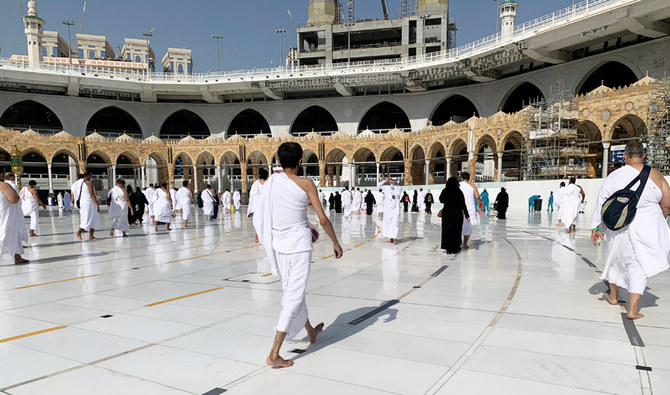

MAKKAH: After careful coordination and planning, the first phase of the resumption of Umrah has brought joy to Muslims everywhere, but hard work still lies ahead for authorities ensuring the safety of pilgrims at the Makkah Grand Mosque, officials say.
Saudi Deputy Minister of Hajj and Umrah Dr. Abdulfattah bin Sulaiman Mashat said that the decision to restore Umrah had made Muslims in Saudi Arabia and abroad very happy. “The plan (has been) developed in coordination with all relevant authorities, and all authorities concerned with Hajj and Umrah are cooperating and coordinating according to one plan,” he said.
He added that all phases will be assessed and reviewed to ensure successful implementation. A meeting with the Ministry of Health will be held after the second phase to determine the list of countries that will be open to Umrah, as well as the number of pilgrims to perform Umrah through the Eatmarna app.
The app not only provides Umrah licenses but allows pilgrims to book transportation from parking lots to the Grand Mosque. The app will soon cover other services such as hotel bookings.
Serving pilgrims has always been a priority in Saudi Arabia, since its establishment by founder King Abdul Aziz. “The Ministry of Hajj and Umrah is monitoring and improving services to provide pilgrims with a beautiful and memorable spiritual journey,” the deputy minister said.
FASTFACT
Serving pilgrims has always been a priority in Saudi Arabia, since its establishment by founder King Abdul Aziz.
Dr. Wael Hamzah Mutair, director general of Makkah Health Affairs, told Arab News that the central area had been fully prepared to receive pilgrims, in line with plans developed by coordination committees. Dr. Mutair said that social distancing between pilgrims was being observed and health measures taken by all hospitals near the central area surrounding the Grand Mosque to be ready to deal with any emergency.
“Emergency centers in the central area are highly efficient and provided with modern medical equipment and treatment services to deal with the pandemic,” he told Arab News. “Field teams have been deployed inside the Grand Mosque to ensure pilgrims and relevant authorities’ commitment to health measures.”
Osama Samkari, general director assistant for transport at the General Syndicate of Cars at the Grand Mosque, said the syndicate has provided 50 buses to transport the groups of pilgrims. Each group includes 200 pilgrims, who are granted three hours to perform Umrah rituals; beginning and ending in the triage areas.
“Pilgrims are given access to free parking before being transported in sterilized buses to and from the Grand Mosques, in line with the precautionary measures,” he said.
Pilgrims assembling at each area will need to be aware of the time needed to reach their starting point and are advised to be ready at the check points well ahead of schedule.


