

TWITTER POLL: Turkey behind escalation between Azerbaijan and Armenia, almost half of Arab News readers say

1 / 2
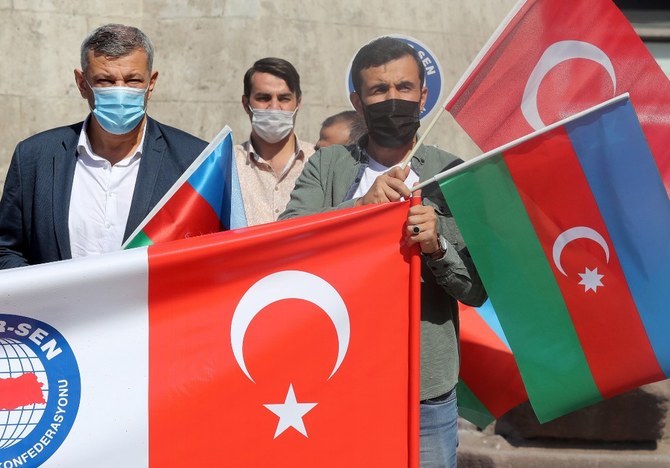
Turkish demonstrators participate in a rally in support of Azerbaijan against Armenia in Ankara on October 1, 2020. (AFP)
2 / 2
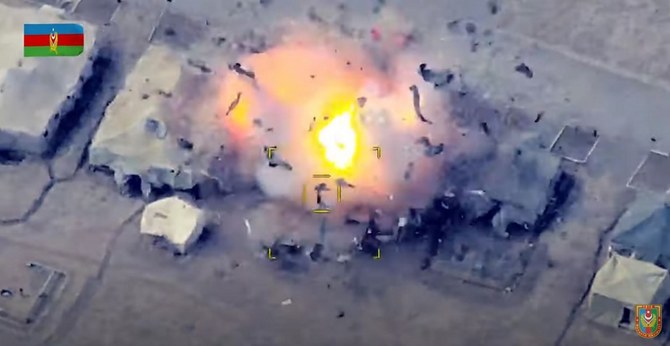
An image grab taken from a video made available on the official web site of the Azerbaijani Defence Ministry on October 2, 2020, allegedly shows Azeri units destroying an Armenian field control post during fighting over the breakaway Nagorno-Karabakh region. (AFP)
Short Url
Updated 04 October 2020
Follow

TWITTER POLL: Turkey behind escalation between Azerbaijan and Armenia, almost half of Arab News readers say

DUBAI: Almost half of Arab News readers think Turkey is behind the escalation of conflict between Azerbaijan and Armenia, a Twitter poll showed.

About a quarter of readers also believe that while Turkey may not have a direct hand in the flare-up between the Caucasus neighbors over the contentious Nagorno-Karabakh region, Ankara however stands to benefit from it. About a quarter of Arab News readers meanwhile said they had no knowledge of Turkey’s involvement.

Turkish President Recep Tayyip Erdogan was the first world leader to wade into the conflict, not to soothe tensions between the warring parties but to declare his all-out support of the Azerbaijanis.

Turkey provides weapons and training to Azerbaijan, but has denied Armenia’s claims that it was sending Syrian fighters and F-16 combat jets to assist Azerbaijani forces in the fighting.

A full-scale war between the former Soviet republics could drag in other powers such as Russia, which has a defense pact with Armenia, whose policy of neutrality over the simmering conflict according to experts was being tested by Ankara’s supposed involvement.

Nagorno-Karabakh was a designated autonomous region within Azerbaijan during the Soviet era. It claimed independence from Azerbaijan in 1991, about three months before the Soviet Union’s collapse.

A full-scale war that broke out in 1992 killed an estimated 30,000 people.

By the time the war ended in 1994, Armenian forces not only held Nagorno-Karabakh itself but substantial areas outside the territory’s formal borders.

Take our new poll


Cambodia takes back looted historic artifacts handled by British art dealer

Updated 28 February 2026
Follow

Cambodia takes back looted historic artifacts handled by British art dealer

  • The objects were returned under a 2020 agreement between the Ministry of Culture and Fine Arts and the family of the late Douglas Latchford, a British art collector and dealer who allegedly had the items smuggled out of Cambodia

PHNOM PENH, Cambodia: Cambodian officials on Friday received more than six dozen historic artifacts described as part of the country’s cultural heritage that had been looted during decades of war and instability.
At a ceremony attended by Deputy Prime Minister Hun Many, the 74 items were unveiled at the National Museum in Phnom Penh after their repatriation from the United Kingdom.
The objects were returned under a 2020 agreement between the Ministry of Culture and Fine Arts and the family of the late Douglas Latchford, a British art collector and dealer who allegedly had the items smuggled out of Cambodia.
“This substantial restitution represents one of the most important returns of Khmer cultural heritage in recent years, following major repatriations in 2021 and 2023 from the same collection,” the Culture Ministry said in a statement. “It marks a significant step forward in Cambodia’s continued efforts to recover, preserve, and restore its ancestral legacy for future generations.”
The artifacts were described as dating from the pre-Angkorian period through the height of the Angkor Empire, including “monumental sandstone sculptures, refined bronze works, and significant ritual objects.” The Angkor Empire, which extended from the ninth to the 15th century, is best known for the Angkor Wat archaeological site, the nation’s biggest tourist attraction.
Latchford was a prominent antiquities dealer who allegedly orchestrated an operation to sell looted Cambodian sculptures on the international market.
From 1970 to the 1980s, during Cambodia’s civil wars and the communist Khmer Rouge ‘s brutal reign, organized looting networks sent artifacts to Latchford, who then sold them to Western collectors, dealers, and institutions. These pieces were often physically damaged, having been pried off temple walls or other structures by the looters.
Latchford was indicted in a New York federal court in 2019 on charges including wire fraud and conspiracy. He died in 2020, aged 88, before he could be extradited to face charges.
Cambodia, like neighboring Thailand, has benefited from a trend in recent decades involving the repatriation of art and archaeological treasures. These include ancient Asian artworks as well as pieces lost or stolen during turmoil in places such as Syria, Iraq and Nazi-occupied Europe. New York’s Metropolitan Museum of Art is one of the prominent institutions that has been returning illegally smuggled art, including to Cambodia.
“The ancient artifacts created and preserved by our ancestors are now being returned to Cambodia, bringing warmth and joy, following the country’s return to peace,” said Hun Many, who is the younger brother of Prime Minister Hun Manet.