

DNA, phone records, Facebook: How police nabbed key suspect in Pakistan motorway rape case

Pakistani policemen search vehicles on a link road to Pakistan's intercity motorway in Lahore on Nov. 3, 2009. (AFP/File)
Short Url
Updated 03 October 2020
Follow

DNA, phone records, Facebook: How police nabbed key suspect in Pakistan motorway rape case

  • Though Abid Ali is still at large, his cellphone records led police to a second suspect, Shafqat Ali, who was arrested on September 14
  • Protests and public outcry have kept much needed pressure on authorities to solve the case and do more to stem violence against women 

LAHORE: It was 48 hours after a woman was gang-raped in front of her children last month that police made their first breakthrough in a case that has shocked and outraged the nation.
On September 11, authorities matched one of two sets of DNA evidence from the scene of the crime along a major Pakistani highway with a 27-year-old man called Abid Ali who had previously been charged with rape and sexual assault.
Therein began a manhunt that has continued to date, as rights activists and citizens have demanded that the Pakistani government do more to stem violence against women, including ensuring perpetrators are held accountable in a country that has seen at least 3,500 rapes this year, according to the group War Against Rape.
In the most recent incident, public outcry has at least kept pressure on authorities to solve the case.
Arab News contacted Senior Superintendent of Police Investigation Zeeshan Asghar, Deputy Inspector General Investigation Shehzad Sultan, and Fiza Mumtaz, a female police officer who is a member of the joint investigation team probing the case. Despite repeated texts and calls, the officers did not respond. Punjab Law Minister Raja Basharat could also not be reached after several calls.
The following account is based on interviews with two senior police officials in Punjab who are directly involved in the investigation. Both requested anonymity as they are not authorized to speak to the media about the case.
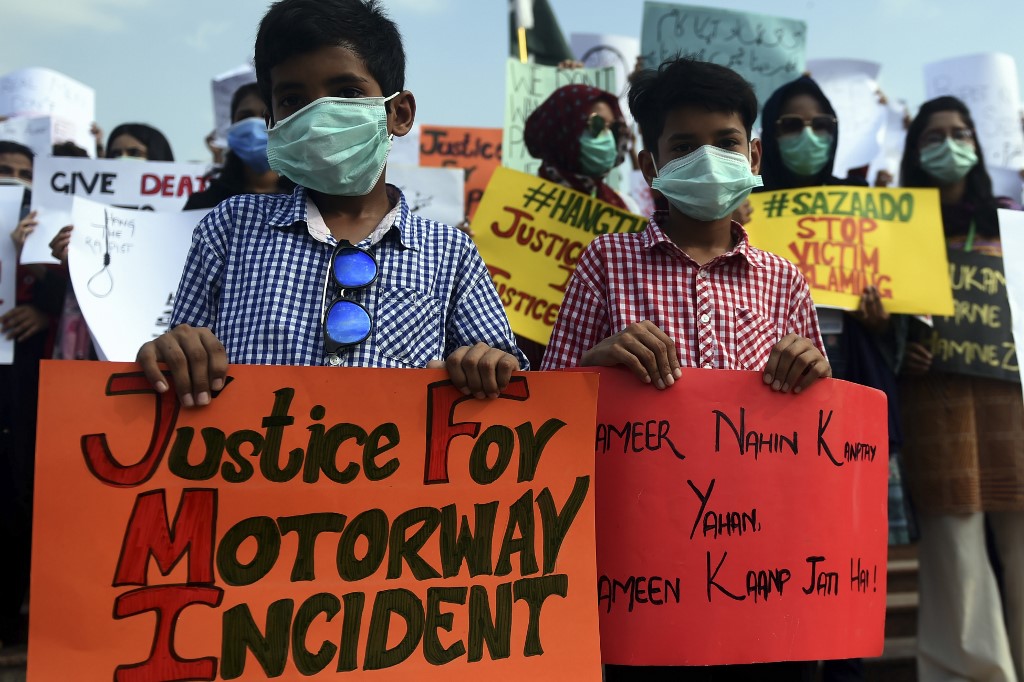


Members of VCare Welfare Trust hold placards during a protest in Karachi on Sept. 13, 2020, after a gruesome gang rape of a woman in front of her two children after her car ran out of fuel near the eastern city of Lahore late on Sept. 9. (AFP)

Last month, after police identified Ali as a suspect, they matched his identity card number to four cell phone numbers, and discovered that one had been switched on on the night of the attack and he had received text message notifications from his cellular company on it, one senior Punjab police official said. This one-way exchange allowed police to place him near the scene of the crime at the time the rape took place, the senior police official said.
Though Ali is still at large, his cellphone records then led police to a second suspect, Shafqat Ali, who was arrested on September 14.
Police trawled through Ali’s phone records for frequent callers and then widened the search to the call records of his family members to see if they were in touch with someone who could be placed near the motorway on the night of the rape.
“We finally got a phone number [of the second accused],” the senior police officer said. And though the phone was switched off when police called, they were able to determine that it was last used in Punjab province’s Okara district.
At this point, the chief of Punjab police said in a press conference that officials had identified a felon named Waqar ul Hassan as the second suspect in the case.
“We are 95-96% sure that this [Hassan] is the man because his phone was also in that location,” the top cop told reporters.
He was wrong. In fact, Shafqat Ali had been using a SIM registered under Hassan’s name, which led police to mistakenly believe Hassan was a suspect, a second officer involved in the investigation told Arab News.
“Waqar’s image was mistakenly being run in the media” as the accomplice, Nayab Haider, the spokesperson of the Punjab police, told Arab News over the phone, saying when police questioned Hassan, he revealed that a day laborer named Shafqat Ali had recently become a close associate of Abid Ali.
Police dugout Shafqat’s ID card but discovered that the picture on it was too old to be able to help identify him. So they turned to social media and found a Facebook account with more recent pictures of the suspect.
Teams were then quickly sent to comb through villages in Okara, where the phone number Shafqat was using was last switched on. Photographs of the suspect were shown to residents, asking for leads.
Finally, on September 14, six days after the gang-rape, the Counter-Terrorism Department found Shafqat hiding in a house in Okara. His DNA samples matched the samples found on the rape survivor’s clothes.
Police are still on the hunt for Ali, and say that in the last two weeks, they have come close to arresting him at least twice.
“It seems that he is hiding in one place and not getting out,” the police spokesperson said. “Since his picture is now viral, I don’t think anyone will give him refuge. People are really angry. So where can he escape to?”


Karachi hosts scaled-down Lux Style Awards as industry reflects on recognition, evolving formats, inclusion

Updated 5 sec ago
Follow

Karachi hosts scaled-down Lux Style Awards as industry reflects on recognition, evolving formats, inclusion

  • 24th edition of prestigious awards held at historic Mohatta Palace after the ceremony in May was canceled
  • Awards introduce new Digital Content Creators category amid changing entertainment and media landscape

KARACHI: Pakistan’s entertainment industry gathered in Karachi on Thursday for a smaller, more intimate ceremony marking the cc, as artists reflected on the importance of recognition, evolving formats and broader inclusion across creative fields.

The awards, considered Pakistan’s longest running and most prestigious entertainment honors, were held at the Mohatta Palace, a departure from previous large-scale events at the Karachi Expo Center. 

Actress Sanam Saeed, who co-hosted the evening, described the ceremony as “small and intimate,” a tone echoed by several attendees.

The scaled-down format followed an unusual year for the awards. The 23rd Lux Style Awards, scheduled to take place in Lahore in May, were canceled amid the brief war between Pakistan and India, with winners announced digitally and trophies delivered to recipients’ homes.

Among the prominent stars attending this year’s ceremony were Fahad Mustafa, Hania Aamir, Mawra Hocane and Yumna Zaidi. Aamir, who won Actor of the Year – Female (Viewers’ Choice), for the hit television drama Kabhi Main Kabhi Tum, said award platforms play a vital role in sustaining creative industries.

“It’s extremely important to appreciate the art that comes out of your country,” she told Arab News at the red carpet. The drama, she noted, resonated beyond Pakistan, trending in Bangladesh and India during its broadcast.

The picture shows entrance of the 24th Lux Style Awards in Karachi, Pakistan, on December 11, 2025. (AN photo)

Addressing fans abroad, Aamir, arguably Pakistan’s most popular celebrity internationally, said:

“Thank you so much for loving beyond borders. We love you as much even more. So thank you so much for appreciating all the hard work that we do.”

She also called for broader recognition across productions. 

“I’d like Lux [Style Awards] and every other award show to have a lot more diverse categories to appreciate every single person who is a part of the team. [And] who actually makes the project come to life.”

The Lux Style Awards have long attracted debate over transparency and credibility, a recurring discussion whenever nominations and winners are announced. 

Still, many artists said the platform remains essential for motivation and visibility.

“Whenever we discuss the awards, no award will be fair because some people will have certain reservations with it,” producer Abdullah Seja of iDream Entertainment told Arab News. “These might be the most authentic awards in Pakistan [but] obviously there is room for improvement in everything.”

Reflecting shifts in Pakistan’s creative economy, the awards introduced a separate category this year for Digital Content Creators. The inaugural trophy went to real-life couple Rabya Kulsoom and Rehan Nazim, known online as ‘Ron and Cocco’.

“The credit goes to Lux [Style Awards] for introducing the category because content creation is not easy,” Nazim said. “Whoever is doing it, it’s a difficult job. And now it has become a full-time job. You can’t take it lightly and do it on the side. So, we need to recognize the people who are doing it.”

Actress Yumna Zaidi, who won her first film award for Nayab, described the ceremony’s return to Karachi as significant. 

“I am so glad that it’s happening in Karachi because it’s been a while,” she said, adding, “Lux [Style Awards] are the strongest because it includes nominations from all the channels and it’s the strongest [competition].”

Mawra Hocane, whose drama Jafaa was nominated for TV Play of the Year (Critics’ Choice), said meaningful storytelling mattered more than trophies. 

“Platforms [like these] are very very important but more than that what’s important is that a project strikes a chord with the audience,” she said.

“I do my projects so that we can work on the position of women in society. [And] somehow elevate them, somehow create some space for them. And I think ‘Jafaa’ has done that.”

Music remained a central draw of the evening. 

Co-host Sanam Saeed said she was particularly looking forward to live performances. 

“Music is the kind of genre that bonds people together and puts Pakistan on the map,” she said. 
“We become one when it comes to music, forgetting all the distance, limitations and borders. [And] Our music does that.”

Singer and songwriter Hasan Raheem, popular among younger audiences, also performed during the ceremony and reflected on the value of such platforms. 

“These [platforms] are important, honestly,” he said. “I feel like things like these should happen because the real present and the gift that I personally get is the love from people that is the epitome of all the awards. I can never get a better award than that.”