UK removes Turkey from ‘travel-free corridor’ amid disputed COVID statistics

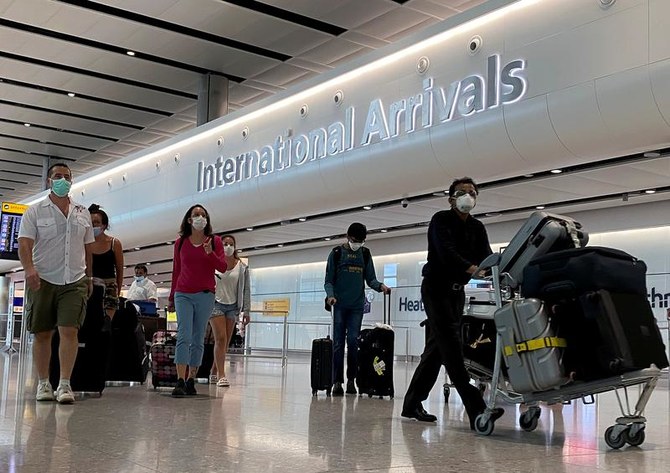
After Ankara announced that it has not published the full number of daily positive COVID-19 cases, European countries - including the UK - have begun revising their travel precautions regarding Turkey. (Reuters/File Photo)
Short Url
Updated 02 October 2020
Follow

UK removes Turkey from ‘travel-free corridor’ amid disputed COVID statistics

  • The UK quickly removed Turkey from its quarantine-free list after the statement of Turkish Health Minister Fahrettin Koca
  • European countries such as the Netherlands and Ireland are already placing travelers returning from Turkey under quarantine for 15 days

ANKARA: After Ankara announced that it has not published the full number of daily positive COVID-19 cases, European countries have begun revising their travel precautions regarding Turkey.

The UK quickly removed Turkey from its quarantine-free list after the statement of Turkish Health Minister Fahrettin Koca that official figures include only symptomatic COVID-19 cases.

British Transport Minister Grant Shapps said on Oct. 1: “The Turkish Health Ministry has been defining the number of new COVID-19 cases in a different way to the definition used by international organisations such as the World Health Organization (WHO) and the European Centre for Disease Prevention and Control, so we have updated our risk assessment for the country.”

Accordingly, Turkish travelers arriving in England and Scotland are obliged to self-isolate for two weeks starting from Oct. 3, officials said as they expanded their COVID-19 quarantine lists.

The penalty for breaching self-isolation rules has also been increased to £10,000 ($13,000).

Other European countries may follow suit over the fear that a huge spike in new cases had been covered up, experts say.

European countries such as the Netherlands and Ireland are already placing travelers returning from Turkey under quarantine for 15 days, and do not allow the entry of Turkish citizens unless they have dual citizenship or residency permit.

“From the perspective of European countries, it is totally understandable to protect their own citizens from passengers arriving from risky countries,” Prof. Guner Sonmez, a radiologist from Uskudar University in Istanbul, told Arab News.

“However, it is a massive blow for the Turkish travel industry and its economy and could place Turkey among untrustworthy countries.” 

Before the pandemic, Turkey ranked sixth in the world for the number of tourists it attracts, according to the UN World Tourism Organization figures.

Turkey’s divergence from the international norms for calculating its COVID-19 data has created a big concern about the government’s transparency and data processing, according to Dr. Ergin Kocyildirim, who is a pediatric cardiothoracic surgeon and an assistant professor in the Department of Cardiothoracic Surgery at the University of Pittsburgh’s School of Medicine.

“There are international public health measures especially for airline travel. In these circumstances, any public health data processing or projection are void due to the Turkish data sharing and processing methods,” he said.

Turkey’s official COVID figures have long been disputed by medical organizations and opposition politicians. The number of new COVID-19 cases in Turkey on Sept. 10 was about 20 times more than the official figures, according to a document that was recently revealed by opposition lawmaker Murat Emir.

Kocyildirim thinks that one of the main reasons for the current state of the outbreak in Turkey is the lack of robust data collecting and processing.

“I hope the Turkish Health Minister will apologize for his mistakes and will make a fresh start to create the core level of public trust,” he said.

Prof. Sonmez expects that other countries may also exempt Turkey from their travel corridor amid pandemic restrictions.

“From now on, all official figures are likely to be questioned and will spark concerns about the transparency of health management in Turkey,” he said.

Following Turkey’s announcement, WHO asked for more detailed information from the Turkish Health Ministry, and advised the country to isolate all positive cases, both symptomatic and asymptomatic ones, in order to break the contagion effectively.

The Turkish Medical Association (TTB) responded to Koca’s revelations by releasing a statement saying, “We have been declaring this for six months. You haven’t run the process transparently. You have hidden the truth. You haven’t prevented the spread of the disease.”

Caghan Kizil, a neuroscience and genetics expert at Dresden University's Faculty of Medicine, noted that the main non-pharmaceutical prevention route for the pandemic is to reduce the community transmission of the virus by isolating all infected individuals and documenting all these cases. 

“As Turkey’s strategy was declared to be documenting only the hospitalized COVID cases, this poses a threat for the control of the pandemic. Asymptomatic cases are capable of spreading the virus, and if these people are not documented or officially listed, the community virus load might be higher than anticipated. This will necessitate measures for other countries to protect themselves and therefore revisit their travel regulations for Turkey,” he told Arab News. 


Trump says Iran ‘want to negotiate’ after reports of hundreds killed in protests

Updated 57 min 24 sec ago
Follow

Trump says Iran ‘want to negotiate’ after reports of hundreds killed in protests

  • US President Donald Trump said Sunday that Iran’s leadership had called him seeking “to negotiate” after he repeatedly threatened to intervene militarily if Tehran killed protesters

WASHINGTON: US President Donald Trump said Sunday that Iran’s leadership had called him seeking “to negotiate” after he repeatedly threatened to intervene militarily if Tehran killed protesters.
For two weeks, Iran has been rocked by a protest movement that has swelled in spite of a crackdown rights groups warn has become a “massacre.”
Initially sparked by anger over the rising cost of living, the demonstrations have evolved into a serious challenge of the theocratic system in place since the 1979 revolution.
Information has continued to trickle out of Iran despite a days-long Internet shutdown, with videos filtering out of capital Tehran and other cities over the past three nights showing large demonstrations.
As reports emerge of a growing protest death toll, and images show bodies piled outside a morgue, Trump said Tehran indicated its willingness to talk.
“The leaders of Iran called” yesterday, Trump told reporters aboard Air Force One, adding that “a meeting is being set up... They want to negotiate.”
He added, however, that “we may have to act before a meeting.”
The US-based Center for Human Rights in Iran (CHRI) said it had received “eyewitness accounts and credible reports indicating that hundreds of protesters have been killed across Iran during the current Internet shutdown.”
“A massacre is unfolding,” it said.
The Norway-based NGO Iran Human Rights (IHR) said it confirmed the killing of at least 192 protesters but that the actual toll could be much higher.
“Unverified reports indicate that at least several hundreds, and according to some sources, more than 2,000 people may have been killed,” said IHR.
More than 2,600 protesters have been arrested, IHR estimates.
A video circulating on Sunday showed dozens of bodies accumulating outside a morgue south of Tehran.
The footage, geolocated by AFP to Kahrizak, showed bodies wrapped in black bags, with what appeared to be grieving relatives searching for loved ones.
Near paralysis
In Tehran, an AFP journalist described a city in a state of near paralysis.
The price of meat has nearly doubled since the start of the protests, and many shops are closed. Those that do open must close at around 4:00 or 5:00 pm, when security forces deploy en masse.
There were fewer videos showing protests on social media Sunday, but it was not clear to what extent that was due to the Internet shutdown.
One widely shared video showed protesters again gathering in the Pounak district of Tehran shouting slogans in favor of the ousted monarchy.
The protests have become one of the biggest challenges to the rule of supreme leader Ayatollah Ali Khamenei, 86, coming in the wake of Israel’s 12-day war against the Islamic republic in June, which was backed by the United States.
State TV has aired images of burning buildings, including a mosque, as well as funeral processions for security personnel.
But after three days of mass actions, state outlets were at pains to present a picture of calm returning, broadcasting images of smooth-flowing traffic on Sunday. Tehran Governor Mohammad-Sadegh Motamedian insisted in televised comments that “the number of protests is decreasing.”
The Iranian government on Sunday declared three days of national mourning for “martyrs” including members of the security forces killed.
President Masoud Pezeshkian also urged Iranians to join a “national resistance march” Monday to denounce the violence.
In response to Trump’s repeated threats to intervene, Iran’s parliament speaker Mohammad Bagher Ghalibaf said Iran would hit back, calling US military and shipping “legitimate targets” in comments broadcast by state TV.
‘Stand with the people’
Reza Pahlavi, the US-based son of Iran’s ousted shah, who has emerged as an anti-government figurehead, said he was prepared to return to the country and lead a democratic transition.
“I’m already planning on that,” he told Fox News on Sunday.
He later urged Iran’s security forces and government workers to join the demonstrators.
“Employees of state institutions, as well as members of the armed and security forces, have a choice: stand with the people and become allies of the nation, or choose complicity with the murderers of the people,” he said in a social media post.
He also urged protesters to replace the flags outside of Iranian embassies.
“The time has come for them to be adorned with Iran’s national flag,” he said.
The ceremonial, pre-revolution flag has become an emblem of the global rallies that have mushroomed in support of Iran’s demonstrators.
In London, protesters managed over the weekend to swap out the Iranian embassy flag, hoisting in its place the tri-colored banner used under the last shah.