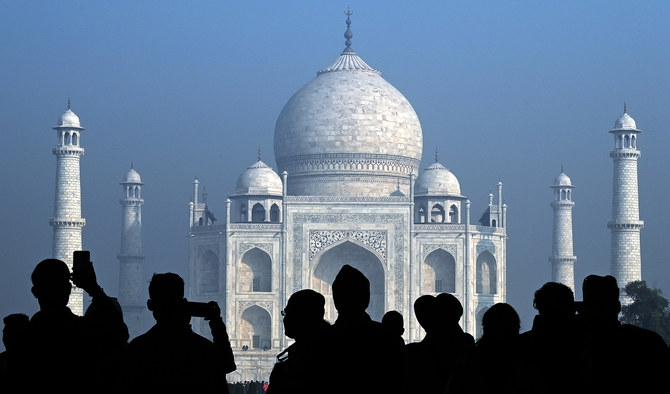

NEW DELHI: India’s ruling party has removed the Taj Mahal from an official tourism advert, in what historians say is an attempt to undermine the country’s Islamic heritage and further sideline its Muslim minority.
The removal of the 17th-century Mughal mausoleum — a UNESCO World Heritage Site — follows the recent erasure of Muslim city and town names in the country.
The tourism department of Uttar Pradesh, where the Taj Mahal is located, used World Tourism Day on Sept. 27 to release a newspaper advertisement with a list of the state’s top 20 tourist attractions. It included Hindu and Buddhist sites, but omitted the world-famous Mughal monument.
“By attacking and undermining Islamic history, the ruling party is trying to put the Indian Muslim minority into oblivion and deny them their civil and political rights, and if possible, their citizenship rights,” Farhat Hasan, a history professor at the University of Delhi, told Arab News.
“In order to deny Muslims their civil and political rights, you also need to deny them their rights over history, and this is what is being done now by undermining the Islamic heritage and undermining their political roles in the present,” Hasan added.
In 2017, when Uttar Pradesh Chief Minister Yogi Adityanath of the Bharatiya Janata Party (BJP) took office, the white marble mausoleum built in Agra by emperor Shah Jahan in 1632 was also left out of the official tourism booklet.
According to estimates, more than 6 million tourists visit Agra every year to see the Taj Mahal. In 2018 to 2019, the monument generated a revenue of over $13 million from both foreign and domestic tourists.
However, the tourism department denied it is undermining the Taj Mahal, and said it is trying to promote lesser-known sites.
“You are interpreting it differently. The whole world knows about the Taj Mahal, but we are just keen to promote the lesser known sites,” said Avinash Chandra Mishra, joint secretary of the Uttar Pradesh tourism department. He added that the promotion theme for this year was “rural tourism.”
He added: “People come to India to see the Taj Mahal. But alongside that we want the attention to go to lesser-known places. We know the Taj Mahal is our bread and butter. We cannot forget it. But there are other places also.
“We don’t want tourists to return from the state after seeing only the famous monument,” he said.
But despite these claims, work to erase Islam’s role in India’s heritage remains in full swing, historians warn.
Under the BJP government, cities founded by the Mughals — India’s rulers from the 16th to the 19th century — have been renamed. Allahabad was changed to Prayagraj, while Faizabad was renamed Ayodhya.
In a more recent move, the Uttar Pradesh chief minister changed the name of Agra’s Mughal Museum to the Chhatrapati Shivaji Maharaj Museum. While proposing the move, he reportedly said: “How can Mughals be our heroes?”
Rajeev Saxena, vice-president of the Tourism Guild of Agra, said: “It’s nothing new. The focus of the present regime is to promote religious sites and religious tourism.”
He added: “When Adityanath said that Mughals can’t be our heroes, it’s understood that the Taj Mahal and Agra would remain out of favor.”
Hasan said there is a “deep misconception” that the Mughal period constituted oppressive Muslim rule in India.
“On the contrary, it was a period when you had the beginning of a conducive and inclusive culture in India, which is actually our greatest achievement in history.
“I think their real problem is that this is the political class that has no sense of history and they are trained to be intolerant. Therefore they lack the vision to rule India,” he added.
Dhirendra K. Jha, a Delhi-based political analyst and author of “Shadow Armies: Fringe Organizations and Foot Soldiers of Hindutva,” said: “The project of the Hindu right-wing is to create division in the society in the name of religion.
“By ignoring Islamic heritage and pushing Muslims to the margin of politics, the whole attempt is to undermine the minorities of India.
“How can you think of ignoring the Taj Mahal, an internationally acclaimed monument. What is happening today is the aberration of history and I don’t think they will succeed in the long run,” he added.