ISLAMABAD: The government is in touch with Chinese authorities to help thousands of Pakistanis studying in China return to their colleges and universities despite coronavirus travel restrictions imposed by Beijing, the Foreign Office said this week.
China suspended the entry of foreign nationals in late March to stop the spread of COVID-19. Students who returned to Pakistan when the pandemic broke out are now unable to return to China and fear they may lose years of education, and end up not getting degrees.
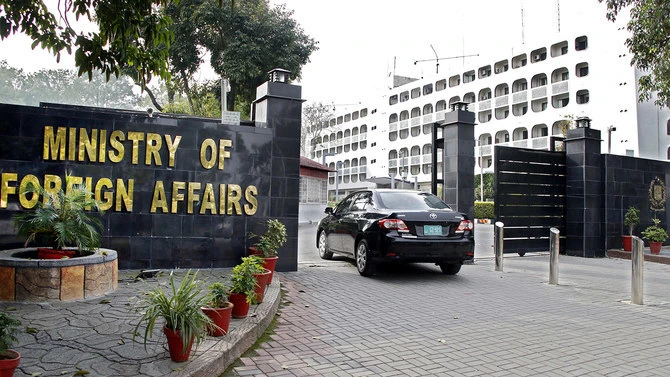
“We are constantly in touch with the Chinese authorities on the issue, and trying to resolve it as soon as possible,” Zahid Hafeez Chaudhri, the spokesperson for the Foreign Office, told Arab News.
He said that a dedicated Foreign Office team was pursuing the matter, saying the problem was not specific to Pakistan and Beijing had a uniform policy for all international students.
The Chinese embassy in Islamabad could not be reached for comment.
Approximately 28,000 Pakistani students are enrolled in Chinese educational institutions and about 5,000 are stuck in Pakistan.
“I will lose my medical degree if the Chinese government doesn’t allow me to rejoin my university in the next couple of weeks,” said Mishal Zubair, who is a final year undergrad student in medicine and surgery at the Wuhan University of Science and Technology.
Zubair returned to Pakistan in June on a special repatriation flight when the outbreak was at its peak in Wuhan city, where the coronavirus was first detected in China. She has since been taking online classes.
“Under Pakistani rules, if I fail to attend classes in person for two consecutive semesters, my medical degree won’t be recognized,” she said.
Pirah Channa, who is pursuing a doctoral degree in textiles from Zhejiang University in Hangzhou and has been back home since February, said she was facing communication problems during online classes because not all instructors had were fluent in English. “We are losing our precious time,” she said.
Students say they have written to the Foreign Office and the Chinese embassy in Islamabad to seek help, but have yet to receive a response.
“No government official and even the Chinese embassy in Islamabad are responding to our emails for visa extensions and updates on our courses,” Nasiruddin, an electronic engineering student at Southeast University in Nanjing, who has been in Pakistan since January, told Arab News.
He said some Chinese universities had engaged students in online classes, but that was not feasible for Pakistani students due to the time difference and poor Internet connectivity in many areas.
“I was planning to publish a paper by the end of this year on the basis of my research work in the university laboratory to complete my degree,” Nasiruddain said, “but for now that all stands upended.”

In touch with Beijing to help Pakistani students return to China — foreign office
https://arab.news/mmjqk
In touch with Beijing to help Pakistani students return to China — foreign office
- Around 5,000 Pakistani students cannot return to Chinese universities as foreign nationals are denied entry into the country due to coronavirus travel restrictions
- Students fear years of studies may go to waste if they are not allowed to resume classes in the coming weeks
Pakistan says IMF has not imposed new conditions under $7 billion bailout
- Finance ministry says measures cited as ‘new conditions’ are phased extensions of reforms already agreed
- Media described steps like civil servants’ asset disclosures and sugar industry deregulation as new demands
ISLAMABAD: Pakistan said on Sunday some of the reform measures mentioned in the media and linked to the International Monetary Fund (IMF) bailout program are not “new conditions” imposed by the lender but extensions of commitments already agreed under the arrangement.
Local media and social platforms have described a series of IMF-linked structural benchmarks as fresh conditions under the $7 billion loan for Pakistan in recent weeks. News reports published and broadcast in India also mentioned 11 measures under the loan, describing them as new IMF demands imposed on the country.
“The Ministry of Finance has clarified the intent, context, and continuity of reform measures under Pakistan’s IMF Extended Fund Facility (EFF) program, particularly in response to recent commentary regarding so-called ‘new conditions,’” said an official statement circulated in Islamabad.
“The purpose is to reaffirm that the measures referenced are part of a phased, medium-term reform agenda agreed with the IMF, many of which are extensions or logical progressions of reforms already initiated by the Government of Pakistan,” it added.
The ministry said the EFF is designed to support medium-term structural reforms implemented in a sequenced manner, with each program review building on prior actions to meet policy objectives agreed at the outset.
It provided detailed clarification on 11 measures that had been characterized as new conditions, including public disclosure of asset declarations of civil servants, strengthening the operational effectiveness of the National Accountability Bureau, empowering provincial anti-corruption bodies through access to financial intelligence and facilitating foreign remittances.
Other measures cited included the development of the local currency bond market, deregulation of the sugar industry, a comprehensive reform roadmap for the Federal Board of Revenue, a medium-term tax reform strategy, phased privatization of power distribution companies, regulatory reforms to strengthen corporate compliance and contingency measures to address potential revenue shortfalls.
The ministry said several of these reforms had been embedded in the Memorandum of Economic and Financial Policies (MEFP), a document detailing mutually agreed commitments, dating back to May 2024 and March 2025, including pledges related to tax policy, governance, energy sector restructuring and revenue mobilization.
“During discussions and negotiations with the IMF, the Government of Pakistan presents its planned policy reform initiatives,” the statement added. “Where the IMF assesses that these initiatives contribute to the agreed program objectives, they are incorporated into the MEFP.”
“As a result,” it continued, “many of the structural benchmarks and actions included in the latest MEFP are derived from reforms already undertaken or initiated by the Government of Pakistan, rather than being externally imposed or newly introduced conditions.”
The statement noted the measures outlined in the latest MEFP represent “continuity, sequencing and deepening of Pakistan’s agreed reform agenda” under the IMF loan, rather than the “imposition of abrupt or unprecedented conditions.”