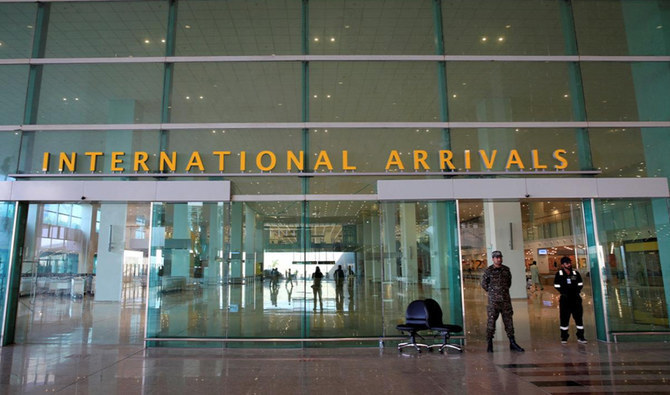
ISLAMABAD: Starting October 5, all international travelers to Pakistan will be required to present a mandatory negative COVID-19 test conducted within 96 hours of the travel date, the ministry of health has said, exempting 38 countries, including Saudi Arabia, from the obligatory test.
In a notification on its website, the ministry issued new standard operating procedures (SOPs) for international travelers entering Pakistan in a bid to curb the spread of the coronavirus.
Besides the mandatory COVID-19 RT-PCR test, the new measures also require that visitors provide traveler contact information through a designated ‘The PassTrack’ mobile app or an accessible web-based form.
“The app helps you to: provide mandatory information that’s required for entry into Pakistan, reduce your wait time and points of contact at the airport, provide the government of Pakistan with voluntary updates and the development of any symptoms during the 14 days after arriving in Pakistan,” the ministry’s website said.
Thirty eight countries have been exempted from mandatory testing, including China, Turkey, Australia, Saudi Arabia, Malaysia and Canada, among others.
“This list will be updated on a fortnightly basis by Ministry National Health Services, Regulation and Coordination based on disease burden of COVID-19,” the ministry said. “This list will be next reviewed on 8th October.”

Saudi Arabia among 38 nations exempted from mandatory coronavirus tests for travelers to Pakistan
https://arab.news/r63c2
Saudi Arabia among 38 nations exempted from mandatory coronavirus tests for travelers to Pakistan
- Starting October 5, all international travelers will be required to present a mandatory negative COVID-19 test conducted within 96 hours of travel date
- Visitors also have to provide traveler information through a designated mobile app or web-based form
Pakistan’s ‘Forward Sports’ to kick off operations in Saudi Arabia
- Forward Sports is a leading Pakistani sports goods manufacturer that produces Adidas’ official World Cup footballs
- Saudi ambassador meets Forward Sports representatives to discuss opening company’s headquarters in Kingdom
ISLAMABAD: Prominent Pakistani sports goods manufacturer Forward Sports is set to open its headquarters in Saudi Arabia, the Kingdom’s embassy said on Thursday.
Forward Sports, based in Pakistan’s eastern city of Sialkot, is famous for manufacturing and exporting high quality footballs. It produces Adidas’s official World Cup match balls and recently displaced a Chinese competitor as the German brand’s largest football supplier.
Pakistan’s Finance Minister told Arab News in November that Forward Sports’ representatives and Saudi officials met during the Future Investment Initiative summit in Riyadh in October. Both sides explored a model in which high-precision manufacturing takes place in Pakistan, with finishing, packaging and regional distribution shifted to Saudi Arabia as part of its industrial localization push, the minister said.
“In the context of strengthening trade relations between the two friendly countries, the ambassador of the Custodian of the Two Holy Mosques to Pakistan, Nawaf bin Said Al-Malki, met representatives of Forward Sports Industries to discuss preparations for opening the company’s headquarters in the Kingdom of Saudi Arabia,” the Saudi embassy in Pakistan said.
The collaboration in manufacturing footballs takes place as Saudi Arabia gears up to host the 2034 FIFA World Cup, which is driving demand for sports-related goods in the Kingdom.
Saudi businessmen have previously eyed collaboration with Pakistan, especially when it comes to importing sports goods and surgical instruments from the country.
A Saudi business delegation in 2022 visited the manufacturing units of Forward Sports, Elmed Instruments (Pvt) Limited and Hilbro International (Pvt) Limited companies, all located in Sialkot, to assess the quality of sports and surgical instruments there.
The development takes place as Prime Minister Shehbaz Sharif directs his government to increase its focus on enhancing exports. Islamabad has sought to escape a prolonged economic crisis over the past few years, seeing increased exports and foreign investment as key drivers of sustainable economic growth.


