

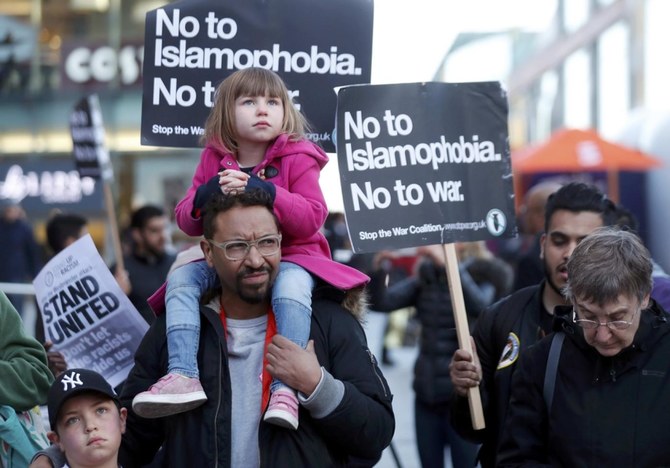

LONDON: UK advocacy group Hope not Hate says it has identified dozens of members of the country’s ruling Conservative (Tory) Party who have used social media to make anti-Muslim statements.
It also cited “alarming” private polling, compiled for a report into allegations of Islamophobia in the party, that shows a large proportion of party members harbor disparaging views about Islam, including that the religion is “incompatible” with British culture.
“In recent years, Hope not Hate has tracked, highlighted and campaigned against the poison of hatred impacting individual political parties,” the report said.
“None have been immune. For several years, there have been well-documented incidents of Conservative Party MPs, councillors and locally elected representatives engaging in vile racism, particularly towards Muslims,” it added.
“Muslim members have reported a lack of action when they complained. Many have resigned from the party in protest.”
The report forms a broad submission by the group to an inquiry into discrimination in the party led by Prof. Swaran Singh of the University of Warwick, after an appeal for evidence.
Allegations of Islamophobia have been raised recently by senior Tory politicians, including former Chancellor Sajid Javid and former party Chair Baroness Warsi.
The inquiry itself has been criticized by the Muslim Council of Britain (MCB) for running the risk of ignoring “the systemic problems of Islamophobia in the party,” after Prime Minister Boris Johnson reneged on a pledge to focus on anti-Muslim prejudice, and instead opened the inquiry up to all instances of prejudice since 2015.
Hope not Hate said it had reported more than 20 Tory councillors to the inquiry for incidents of Islamophobia.
Meanwhile, in its poll of 1,200 Tory members carried out by YouGov, just 43 percent of respondents said they hold favorable views of Islam, with 47 percent saying they consider it “generally a threat” to British society.
Almost a quarter claimed it breeds “intolerance.” Just 27 percent believe Islam to be compatible with life in the UK.
In comparison, 75 percent of respondents said they have positive views of Sikhs in the UK, and 73 percent look favorably on Britain’s Hindu community.
Hope not Hate said it had identified 40 cases of Tory activists or politicians using social media to post offensive anti-Muslim content.
In one incident, a member posted offensive content about the 2019 Christchurch mosque massacre in New Zealand.
Hope not Hate said the member, who was made to complete an “online diversity course,” was subsequently allowed back into the party, and continued to post Islamophobic content online.
Another case saw a councillor suspended in 2018 for sharing an article that called Muslims living in France “parasites,” only to be re-admitted months later.
The group said quiet re-admittance was standard practice for members disciplined for instances of Islamophobia.
In one example, a female councillor was re-admitted after comparing an Asian man to a dog, saying: “He’s brown, he stinks, he can’t speak a word of English.”
The group highlighted that this contradicted the following statement made by Johnson in 2019: “What we do in the Tory party is, when anybody is guilty of any kind of prejudice or discrimination against another group, then they’re out first bounce.”
Hope not Hate’s Chief Executive Nick Lowles told The Times newspaper: “It’s been clear for a number of years that the Conservative Party has a deep problem with anti-Muslim prejudice. The evidence is clear; the only question is what the Conservatives decide to do with it.”
The report suggests a number of measures to deal with Islamophobia. They include setting up a new independent complaints and disciplinary process, a transparent suspension system, and compulsory training for MPs and others on Islamophobia.
An MCB spokesperson told Arab News: “For years, we’ve been alarmed at how entrenched deeply Islamophobic views are in the Conservative Party. This polling, coupled with the MCB’s dossier of over 300 members engaging in Islamophobia, is further evidence of how institutional, systemic and embedded in the culture of the Conservative Party this is.”
The spokesperson added: “If the Conservative Party was serious about eradicating the concerning levels of vitriolic hate from amongst its membership, it would immediately suspend all those highlighted in this report and hold a truly independent inquiry specifically into Islamophobia, instead of this review into its complaints procedure which will serve as nothing more than a rubberstamping exercise, further kicking the can into the long grass.
“Instead, all we’ve seen is a total dereliction of duty by successive prime ministers and party chairs to address Islamophobia within its ranks. The total absence of political leadership only serves to condone Islamophobic views and embolden racist sentiments.”
A Tory spokesman said: “We take any complaint very seriously. There is currently an independent investigation into our complaints processes. We will consider any recommendations to further strengthen our procedures.”
The UK’s Equality and Human Rights Commission, which recently launched an inquiry into allegations of systematic anti-Semitism in the UK’s main opposition Labour Party, said in May that before it decides whether to conduct its own formal inquiry into allegations of Tory Islamophobia, it will await the outcome of Singh’s investigation. Pre-emptive action would not be “proportionate,” the commission said.


