



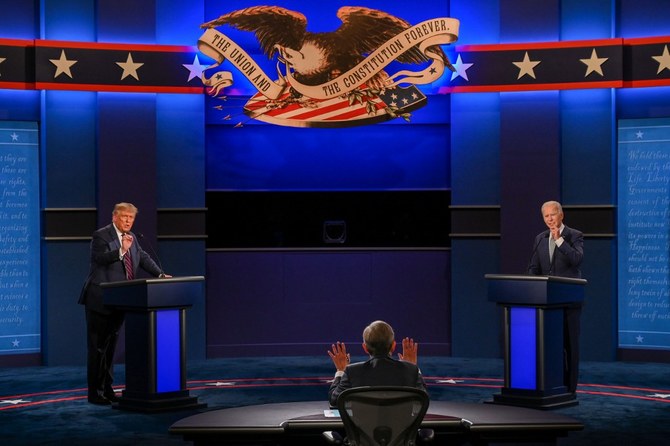
DUBAI: Americans living in the Gulf looked on, aghast, as personal insults flew back and forth between the two men who aspire to lead the US.
A chaotic 90 minutes of insults, temper tantrums, endless interruptions and attacks on an opponent’s family turned the first televised debate between Donald Trump and Democratic challenger Joe Biden into the most acrimonious televised presidential head-to-head in US history.
Expatriates in the Middle East set their alarms for the early hours to watch what turned out to be a “dumpster fire” of a debate, as some commentators described it, unfold in Cleveland, Ohio.
“This debate completely lacked in substance, so how could an expat understand anything about Biden (or Trump’s) positions,” said Liberty Jones, who is from Washington D.C. and has lived in Dubai for eight years. “Aside from a quick discussion on how Trump is handling COVID, it was devoid of any depth on their approaches.”
Opinion
This section contains relevant reference points, placed in (Opinion field)
The debate was the first of three between the two candidates in the run up to election day on Nov. 3. Any attempt at substantive exchanges about the six main issues — the Supreme Court, COVID-19, race and violence in US cities, the economy, and the integrity of the election — were drowned out by acrimony.
“You’re the worst president that America ever had,” Biden told Trump. “In 47 months I’ve done more than you have done in 47 years,” Trump responded.
The moderator, Chris Wallace of Fox News, had to raise his voice on several occasions to demand that Trump respect the two-minute time allocated for uninterrupted answers to questions and let Biden speak. Biden also provided fuel for the fire with a series of personal attacks, calling Trump a liar and a racist.
Then there was Biden’s “inshallah” moment, which lit up Twitter across the Arab world. It came after Trump promised to release his still-hidden tax returns, some details of which were published by the New York Times last week. Biden sarcastically asked, “When?” followed by a word that many viewers thought sounded like “Inshallah,” meaning “God willing.”
Whether or not he actually uttered the familiar Arabic expression remains a mystery but it certainly caught the attention of American expats in the Gulf, some of whom feel distanced from the core issues of the election.
“As expats, we are naturally not as close to the candidates and their platforms,” said Jones, who is a public relations director for luxury retailer Tiffany & Co. “While we can consume news, we don’t have the benefit of our community and families sharing their perspectives on the candidates. This places greater weight on the debates to help expats understand the platforms and policies of the respective candidates.”
James Erazo Ruiz, a healthcare company director who lives in Abu Dhabi and describes himself as a Republican, said: “The American people are the losers of this debate.
“History tells us that presidential debates are not decision-making events. I hoped this one would be different but all we saw was name-calling and an insulting debacle that served no purpose.
“The debate was light on policy, issues and solutions. Quite frankly, it was the worse debate I have ever seen. It was a joke.”
Brian Raggott, who has worked in Dubai for nine years for an American IT company, said the debate reinforced the negative image of America outside of the US.
“America needs someone who can bring the country back together again and last night we didn’t see it,” he said. “As an American outside of the US, you want to bring American ideals wherever you go — and right now it’s a tough time.”
Ali Khalaf, who has lived in Dubai since 2007, sounded a slightly more optimistic note for the future of American politics. He said that he hopes the “disturbing” nature of the debate will shock more people into greater engagement with the political process.
“The hope that can be drawn from these debates is that we emerge from these elections with the desire to invest more in our nation’s choices,” he added.
The last topic of the debate, the integrity of the election, in particular struck a chord with Americans in the Gulf, many of whom said that despite submitting a request weeks ago they are still waiting to receive their absentee ballots.
Approximately 9 million Americans live overseas, according to 2016 figures from the US State Department. If they were considered to be a US state, it would rank as the 12th largest in population size, so they represent a powerful block of votes.
An anonymous US citizen living in Dubai, who declined to be named, said: “Americans abroad deserve to feel confident that our votes are accurately counted and protected from fraud. It’s strange to wait this long for a ballot — and then when it comes and we mail it in, can we trust that it will be counted appropriately?”
“Our votes absolutely count,” said Jean Candiotte, a creative director, writer and producer who has lived in Dubai for almost seven years. “This has the potential to be a close election, which means that every single vote is important.
“As Americans, we get to take our home country with us when we live overseas; we file and pay our home country’s taxes and we maintain the right to vote, and it’s important to exercise that right — it’s who we are as a nation.”


