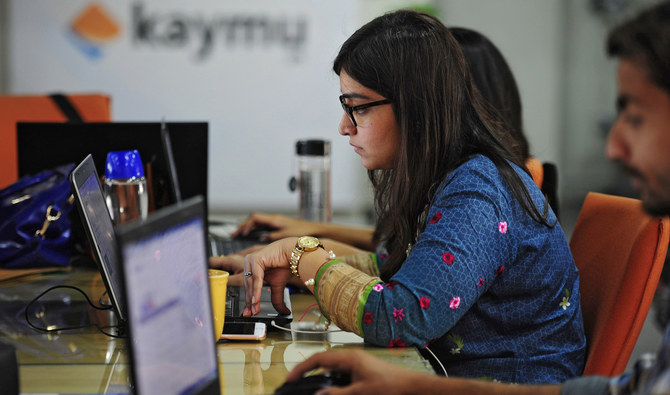
KARACHI: Pakistan’s ongoing digital transformation is fast changing the country's business landscape as more women employ their entrepreneurial skills to bridge the gender pay gap that has remained a norm in the country for decades, female business leaders told Arab News on Tuesday.
“Women in Pakistan are becoming entrepreneurs not only to be more self-reliant but also to financially support their families. They are also closing gender pay gap. The country’s digital transformation is creating vast online business opportunities for women,” Shanaz Ramzi, President Women Chamber of Commerce and Industry (WCCI) Karachi (South), said.
Women constitute more than 50 percent of Pakistan’s population which, according to the 2017 census, stands at 207.7 million.
The country’s female labor force participation rate stands at 22.18 percent in 2020, according to the World Bank data. It was 12.51 percent in 1995, but went up to 23.85 percent in 2015.
“Women are taking advantage of online opportunities after the outbreak of COVID-19. Some of them have started food businesses with delivery options. Others are running educational setups. You will also find some highly qualified women are in tech businesses. They are doing this right from their homes. Hence, they are not only financially supporting their families but also looking after children,” she continued.
Pakistani businesswomen say that COVID-19 opened new avenues, enabling many of them not only to run their businesses better but also expand them further.
Last week, a Lahore-based female fitness studio chain, AimFit, raised $1 million to become the first Venture Capital-backed fitness startup in Pakistan. The organization, which has been in the market for the last six years, said it would utilize the amount to expand fitness studios across the country.
“We have three studios in Lahore and one in Islamabad. The money raised would be utilized to expand physical outreach and online expansion through development of app-based technology system,” Mariam Yasin, its chief operating officer, told Arab News. “We plan to provide both online and offline fitness solutions to women.”
Yasin said that her organization intended to redefine fitness by taking a holistic approach and focusing on both physical and mental health. “Bringing out women to studios was a challenge that we met by providing them a secure environment,” she said, adding: “We now aim to add 10,000 more women to the network of 5,000 within the next two years through our home workout challenge.”
Another female fitness facility in Karachi has also witnessed an increase in female participation by providing a secure atmosphere and modern workout gadgets.
“We have made separate arrangements for females so their families are more comfortable. This explains why the number of female fitness freaks is rising,” Amber Naeem, operations manager at the Atmosphere Gym, told Arab News.
“We have also made substantial investment in hi-tech machines for ladies,” she added.
The government is also supporting female entrepreneurs by extending soft loans to them at a maximum markup rate of 5 percent per annum. Women can avail up to Rs5 million for five years.
“Women are also availing government facilities offered by banks and microfinance institutions that suit their business models and empower them,” Ramzi noted. “Many of these women who have attained financial autonomy are now immune to workplace harassment.”
One of the major impediments to female financial autonomy is resistance from families not only because of the conservative social norms but also the fear of losing male dominance, say businesswomen.
“Business opportunities are equally available to male and female members of a family, but male partners usually feel threatened when women seek financial independence due to the conservative nature of our society,” Sobia Raheem, director at the Macca Foods, told Arab News.
“This mindset has to change since it’s a kind of harassment,” she continued.
Raheem, who also exports seafood, another male dominated business, said: “We don't care about gender in business dealings.”


![]()

Businesswomen say Pakistan’s digital transformation bridging gender pay gap
Short Url
https://arab.news/83bf4
Businesswomen say Pakistan’s digital transformation bridging gender pay gap
- The country’s female labor force participation rate stands at 22.18 percent in 2020, according to the World Bank
- Women entrepreneurs are less prone to workplace harassment as compared to working class women, say business leaders
Latest updates


© 2026 SAUDI RESEARCH & PUBLISHING COMPANY, All Rights Reserved And subject to Terms of Use Agreement.