WHO chief praises Pakistan, says saving economy and fighting coronavirus can go ‘hand-in-hand’

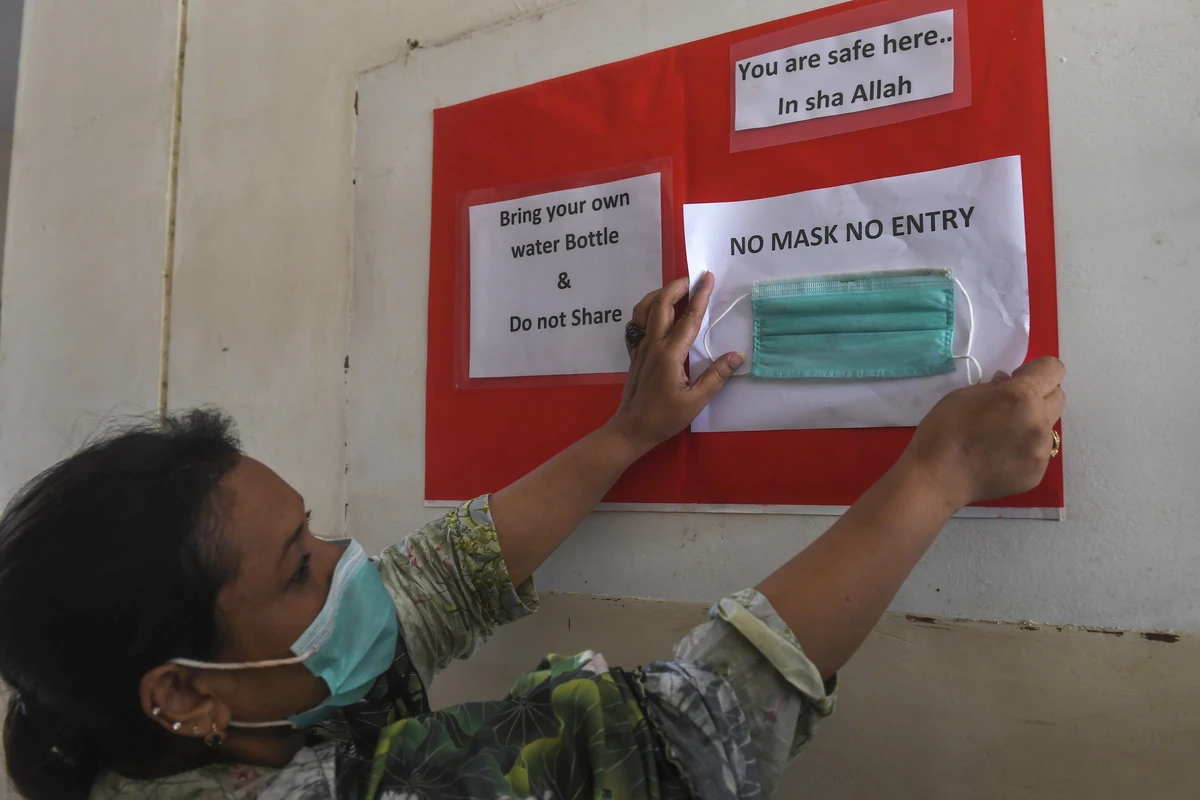
A teacher puts a sign up in a government school following the government's announcement to reopen educational institutes starting from September 15 after nearly six months under lockdown due to the COVID-19 coronavirus, in Karachi on September 14, 2020. (AFP)
Short Url
Updated 30 September 2020
Follow

WHO chief praises Pakistan, says saving economy and fighting coronavirus can go ‘hand-in-hand’

  • Says Pakistan deployed the infrastructure built up over many years for polio to combat COVID-19
  • Steady decline in virus cases since June led Pakistan to reopen nearly all sectors of the economy last month

ISLAMABAD: World Health Organization (WHO) chief Tedros Adhanom Ghebreyesus has praised Pakistan for successfully suppressing coronavirus cases in the country, saying Pakistan had reinforced the lesson that saving the economy and fighting the virus could go “hand-in-hand.” 

After imposing lockdowns in March, a steady decline in coronavirus cases since June led Pakistan to reopen nearly all sectors of the economy last month as well as wedding halls and universities and schools in September. 

“Community health workers who have been trained to go door-to-door vaccinating children against polio have been redeployed and utilized for surveillance, contact tracing and care,” Ghebreyesus said in an op-ed in The Independent. “This has suppressed the virus so that, as the country stabilizes, the economy is also now picking up once again. Reinforcing the lesson that the choice is not between controlling the virus or saving the economy; the two go hand-in-hand.”

As of Wednesday, Pakistan has registered 312,263 infections, 6,479 deaths and 296,881 recoveries. Though testing has been relatively low, the recorded drop in infections is supported by the decreasing proportion of tests that come back positive, as well as dwindling hospital admissions.

Epidemiologists have said the principal reason for the decline is Pakistan’s young population. The average age in Pakistan is 22 years, compared to about 41 in the UK. The vast majority of deaths globally from the coronavirus have been of elderly patients.
Pakistan PM invites UAE investment across tech and resource sectors at National Day event

Updated 08 December 2025
Follow

Pakistan PM invites UAE investment across tech and resource sectors at National Day event

  • Shehbaz Sharif says the UAE remains a key economic partner and continues to lend ‘critical support’ to Pakistan
  • UAE envoy says both nations have potential for cooperation in renewable energy, AI and economic diversification

ISLAMABAD: Pakistan is ready to welcome investment from the United Arab Emirates across emerging technologies and resource sectors, Prime Minister Shehbaz Sharif said on Monday, as both countries marked the 54th National Day of the Gulf country in Islamabad.

Speaking at the ceremony attended by senior ministers, diplomats and business leaders, Sharif said the UAE remained a key economic partner for Pakistan and continued to lend “critical support” to the country’s stabilizing economy.

“Pakistan takes great pride in its strategic partnership with the UAE, which continues to deepen across every domain of life,” he said. “With Pakistan’s economy stabilizing, we stand ready to welcome Emirati investment in renewable energy, AI, fintech, agriculture and minerals.”

Sharif praised the UAE’s leadership and recalled his earliest memories of the Gulf nation as “a land that believed in possibilities long before they became realities,” saying the country’s progress under President Sheikh Mohamed bin Zayed Al Nahyan commanded “profound admiration.”

UAE Ambassador Salem Al Bawab Al Zaabi said the Emirates was committed to strengthening ties with Pakistan in areas including the economy, energy and artificial intelligence.

He said the two countries shared a “deep-rooted friendship built on mutual respect, shared values and a common vision for regional peace and development.”

“We see tremendous potential for collaboration in renewable energy, artificial intelligence, sustainability and economic diversification,” the ambassador said, adding that the UAE aimed to broaden the scope of its economic relations with Pakistan.

The UAE hosts around 1.8 million Pakistani expatriates, one of the country’s largest overseas communities, who Sharif said contributed “tirelessly” to the Gulf state’s development.

Sharif and Deputy Prime Minister Ishaq Dar also joined the UAE ambassador in a cake-cutting ceremony to mark the occasion.