

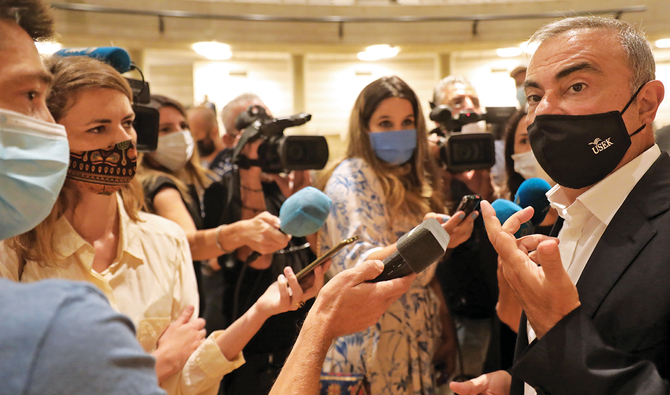

BEIRUT: Carlos Ghosn, the former Nissan and Renault head who fled Japan where he was facing trial, is launching a university management and business program in Lebanon, a nation mired in a deep crisis blamed on years of misrule, mismanagement and corruption.
Nine months after his dramatic escape to Beirut from Tokyo, the Lebanese-French executive has unveiled a plan to shake up the business school at the Universite Saint-Esprit de Kaslik (USEK), a private university north of the Lebanese capital.
Ghosn, credited with turning round the Japanese and French carmakers before he faced charges of financial wrongdoing that he denies, plans programs to coach top executives, offer technology training and help startups that will create jobs.
Ghosn, a fugitive from a Japanese justice system he says was rigged against him, has found refuge in his childhood home Lebanon where the economy is collapsing under debts amassed since the 1975-1990 civil war. A devastating blast in Beirut on Aug. 4 compounded Lebanon’s woes.
“Obviously I am not interested in politics but I will dedicate time and effort into supporting Lebanon during this difficult period,” he told Reuters at the weekend, ahead of Tuesday’s formal launch during a press conference of his new university program.
“This is about creating jobs, employment and entrepreneurs to allow society to take its role into the reconstruction of the country,” Ghosn told a press conference at USEK on Tuesday.
Ghosn, who was approached by USEK in the weeks after arriving in Lebanon at the end of December, said the programs aimed to offer practical help. He will help supervise.
Drawing on his experience, the focus for the executive program would be turning around companies in trouble, corporations struggling with a troubled environment and how to “make yourself invaluable” in a company.
Ghosn said several international executives had agreed to give pro bono courses, such as Jaguar and Land Rover CEO Thierry Bollore, former Goldman Sachs vice-chairman Ken Curtis and venture capitalist Raymond Debbane.
The short courses, expected to start in March, would be open to 15 to 20 senior executives in Lebanon and the Middle East.
“The role model is my experience, what I think are the basic needs of a top executive in a very competitive environment,” he said, adding that, when he was in charge, Nissan’s executive training program in Japan had been open to other companies.
The second USEK program, subsidised by the executive program, would train people on new technologies, such as computer-assisted design and artificial intelligence.
Ghosn said Lebanon’s jewelry exporters were among those who would benefit from the use of software to help with designs.
The third program would act as an incubator for start-ups, and he aimed to invest in two projects. “I am mainly interested in projects that have environmental impact,” he said, citing the example of a project to turn sewage into fertilizer.
“You are creating entrepreneurs which are badly needed, you are creating employment,” he said, adding he had been persuaded to work with USEK by the president of the Maronite Christian institution, Father Talal Hachem, and his young team.
Ghosn said he had also chosen to work with USEK, rather than some of the bigger Lebanese universities, because he liked the idea of working with an institution that drew in a broad range of students, not just the wealthy.
“These students need help more than anybody else. This is the class that has been smashed by the situation today,” he told Reuters.
“I’m going to help in the way I can,” he said. “I’m going to help build the economy by helping to solve problems that every Lebanese is facing today.”


