DUBAI: The UAE on Tuesday announced its candidacy for a two-year term on the UN Security Council in 2022-2023, the state news agency WAM said.
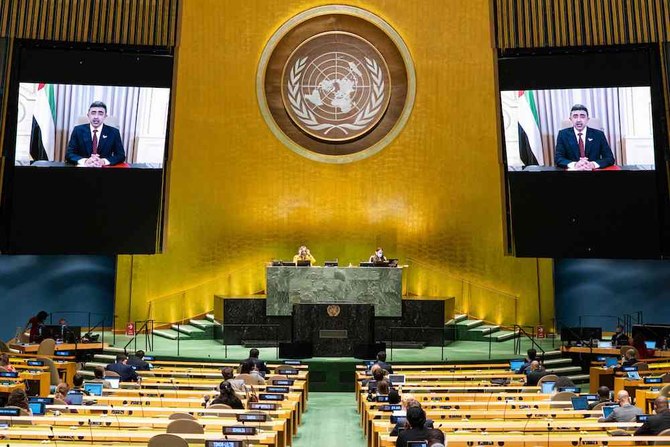
The announcement came in a statement made by the minister of foreign affairs and international cooperation, Sheikh Abdullah bin Zayed, at the annual UN General Assembly in New York.
The Security Council is the only UN body that can make legally binding decisions like imposing sanctions and authorizing the use of force. It has five permanent, veto-wielding members — the United States, Britain, France, China and Russia — among 15 in all.
“The UAE’s campaign for a non-permanent seat on the Security Council will focus on efforts to advance inclusion, spur innovation, build resilience and secure peace,” WAM said, adding that the Gulf state previously served on the Council in 1986-1987.
Voting will take place in June 2021. To ensure global geographical representation, seats are allocated to regions for overlapping two-year terms. Candidates need to win the support of more than two-thirds of the UN General Assembly.

UAE announces candidacy for UN Security Council seat
https://arab.news/gsf8h
UAE announces candidacy for UN Security Council seat
- Voting will take place in June 2021
- UAE previously served on the Council in 1986-1987
Algeria inaugurates strategic railway to giant Sahara mine
- The mine is expected to produce 4 million tons per year during the initial phase, with production projected to triple to 12 million tons per year by 2030
- The project is financed by the Algerian state and partly built by a Chinese consortium
ALGEIRS: Algerian President Abdelmadjid Tebboune on Sunday inaugurated a nearly 1,000-kilometer (621-mile) desert railway to transport iron ore from a giant mine, a project he called one of the biggest in the country’s history.
The line will bring iron ore from the Gara Djebilet deposit in the south to the city of Bechar located 950 kilometers north, to be taken to a steel production plant near Oran further north.
The project is financed by the Algerian state and partly built by a Chinese consortium.
During the inauguration, Tebboune described it as “one of the largest strategic projects in the history of independent Algeria.”
This project aims to increase Algeria’s iron ore extraction capacity, as the country aspires to become one of Africa’s leading steel producers.
The iron ore deposit is also seen as a key driver of Algeria’s economic diversification as it seeks to reduce its reliance on hydrocarbons, according to experts.
President Tebboune attended an inauguration ceremony in Bechar, welcoming the first passenger train from Tindouf in southern Algeria and sending toward the north a first charge of iron ore, according to footage broadcast on national television.
The mine is expected to produce 4 million tons per year during the initial phase, with production projected to triple to 12 million tons per year by 2030, according to estimates by the state-owned Feraal Group, which manages the site.
It is then expected to reach 50 million tons per year in the long term, it said.
The start of operations at the mine will allow Algeria to drastically reduce its iron ore imports and save $1.2 billion per year, according to Algerian media.