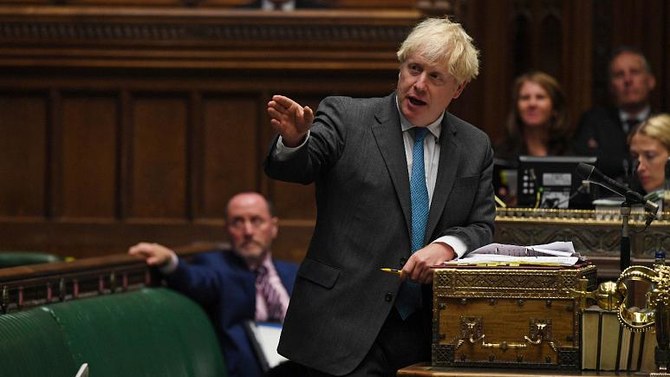
LONDON: British lawmakers on Tuesday adopted a bill to regulate the UK’s internal market after Brexit, defying a looming EU ultimatum as the two sides entered a final week of tense talks.
Despite deep disquiet even from some members of the ruling Conservatives, the House of Commons passed the bill by 340 votes to 256.
Senior minister Michael Gove said the bill was “vitally important” to ensure smooth trade among the UK’s four constituent nations, dismissing vociferous objections from Scottish pro-independence MPs as “stories to scare children at bedtime.”
The government rejected warnings that the bill could imperil peace in Northern Ireland after US President Donald Trump’s special envoy, Mick Mulvaney, conceded that it could leave the province’s Good Friday Agreement “at risk.”
For the main opposition Labour party, business spokesman Ed Miliband said that “when even the Trump administration” speaks out to defend international law, “you know you are in trouble.”
The legislation now passes to the upper House of Lords, where it faces opposition after the government admitted that key clauses will violate Britain’s EU divorce treaty, by unilaterally imposing post-Brexit controls on Northern Ireland.
But it is still expected to become law in the coming weeks.
Prime Minister Boris Johnson’s government defused a bigger revolt in the Commons after agreeing that parliament, rather than ministers, will have the final say on triggering the treaty-breaking clauses.
The EU, however, had insisted that the offending provisions be revoked by Wednesday or it would take Britain to court, noting that the treaty is meant to guarantee a say for the bloc over future trade between Northern Ireland and EU member Ireland.
The legislative tussle loomed as British and EU negotiators launched their last week of intense discussions ahead of a summit on October 16, where EU leaders will decide whether it is still worth pursuing a trade deal with London.
Despite the economic carnage inflicted by the coronavirus pandemic, Johnson insists the UK is ready to go its own way if necessary after a transition period ends in December, nearly a year after Britain formally left the EU in the wake of a historic referendum.
In Brussels, the negotiators are battling over the thorny issues that have deadlocked talks since March, including rules for paying state subsidies to private companies and distribution of fishing rights.
Failure to reach a deal would put EU and UK relations on minimum standards set by the World Trade Organization and cause a severe shock to their interdependent economies.
According to European diplomats, Britain is pushing to intensify negotiations and enter a final phase known as the “tunnel” — in which all communication outside the negotiation room is strictly curtailed.
But the EU is so far refusing the invitation, insisting that Britain first budge on the key issues.
“First, the UK should show some leg on the state aid, governance and fish,” an EU diplomat told AFP.
European Commission chief Ursula von der Leyen on Monday insisted that a deal was still possible and that failure to unblock the talks would be bad for both Britain and Europe.
The trade talks have continued despite Britain refusing to back down on its internal market bill, which overrides parts of the Brexit treaty that Johnson struck with the EU last year.
Johnson’s predecessor as prime minister, Theresa May, and former finance minister Sajid Javid were among Conservative MPs who had vowed to vote against the bill.
May said the bill would “lead to untold damage to the UK’s reputation and put its future at risk.”
But Johnson argues the bill is only intended as a “safety net” against purported EU threats to impose tariffs on UK internal trade and even stop food going from mainland Britain to Northern Ireland.
As the vote loomed in London, an EU spokeswoman said Brussels would respond “in the next few days.”


![]()


Defying EU ultimatum, British MPs approve post-Brexit bill
Short Url
https://arab.news/gvurv
Defying EU ultimatum, British MPs approve post-Brexit bill
- Despite deep disquiet even from some members of the ruling Conservatives, the House of Commons passed the bill by 340 votes to 256
- The legislation now passes to the upper House of Lords, where it faces opposition after the government admitted that key clauses will violate Britain’s EU divorce treaty


Thai villagers stay behind to guard empty homes as border clashes force mass evacuations
SURIN: Fighting that has flared along the Thai-Cambodian border has sent hundreds of thousands of Thai villagers fleeing from their homes close to the frontier since Monday. Their once-bustling communities have fallen largely silent except for the distant rumble of firing across the fields.
Yet in several of these villages, where normally a few hundred people live, a few dozen residents have chosen to stay behind despite the constant sounds of danger.
In a village in Buriram province, about 6 miles (10 kilometers) from the border, Somjai Kraiprakon and roughly 20 of her neighbors gathered around a roadside house, keeping watch over nearby homes. Appointed by the local administration as Village Security Volunteers, they guarded the empty homes after many residents were forced to flee and with fewer security officials stationed nearby than usual.
The latest large-scale fighting derailed a ceasefire pushed by US President Donald Trump, which halted five days of clashes in July triggered by longstanding territorial disputes. As of Saturday, around two dozen people had been reported killed in the renewed violence.
At a house on the village’s main intersection, now a meeting point, kitchen and sleeping area, explosions were a regular backdrop, with the constant risk of stray ammunition landing nearby. Somjai rarely flinched, but when the blasts came too close, she would sprint to a makeshift bunker beside the house, built on an empty plot from large precast concrete drainage pipes reinforced with dirt, sandbags and car tires.
She volunteered shortly after the July fighting. The 52-year-old completed a three-day training course with the district administration that included gun training and patrol techniques before she was appointed in November. The volunteer village guards are permitted to carry firearms provided by relevant authorities.
The army has emphasized the importance of volunteers like Somjai in this new phase of fighting, saying they help “provide the highest possible confidence and safety for the public.”
According to the army, volunteers “conduct patrols, establish checkpoints, stand guard inside villages, protect the property of local people, and monitor suspicious individuals who may attempt to infiltrate the area to gather intelligence.”
Somjai said the volunteer team performs all these duties, keeping close watch on strangers and patrolling at night to discourage thieves from entering abandoned homes. Her main responsibility, however, is not monitoring threats but caring for about 70 dogs left behind in the community.
“This is my priority. The other things I let the men take care of them. I’m not good at going out patrolling at night. Fortunately I’m good with dogs,” she said, adding that she first fed a few using her own money, but as donations began coming in, she was able to expand her feeding efforts.
In a nearby village, chief Praden Prajuabsook sat with about a dozen members of his village security team along a roadside in front of a local school. Around there, most shops were already closed and few cars could be seen passing once in a while.
Wearing navy blue uniforms and striped purple and blue scarves, the men and women chatted casually while keeping shotguns close and watching strangers carefully. Praden said the team stationed at different spots during the day, then started patrolling when night fell.
He noted that their guard duty is around the clock, and it comes with no compensation and relies entirely on volunteers. “We do it with our own will, for the brothers and sisters in our village,” he said.
Beyond guarding empty homes, Praden’s team, like Somjai, also ensures pets, cattle and other animals are fed. During the day, some members ride motorbikes from house to house to feed pigs, chickens and dogs left behind by their owners.
Although his village is close to the battlegrounds, Praden said he is not afraid of the sounds of fighting.
“We want our people to be safe… we are willing to safeguard the village for the people who have evacuated,” he said.
Yet in several of these villages, where normally a few hundred people live, a few dozen residents have chosen to stay behind despite the constant sounds of danger.
In a village in Buriram province, about 6 miles (10 kilometers) from the border, Somjai Kraiprakon and roughly 20 of her neighbors gathered around a roadside house, keeping watch over nearby homes. Appointed by the local administration as Village Security Volunteers, they guarded the empty homes after many residents were forced to flee and with fewer security officials stationed nearby than usual.
The latest large-scale fighting derailed a ceasefire pushed by US President Donald Trump, which halted five days of clashes in July triggered by longstanding territorial disputes. As of Saturday, around two dozen people had been reported killed in the renewed violence.
At a house on the village’s main intersection, now a meeting point, kitchen and sleeping area, explosions were a regular backdrop, with the constant risk of stray ammunition landing nearby. Somjai rarely flinched, but when the blasts came too close, she would sprint to a makeshift bunker beside the house, built on an empty plot from large precast concrete drainage pipes reinforced with dirt, sandbags and car tires.
She volunteered shortly after the July fighting. The 52-year-old completed a three-day training course with the district administration that included gun training and patrol techniques before she was appointed in November. The volunteer village guards are permitted to carry firearms provided by relevant authorities.
The army has emphasized the importance of volunteers like Somjai in this new phase of fighting, saying they help “provide the highest possible confidence and safety for the public.”
According to the army, volunteers “conduct patrols, establish checkpoints, stand guard inside villages, protect the property of local people, and monitor suspicious individuals who may attempt to infiltrate the area to gather intelligence.”
Somjai said the volunteer team performs all these duties, keeping close watch on strangers and patrolling at night to discourage thieves from entering abandoned homes. Her main responsibility, however, is not monitoring threats but caring for about 70 dogs left behind in the community.
“This is my priority. The other things I let the men take care of them. I’m not good at going out patrolling at night. Fortunately I’m good with dogs,” she said, adding that she first fed a few using her own money, but as donations began coming in, she was able to expand her feeding efforts.
In a nearby village, chief Praden Prajuabsook sat with about a dozen members of his village security team along a roadside in front of a local school. Around there, most shops were already closed and few cars could be seen passing once in a while.
Wearing navy blue uniforms and striped purple and blue scarves, the men and women chatted casually while keeping shotguns close and watching strangers carefully. Praden said the team stationed at different spots during the day, then started patrolling when night fell.
He noted that their guard duty is around the clock, and it comes with no compensation and relies entirely on volunteers. “We do it with our own will, for the brothers and sisters in our village,” he said.
Beyond guarding empty homes, Praden’s team, like Somjai, also ensures pets, cattle and other animals are fed. During the day, some members ride motorbikes from house to house to feed pigs, chickens and dogs left behind by their owners.
Although his village is close to the battlegrounds, Praden said he is not afraid of the sounds of fighting.
“We want our people to be safe… we are willing to safeguard the village for the people who have evacuated,” he said.
Latest updates



© 2025 SAUDI RESEARCH & PUBLISHING COMPANY, All Rights Reserved And subject to Terms of Use Agreement.