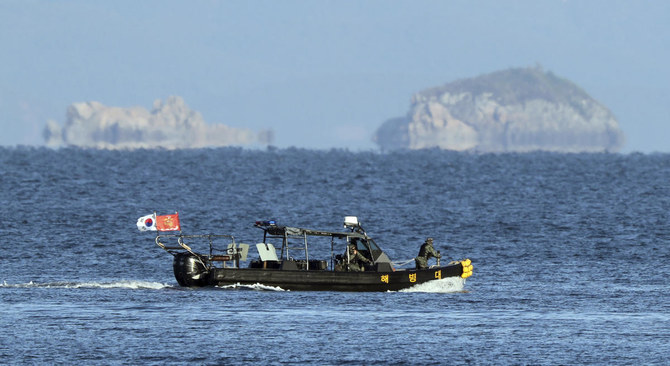
SEOUL: South Korea said Tuesday that a government official slain by North Korean sailors wanted to defect, concluding that the man, who had gambling debts, swam against unfavorable currents with the help of a life jacket and a floatation device and conveyed his intention of resettling in North Korea.
Senior coast guard officer Yoon Seong-hyun said at a televised briefing that there was a “very low possibility” that the man could have fallen from a ship or tried to kill himself because he was putting on a life jacket when he was found in North Korean waters last week.
Yoon said tidal currents at the time would also make it extremely difficult for him to drift into North Korean waters naturally.
The coast guard said its assessment was based on an analysis of tidal currents in the area, a visit to a government boat the official had been aboard before his disappearance, investigation of his financial transactions and a meeting with South Korean Defense Ministry officials.
Yoon said the man conveyed his wish to defect before his death. He cited intelligence showing North Korea knew the man’s name, age, height and hometown as an evidence of his communication with the North.
Yoon didn’t elaborate. But some experts said he likely was referring to South Korea’s interception of communications among North Korean officials about the man.
Coast guard officials have previously said the 47-year-old official was a father of two with some debts. Yoon said Tuesday the debts totaled about $282,240, 80 percent of which were from gambling.
It’s still unclear whether Tuesday’s announcement would sooth mounting questions about why the man was in North Korean waters. The brother of the late official has said it was more likely that he fell into the sea by accident. The official had been aboard a government inspection ship before he disappeared.
South Korea has accused North Korea of having fatally shot him and burning his body. North Korea acknowledged that its troops killed him because he refused to answer to questions and attempted to flee. But North Korea said its troops only burned the man’s flotation device.
North Korean leader Kim Jong Un has offered a rare apology over the man’s death, but his government hasn’t confirmed the man was trying to defect.
The man’s shooting has triggered a huge political firestorm in South Korea, with conservatives launching fierce political attacks on liberal President Moon Jae-in, who espouses greater ties with the North.

South Korea: Slain government official tried to defect to Pyongyang
Short Url
https://arab.news/wtnbh
South Korea: Slain government official tried to defect to Pyongyang
- Slain government official conveyed his wish to defect before his death
Russia says made ‘proposal’ to France over jailed researcher
MOSCOW: Moscow has made an offer to Paris regarding jailed French researcher Laurent Vinatier, who is facing espionage charges that could see him sentenced to 20 years in a Russian prison, the Kremlin said on Thursday.
The surprise public overture comes as both Russia and France have expressed interest in possible talks between Presidents Vladimir Putin and Emmanuel Macron.
Vinatier, who works for a Swiss conflict mediation NGO and was jailed in June 2024, is serving a three-year sentence for failing to register as a “foreign agent” but faces fresh allegations of spying.
“There were appropriate contacts between our side and the French. Indeed, a proposal was made to the French regarding Vinatier,” Kremlin spokesman Dmitry Peskov told reporters, including AFP.
Peskov did not provide details.
“The ball is now in France’s court,” he added.
Vinatier’s family have rejected the accusations against him, saying he is a victim of tensions between Moscow and Paris over the war in Ukraine.
Western countries have long accused Russia of arresting their citizens on baseless charges, seeking to use them as bargaining chips to secure the release of alleged Russian spies and cyber criminals jailed in Europe and the United States.
Putin said last week he would look into Vinatier’s case after a French journalist asked him about it during an end-of-year televised press conference.
“I don’t know anything about this case. This is the first I’ve heard of it,” Putin said.
“But I promise you I’ll definitely find out what it is. And if there’s even the slightest chance of resolving this matter favorably, if Russian law allows it, we’ll make every effort,” Putin said.
- Macron-Putin -
Asked by AFP about the Kremlin statement, the French foreign ministry declined to comment.
The Kremlin said at weekend that Putin was “ready” to engage in dialogue with Macron.
This came after the French leader extended an olive branch to Moscow, opening the chances the two men would soon speak amid a flurry of diplomacy over the Ukraine war.
Macron has urged Russia to free Vinatier, saying he is being unfairly detained and that the “propaganda” against him “does not match reality.”
He is one of several Westerners to have been arrested after Putin launched an all-out offensive on Ukraine in February 2022.
Several US citizens have been imprisoned and then released in exchanges brokered by both US President Donald Trump and his predecessor Joe Biden.
In the original case, prosecutors accused Vinatier of gathering military information without registering with the Russian authorities — something he apologized for and said he was not aware he was required to do.
Speaking Russian during that trial, he said that in his work he always tried to “present Russia’s interests in international relations.”
In brief remarks as he was led by police from a court hearing in the Russian capital over the summer, he said he was “tired.”
Asked whether he felt like a “hostage” of the authorities, he replied in French: “Yes.”
Moscow has used alleged breaches of the “foreign agents” law to arrest people before then applying more serious charges — as happened to Vinatier.
The surprise public overture comes as both Russia and France have expressed interest in possible talks between Presidents Vladimir Putin and Emmanuel Macron.
Vinatier, who works for a Swiss conflict mediation NGO and was jailed in June 2024, is serving a three-year sentence for failing to register as a “foreign agent” but faces fresh allegations of spying.
“There were appropriate contacts between our side and the French. Indeed, a proposal was made to the French regarding Vinatier,” Kremlin spokesman Dmitry Peskov told reporters, including AFP.
Peskov did not provide details.
“The ball is now in France’s court,” he added.
Vinatier’s family have rejected the accusations against him, saying he is a victim of tensions between Moscow and Paris over the war in Ukraine.
Western countries have long accused Russia of arresting their citizens on baseless charges, seeking to use them as bargaining chips to secure the release of alleged Russian spies and cyber criminals jailed in Europe and the United States.
Putin said last week he would look into Vinatier’s case after a French journalist asked him about it during an end-of-year televised press conference.
“I don’t know anything about this case. This is the first I’ve heard of it,” Putin said.
“But I promise you I’ll definitely find out what it is. And if there’s even the slightest chance of resolving this matter favorably, if Russian law allows it, we’ll make every effort,” Putin said.
- Macron-Putin -
Asked by AFP about the Kremlin statement, the French foreign ministry declined to comment.
The Kremlin said at weekend that Putin was “ready” to engage in dialogue with Macron.
This came after the French leader extended an olive branch to Moscow, opening the chances the two men would soon speak amid a flurry of diplomacy over the Ukraine war.
Macron has urged Russia to free Vinatier, saying he is being unfairly detained and that the “propaganda” against him “does not match reality.”
He is one of several Westerners to have been arrested after Putin launched an all-out offensive on Ukraine in February 2022.
Several US citizens have been imprisoned and then released in exchanges brokered by both US President Donald Trump and his predecessor Joe Biden.
In the original case, prosecutors accused Vinatier of gathering military information without registering with the Russian authorities — something he apologized for and said he was not aware he was required to do.
Speaking Russian during that trial, he said that in his work he always tried to “present Russia’s interests in international relations.”
In brief remarks as he was led by police from a court hearing in the Russian capital over the summer, he said he was “tired.”
Asked whether he felt like a “hostage” of the authorities, he replied in French: “Yes.”
Moscow has used alleged breaches of the “foreign agents” law to arrest people before then applying more serious charges — as happened to Vinatier.
© 2025 SAUDI RESEARCH & PUBLISHING COMPANY, All Rights Reserved And subject to Terms of Use Agreement.


