

Fresh allegations about mistreatment of Kurds in Turkey

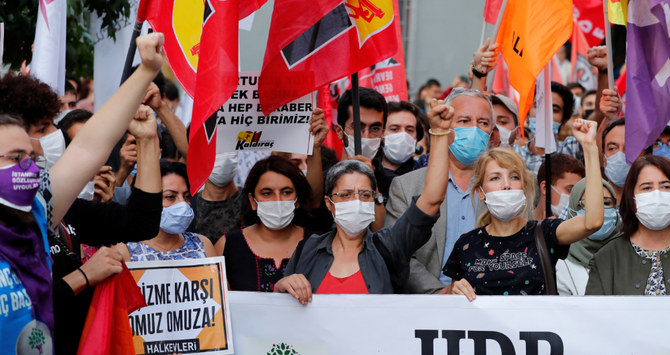
Amnesty International’s Turkey campaigner, Milena Buyum, called for a prompt, independent and impartial investigation into the ill-treatment of Kurdish villagers. (Reuters)
Short Url
Updated 29 September 2020
Follow

Fresh allegations about mistreatment of Kurds in Turkey

  • Opposition party submits parliamentary question on torture after villagers allegedly thrown from military helicopter

ANKARA: The mistreatment of Kurds in Turkey is under the spotlight again following allegations of torture and food poisoning.

Three politicians from the pro-Kurdish People’s Democratic Party (HDP) who were recently arrested said they were hospitalized with food poisoning during their detention, while Amnesty International has demanded the government investigate allegations that two Kurds were thrown out of a military helicopter.

The government accuses the HDP of ties to the outlawed Kurdistan Workers Party (PKK) and thousands of its members have been prosecuted for the same reason, including its leaders. The HDP denies such links. The PKK is designated a terrorist group by Turkey, the European Union and US.

The HDP politicians, including Ayhan Bilgen who is mayor of Van province, fell ill after eating food served at Ankara police headquarters.

Bilgen was not immediately taken to hospital, nor was he allowed to talk to his legal team until after HDP lawmakers had talked with government officials to have him hospitalized.

The trio are under arrest as part of a probe into violent protests that took place in Kobane in 2014. Their detention period was extended on Monday by another four days.

Amnesty International has urged the government to investigate allegations that two Kurds, aged 55 and 50, were thrown from a military helicopter in Van. The rights group voiced its concerns about the “allegations of torture and mistreatment” which it said were unacceptable under international human rights law and standards that Turkey was obliged to comply with.

The men alleged to have been thrown out of a military helicopter were arrested on Sept. 11 as part of an operation against the PKK. Both were hospitalized and had signs of heavy beatings on their bodies.

One of the men was shown to the media with a bloodied face. He is experiencing memory loss. The other man’s condition remains critical. He is suffering from brain trauma, broken ribs, a punctured lung, and has been in intensive care for more than two weeks.

Relatives of the villagers have demanded justice and the uncovering of the truth through a proper investigation.

Amnesty International wants Turkey to investigate the case impartially, and the main opposition Republican People’s Party (CHP) has submitted a parliamentary question about the allegations of torture.

HDP lawmaker Ali Kenanoglu said his party would follow up the mistreatment allegations at a domestic and international level.

“Kurds have become the scapegoat of the current regime because they are considered as the easiest target that doesn’t have any strong social support behind it,” he told Arab News. “Currently all policies involving war and violence are conducted by targeting Kurds. The mistreatment regarding this segment of society has not received strong backing so far, which opens more room for such efforts.”

Once the Kurdish lawmakers were arrested they were automatically under state protection, he said. “However, state impunity still prevails when it comes to the implementation of the rights of Kurdish community.”

On Monday, HDP deputies and officials were outside the parliament building to protest against the detention of their colleagues, who are accused of inciting violence in Kobane.

Amnesty International’s Turkey campaigner, Milena Buyum, called for a prompt, independent and impartial investigation into the ill-treatment of Kurdish villagers.

“Those found to be responsible should be brought to justice in a fair trial,” she told Arab News. “Turkey is bound by the UN Convention Against Torture and the European Convention for the Prevention of Torture, both of which it is a party to. The Committee for the Prevention of Torture of the Council of Europe is tasked with monitoring places of detention in member states and can ask questions regarding the cases of alleged torture and other ill-treatment. As Amnesty International, we will continue monitoring the developments in this shocking case.”

Buyum said that people in detention must be allowed access to their lawyers once they were deprived of their liberty.

“The delay in speaking to the lawyers is concerning. The HDP representatives have been able to consult their legal representatives after four days. They still don't know the substance of the allegations they face as they have not yet been questioned.”

The rights group said that there was increased concern about detention conditions because of the pandemic, and that authorities should step up their efforts to ensure the health and safety of those in custody.

Separately, a Kurdish singer said on Monday that he had been warned by security and intelligence officials against singing in his mother tongue and to stay away from HDP events.

“You will be in trouble if you sing in Kurdish again,” Cesim Basboga was reportedly told. "You’ve been provoking people with songs.”

Basboga will file a complaint.


Deal with Iran ‘Unimaginable,’ Pompeo tells WGS in Dubai

Updated 4 sec ago
Follow

Deal with Iran ‘Unimaginable,’ Pompeo tells WGS in Dubai

  • UAE’s Gargash says he would like to see direct US negotiations with Tehran

DUBAI: Former US secretary of State, Mike Pompeo, told the World Government Summit in Dubai on Monday that he believed a deal between Iran and the United States was “unimaginable” under the current Ayatollah regime believing US strikes on the nation were still a possibility despite the apparent deescalation of the last few days.

“It's unimaginable that there could be a deal. To me, we've had a deal with Iranians multiple times,” he told a panel in Dubai on Tuesday.

“They have cheated and lied and avoided compliance with every deal they've signed.”

Pompeo was central to the US decision to leave the Joint Comprehensive Plan of Action (JCPOA) nuclear deal when he served as secretary during Donald Trumps first term. According to the US department of Justice, the Islamic Republic subsequently placed a $1 million bounty on his head.

Trump has in previous days said the US was seeking to srike a deal with Iran whilst simultanously ordering a large scale militray build up in the region. Pompeo said that he believed the US president could use military strikes – or at least the threat of them – to increase leverage on the regime to give up its enrichment and missiles fully, although he remained cynical of anything being achieved without regime change. 

“To think that there's a long-term solution that actually provides stability and peace to this region while the Ayatollah was still in power, is something I pray for, but find unimaginable,” Pompeo said.

On Syria, Pompeo expressed cautious optimism that the interim president Ahmed Hussein al-Sharaa will succeed in rebuilding his country with a lasting peace.

Al-Sharaa has previously said he was focused on consolidating power, rebuilding state institutions, integrating military factions, and restoring Syria's international relations, including with the United States, Russia, and regional powers.

Pompeo said he maintained a level of mistrust in the Syrian president – most notably due to his involvement with Al-Qaeda - but added that he hoped Al-Sharaa would do well.

 “I have known of Mr. Sharaa for a long time, when I was a CIA director… we had a $10m bounty on his head. He was an Al Qaeda terrorist,” he said.

“It is important for the region to get stability in Syria and so I am rooting for him…. I hope we all do our part to help him be more successful at bringing a very fractured nation back together so that.”

He said he hoped the up to seven million people who had fled the country as refugees could one day return to their homes.

“But it is a very difficult task for anyone and someone with the history that he has, I think it makes it even more complicated for him to be successful. But he’s the leader today and we all should hope that he is able to pull off what It is he has stated his intentions are.”

Pompeo was joined on stage by former UAE Minister of State for Foreign Affairs, Anwar Gargash, who was more hopeful of a diplomatic solution to the Iranian crisis; saying the region stood firm against escalation and further prolonged military conflict.

Gargash believed that it was in the best interest of Iran to strike a deal with the US that would open the pathway to it resolving its multitude of crises.

“I think that the region has gone through various various calamitous confrontations. I don't think we need another one,” he told the summit.

“I would like to see direct Iranian American negotiations leading to understandings so that we don't have these issues every other day.”

Speaking more broadly on regional security, Gargash said resolving the Palestinian issue was still of utmost importance if the middle east was to secure a prosperous future. He said that the UAE was commiitted to seeing through the Trumps plan but ruled out rumours that the emirates was poised to take over governance of the territory.

“We have to work with the Palestinians. We have to work with the Egyptians, the Israelis, the Jordanians, and of course, American leadership is key, really, for achieving a sort of, I won't say, sustainable solution at this time, but moving on with with the part two of President Trump's plan,” he said.

On the international stage, Gargash said he bvelived the health of the China-US relationship was the biggest hinderence to peace – warning that if not managed properly it would likely lead to increasing comflict around the world. He said it was paramount that the two countries maintained a mature relationship based on competition.
