UK to return looted Sumerian artifact to Iraq

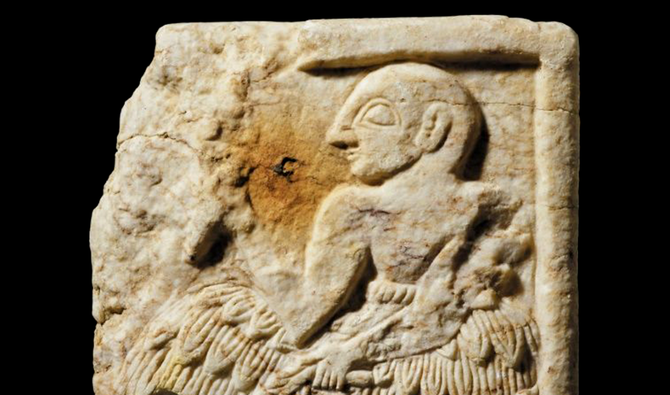
A handout picture released by the British Museum in London on 28 September 2020 shows a Sumerian plaque, dating to around 2400BC, and belonging to the Early Dynastic III period of southern Iraq, that was smuggled out of Iraq and then seized from an online auction site by the UK authorities. (Reuters)
Short Url
Updated 28 September 2020
Follow

UK to return looted Sumerian artifact to Iraq

  • Temple plaque found in online auction spotted by experts at British Museum
  • Thought to have been stolen from Tello in southern Iraq, site of ancient city of Girsu

LONDON: An ancient artifact that may have been looted before being smuggled to the UK is set to return to Iraq.

The item is a Sumerian temple plaque featuring the seated figure of a high priest or ruler, carved from limestone and dating from around 2400 BC.

It will be sent to Iraq, where it is thought to have originated, after it was spotted for sale and seized by police in 2019 following a tip off by experts at the British Museum in London.

The plaque will be put on display to the public for the next two months at the museum before its repatriation.

Prior to its discovery, no record of the plaque was found in any official record or museum inventory, lending credence to the theory that it may have been looted.

It bears physical resemblances to other Sumerian artifacts discovered at Girsu, one of the world’s oldest known settlements, at modern-day Tello in southern Iraq.

Girsu, originally excavated by French archaeologists from the late 19th century, has also been the focus of researchers from the British Museum in recent years. Even now, only a small part of the site has been successfully excavated.

The trade in stolen and smuggled items of huge value from the Middle East is lucrative, and a constant source of dialogue between the British Museum and international police forces hunting stolen goods.

“We’re used to coming across tablets, pots, metalwork, seals and figurines on the art market or in seizures that have been trafficked. But it’s really exceptional to see something of this quality,” said Dr. St. John Simpson, the museum’s senior curator.

“There are only about 50 examples of these known from ancient Mesopotamia. So that immediately places it on the high-rarity scale,” he added.

“We can be fairly sure that this object comes from the Sumerian heartland. That is the area that got very badly looted between the 1990s and 2003.”

Christopher Wren of TimeLine Auctions, where the plaque was spotted for sale by Simpson’s colleague Sebastien Rey, admitted that it was possible that it had been looted from Iraq. 

“The vendor, who had casually and innocently acquired it from a German arts fair some years ago, was horrified to hear this and immediately volunteered to renounce any claim to ownership and expressed the wish that it be returned to its place of origin,” Wren said.

“The piece is not documented as having been looted and is not listed on any database, so it did not show on the checks undertaken by us.”

Mohammad Jaafar Al-Sadr, Iraq’s ambassador to the UK, said: “We extend our gratitude to the British Museum staff for their efforts and cooperation with us.”


Hamza Hawsawi on headlining The Fridge in Riyadh

Updated 14 February 2026
Follow

Hamza Hawsawi on headlining The Fridge in Riyadh

DUBAI: Saudi R&B artist Hamza Hawsawi headlined The Fridge’s “Concert Series KSA Season 1” over the weekend, performing a show in Riyadh’s JAX District as part of a two-day program spotlighting emerging talent.

Hawsawi’s performance followed “The Fridge Open Mic,” which took place at the same venue the night before. The open mic offered rising artists a professional stage to perform original material in front of a live audience, creating space for experimentation and discovery within the local music scene.

Speaking during the event, Hawsawi highlighted the importance of platforms such as open mics for artists. “I think it is important because an open mic is an opportunity to get to know new artists,” he said. “For industry professionals, like Fridge, it is an eye-opener to the scene, and it lets you understand how the scene is going, what kind of artists you’re gonna be dealing with in the future.”

From an artist’s standpoint, he added, the format remains essential for growth. “We do need open mics. We do need to be out there and to try different things, and to sing to different people, and to test our art and find out if people are gonna gravitate towards it or not.”

Hawsawi has spent more than 15 years developing a sound rooted in R&B, soul and pop, building an audience that now spans the region and beyond. He has accumulated more than 33 million global views and collaborated with a range of regional and international artists. 

His track “Million Miles” was selected as the official Rally Dakar anthem, while his live performances have included stages such as MDLBeast and the Abu Dhabi Grand Prix.

Asked whether he feels a responsibility to help shape the Saudi R&B scene, Hawsawi described a fluid relationship with that role. “Sometimes I feel that sense of responsibility,” he said. “Other times I feel like I’m just a human being trying to express my feelings … But we’re just artists at the end of the day.”

He added that while he sometimes embraces being a beacon for the genre, “other times I feel like I want to be low-key, and I don’t even want to be seen or heard.”

Hawsawi also reflected on one of his personal challenges as an artist in the Kingdom: writing and performing primarily in English. 

“That has been the biggest challenge to face,” he said. 

While Arabic remains the most widely spoken language in Saudi Arabia, Hawsawi explained that English allows him to express what he feels more clearly, particularly when it comes to emotion and meaning.

“The nuances of what I feel and all the metaphors for me trying to say something but not saying it, you know, not a lot of people get that,” he said, noting that his work often reaches a niche audience. “But I’m happy with that.”