

Top Lebanese politician Gebran Bassil infected with coronavirus

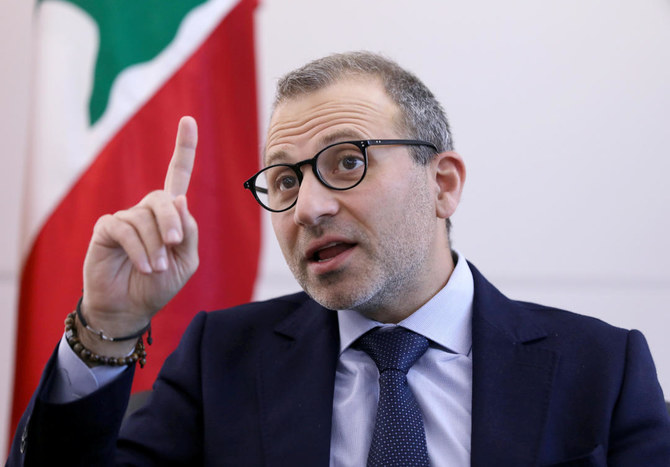
Gebran Bassil, a Lebanese politician and head of the Free Patriotic movement, talks during an interview with Reuters in Sin-el-fil, Lebanon July 7, 2020. (File/Reuters)
Short Url
Updated 28 September 2020
Follow

Top Lebanese politician Gebran Bassil infected with coronavirus

  • Bassil is the son-in-law of Lebanese President Michel Aoun and a former foreign minister who heads the country’s largest Christian political bloc
  • He discovered he was infected on Saturday after several tests

BEIRUT: Former Lebanese Foreign Minister Gebran Bassil has been infected with the coronavirus, he said on Sunday, as cases surge throughout the country.

Bassil, the son-in-law of Lebanese President Michel Aoun and leader of the country’s largest Christian political bloc, said he had tested positive for coronavirus disease (COVID-19) on Saturday.

The party said he had a mild case of the disease and had made it public as a “message to everyone who has had contact with him recently.” He would quarantine himself until he overcame the virus, it said.

“Bassil wanted to issue this statement to inform all those he was recently in contact with, as they could not all be contacted individually, and to apologize for not knowing in advance about the matter,” the political party said in the statement.

The statement did not specify when Bassil last met with the 85-year-old Aoun.

Lebanon’s leading politicians have been meeting frequently in recent weeks amid efforts to form a new government.

The country has seen a spike in coronavirus infections following a devastating Aug. 4 port blast. On Saturday, the country registered a record 1,280 new daily infections. The virus has killed at least 340 people.

Bassil is widely unpopular among Lebanon’s street protesters, many of whom made sarcastic comments on social media.

“Corona announces that it has been infected with the Gebran Bassil virus,” one wrote.

He is the third Lebanese politician to be infected, after former minister Mohammed Safadi and current caretaker Foreign Minister Charbel Wehbe.


Iraqi army fully takes over key base following US withdrawal

Updated 6 sec ago
Follow

Iraqi army fully takes over key base following US withdrawal

BAGHDAD: US forces have fully withdrawn from an air base in western Iraq in implementation of an agreement with the Iraqi government, Iraqi officials said Saturday.
Washington and Baghdad agreed in 2024 to wind down a US-led coalition fighting the Daesh group in Iraq by September 2025, with US forces departing bases where they had been stationed.
However, a small unit of US military advisers and support personnel remained. Iraqi Prime Minister Mohammed Shia Al-Sudani in October told journalists that the agreement originally stipulated a full pullout of US forces from the Ain Al-Asad air base in western Iraq by September. But “developments in Syria” since then required maintaining a “small unit” of between 250 and 350 advisers and security personnel at the base.
Now all US personnel have departed.
Iraqi Army Chief of Staff Lt. Gen. Abdul Amir Rashid Yarallah oversaw the assignment of tasks and duties to various military units at the base on Saturday following the withdrawal of US forces and the Iraqi Army’s full assumption of control over the base, the military said in a statement.
The statement added that Yarallah “instructed relevant authorities to intensify efforts, enhance joint work, and coordinate between all units stationed at the base, while making full use of its capabilities and strategic location.”
A Ministry of Defense official who spoke on condition of anonymity because he was not authorized to comment publicly confirmed that all US forces had departed the base and had also removed all American equipment from it.
There was no statement from the US military on the withdrawal.
US forces have retained a presence in the semi-autonomous Kurdish region in northern Iraq and in neighboring Syria.
The departure of US forces may strengthen the hand of the government in discussions around disarmament of non-state armed groups in the country, some of which have used the presence of US troops as justification for keeping their own weapons.
Al-Sudani said in a July interview with The Associated Press that once the coalition withdrawal is complete, “there will be no need or no justification for any group to carry weapons outside the scope of the state.”