

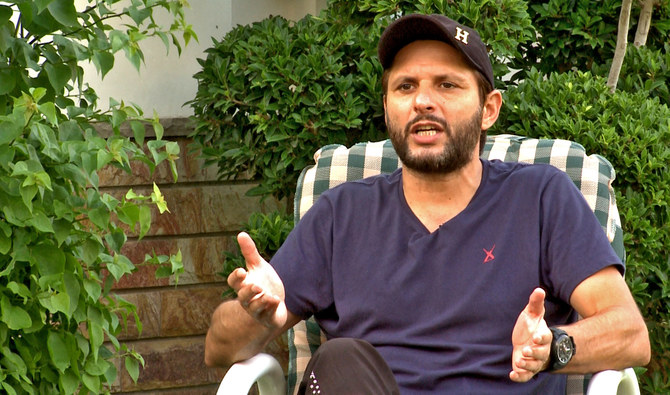

KARACHI: Pakistani all-rounder and former skipper Shahid Khan Afridi has said there was ‘no chance’ of reviving cricketing ties with India as long as Indian Prime Minister Narendra Modi was in power.
Strained relations between the two nations, who were one before the partition of British India split them into India and Pakistan in 1947, and a decades-long dispute over the Himalayan valley of Kashmir, has laid the foundations of one of the most intense sports rivalries in the world.
Ties have been especially strained over the last year when Modi’s government stripped the autonomy of Kashmir, which both nations rule in part but claim in full.
Pakistan and Indian have not played a bilateral Test series since 2008 when already brittle ties were shattered by the Mumbai attacks.
“The government of Pakistan is always ready but with the present regime [in India] there are no such chances of [resuming] cricket relations, of [Pakistan-India] series,” Afridi told Arab News in a wide-ranging interview at his home in Karachi this week. “With Modi in power, I don’t see it’s going to happen.”
Both India and Pakistan are crazy about cricket and emotions and adrenaline run high whenever the two sides play each other, usually in packed stadiums resounding with jingoistic slogans.
New Delhi and Islamabad have in the past used cricket matches to try to make progress on issues that have dogged relations since 1947, especially over the fate of the Kashmir region.
In 1987, then-Pakistan President general Muhammad Zia-ul-Haq visited India to watch a cricket match but the event was also used to defuse a crisis over troop build-ups on one of the world’s most militarised borders, and the Pakistani leader met Indian prime minister of the day, Rajiv Gandhi.
In 2005, Pakistan’s then-military ruler Pervez Musharraf visited India to watch a cricket match, but the trip also became a summit with Prime Minister Manmohan Singh and the two leaders agreed to open up the Kashmir border.
Afridi agreed that sports could play an important role in improving relations between the two countries, especially since cricket was like a “religion” for the people of India and Pakistan: “So, I think that sports are a thing which can help improve ties.”
Commenting on the 2020 Indian Premier League, which was originally scheduled to begin in March in India but is being held in the United Arab Emirates due to the COVID-19 pandemic, Afridi said Pakistani players were missing a “big opportunity” by not being part of the tournament.
“I know that IPL is a very big brand in the world of cricket and it is an excellent opportunity for, whether it’s Babar Azam, or many other Pakistani players to go there [to India] and play under pressure and share dressing rooms,” the Pakistani cricketer said. “So in my opinion Pakistani players are missing a big opportunity.”
Asked if he stood by an earlier statement that he was more loved in India than in Pakistan, Afridi said: “If their love is true, no one can take it away, no matter whose government it is.”
“Love is love,” the cricketer said. “No doubt, the way I have enjoyed cricket in India; I have always appreciated the love and respect that I have gotten from the people of India. And now when I speak on social media, I get many messages from India and I reply to many people. I believe that my overall experience of India has been excellent.”
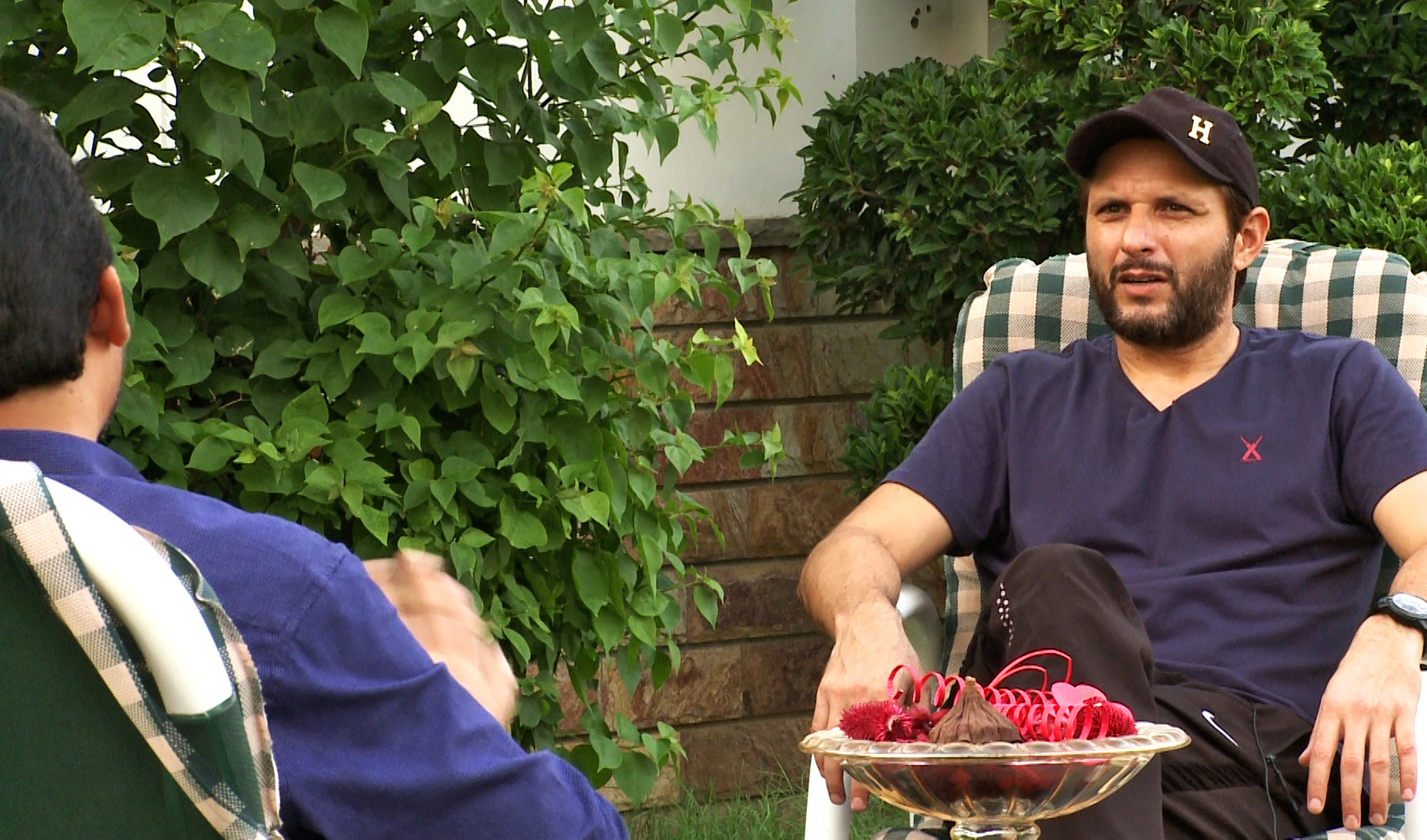
Pakistani cricket star Shahid Afridi talks to Arab News at his home in Karachi on Wednesday, Sept. 23, 2020. (AN photo)
Speaking about the government of Prime Minister Imran Khan, Afridi said Khan had been an exemplary cricketer who led Pakistan to world cup victory in 1992, but as prime minister one should not expect him to change decades of problems in a few years.
“It’s the time to fulfill the promises he [Khan] had made before elections,” he said. “This is a great opportunity; army is with you, judiciary is there. All are on one page.”
Khan has a favorable “ground and pitch” to achieve success, Afridi said, adding that the PM needed a stronger team to help him win.
“Imran bhai will have to play [with a] strong team, [he] will have to take honest and clean people along with him,” he said. “The people who we see around Imran bhai should work for this country so a time may not come when Imran bhai is all alone.”
#WATCH: #Pakistan's former skipper @SAfridiOfficial while commenting on #Motorwayincident says #Pakistan should learn from #SaudiArabia by giving punishments to the culprits to curb rape cases || #ShahidAfridi #ANShortCuts
–
Read special by @NKMalazai: https://t.co/lAhCJb0JpX pic.twitter.com/YFgNcRFtzj— Arab News Pakistan (@arabnewspk) September 27, 2020
Speaking about punishing culprits in the recent case of a woman who was gang-raped on a major highway this month in front of her children, Afridi said: “Don’t hang them publicly. Hang them [while] hiding [from people] but do hang them and set an example, and do it immediately.”
The 40-year-old cricketer is also well-known for his philanthropic work across Pakistan and has formerly worked with UNICEF and a number of national organizations. He told Arab News his parents were his “inspiration” for starting charity work and setting up the Shahid Afridi Foundation, which aims to provide education, health care, access to water and sports rehabilitation in Pakistan’s underprivileged communities.
Afridi has established hospitals in his hometown of Tirah in Khyber district as well as Kohat. His foundation has distributed ration among 40,000 families across Pakistan and offers free education to deserving students in 14 schools across Pakistan. It also gives scholarships to 10 students from the tribal areas each year.
Afridi has launched 200 water projects in the tribal districts and the parched Tharparkar region in Sindh and also helped repatriate over 250 Pakistanis who were stranded in the Middle East due to the coronavirus pandemic.
“We will have to educate these children,” he said, referring to Pakistan’s tribal areas. “I hope [cricket] academies will reach these areas.”


