

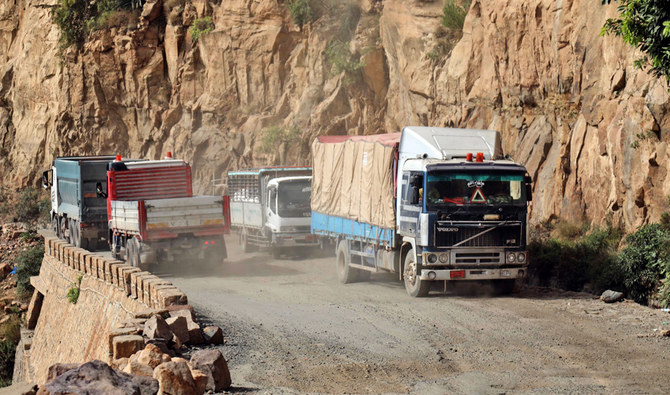

TAIZ: Lorries filled to the brim with goods labor up and down the dangerously winding and precipitous road of Hayjat Al-Abed, the mountainous lifeline to Yemen’s third largest city.
Unlike all other routes linking southwest Taiz to the rest of the war-torn country, the road — with its dizzying drop-offs into the valley below — is the only one that has not fallen into the hands of the Houthi rebels.
Some 500,000 inhabitants of the city, which is besieged by the Iran-backed Houthis, depend on the 7-km stretch of crater-filled road for survival, as the long conflict between the insurgents and the government shows no signs of abating.
Convoys of vehicles big and small move at a snail’s pace as they squeeze past each other on the narrow road that has been severely damaged over the years by heavy rainfall.
“As you can see, it is full of potholes, and we face dangerous slopes,” Marwan Al-Makhtary, a young truck driver, told AFP. “Sometimes trucks can no longer move forward, so they stop and roll back.”
Makhtary said nothing was being done to fix the road, and fears are mounting that the inexorable deterioration will ultimately bring the supply of goods to a halt.
Dozens of Taiz residents on Tuesday urged the government to take action, forming a human chain along the road — some of them carrying signs saying: “Save Taiz’s Lifeline.”
NUMBER
500,000 inhabitants of Taiz, which is besieged by the Iran-backed Houthis, depend on the 7-km stretch of crater-filled road for survival.
“We demand the legitimate government and local administration accelerate efforts to maintain and fix the road,” said one of the protesters, Abdeljaber Numan.
“This is the only road that connects Taiz with the outside world, and the blocking of this artery would threaten the city.”
Sultan Al-Dahbaly, who is responsible for road maintenance in the local administration, said the closure of the road would represent a “humanitarian disaster” in a country already in crisis and where the majority of the population is dependent on aid.
“It is considered a lifeline of the city of Taiz, and it must be serviced as soon as possible because about 5 million people (in the province) would be affected,” he told AFP.
Humanitarian aid
Meanwhile, Yemen’s president on Thursday urged his government’s rival, the Iran-backed Houthi rebels, to stop impeding the flow of urgently needed humanitarian aid following a warning from the UN humanitarian chief last week that “the specter of famine” has returned to the conflict-torn country.
President Abed Rabbo Mansour Hadi’s plea came in a prerecorded speech to the UN General Assembly’s ministerial meeting being held virtually because of the COVID-19 pandemic. It aired more than a week after Human Rights Watch warned that all sides in Yemen’s conflict were interfering with the arrival of food, health care supplies, water and sanitation support.


