Supreme Court orders government to make Peshawar school massacre report public

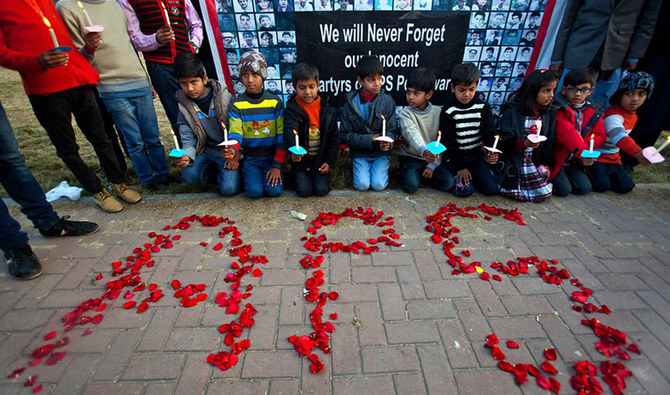
Pakistani youth hold candles next to a banner showing pictures of victims of an attack on a Peshawar school in 2014 during a demonstration in connection with the first anniversary of the attack on Dec. 15, 2015. (AP/File)
Short Url
Updated 26 September 2020
Follow

Supreme Court orders government to make Peshawar school massacre report public

  • The country’s top judiciary wants the government to take strict action against those whose negligence made the carnage possible
  • Chief Justice Gulzar Ahmed says it is important to prevent such future tragedies

ISLAMABAD: The Supreme Court of Pakistan instructed the government on Friday to make public the judicial commission report on the Army Public School massacre that took place in Peshawar on December 16, 2014.
The attack happened when six Tehreek-e-Taliban Pakistan militants conducted a terrorist attack on a military-run education institute in the provincial capital of Khyber Pakhtunkhwa, killing 149 people including 132 schoolchildren.
Pakistan’s former chief justice, Saqib Nisar, formed the commission in 2018 since the parents of the martyred children wanted an investigation into the tragedy.
During the hearing, the court asked the attorney general to name those whose negligence made it easy for terrorists to take so many lives of innocent children and members of the school management.
Chief Justice Gulzar Ahmed asked him to begin with those individuals were in power, adding that strict action should be taken against them to prevent such tragedies from taking place in the future.
According to Dawn, a local newspaper, the commission report maintained that the TTP militants had crossed Pakistan’s border with Afghanistan and reached their destination after “befooling the security apparatus.”
The report also said they were assisted by the residents of the neighborhood where the school was located, adding: “When one’s own blood and flesh commit treachery and betrayal, the result would always be devastating.”
The hearing of the case has now been adjourned for a month. 


Pakistan engages Saudi Arabia, China in bid to ease surging Middle East tensions 

Updated 10 March 2026
Follow

Pakistan engages Saudi Arabia, China in bid to ease surging Middle East tensions 

  • Pakistan’s foreign minister stresses need for de-escalation in conversations with Chinese, Saudi counterparts
  • Tensions in the Middle East continue to remain high as conflict between US, Israel and Iran intensifies

ISLAMABAD: Pakistan’s Deputy Prime Minister Ishaq Dar spoke to the foreign ministers of Saudi Arabia and China on Tuesday, stressing the importance of diplomatic engagement to de-escalate tensions in the Middle East as the Iran war intensifies. 

Pakistan has constantly engaged regional countries in efforts to broker a ceasefire in the Middle East, after the US and Isreal launched coordinated strikes against Iran on Feb. 28. 

Iran launched fresh attacks on Gulf countries on Tuesday morning, where it has targeted US military bases in recent weeks. In addition to firing missiles and drones at Israel and American bases in the region, Iran has also been targeting energy infrastructure which, combined with its stranglehold on the Strait of Hormuz, has sent oil prices soaring worldwide. 

Dar spoke to Saudi Foreign Minister Prince Faisal bin Farhan to discuss developments in the Middle East and ongoing deliberations at the UN Security Council, Pakistan’s foreign office said in a statement. 

“DPM/FM shared Pakistan’s perspective, underscoring the importance of continued coordination and diplomatic engagement to support de-escalation and promote peace and stability across the region and beyond,” the statement said. 

Dar, who also serves as Pakistan’s foreign minister, spoke to Chinese foreign minister Wang Yi over the telephone separately. The two discussed the evolving regional situation and broader global developments.

Dar underscored the need to ease tensions in the Middle East and the wider region during the conversation, the foreign office said. 

Yi appreciated Pakistan’s constructive efforts aimed at promoting de-escalation and stability in the region, it added. 

“The two leaders stressed the importance of de-escalation and emphasized the need to pursue dialogue and diplomacy in accordance with the principles of the UN Charter,” the foreign office’s statement said. 

The conflict in the Middle East has hit Pakistan hard as well, forcing Islamabad to hike petrol and diesel prices by Rs55 per liter last Friday. 

Pakistan’s government has also announced a set of austerity measures, which include closing schools and cutting down on government expenditures, as it evaluates petrol stocks and looks for alternative supply routes.