Virus fears stop Indian Sikhs visiting Pakistan site for festival 

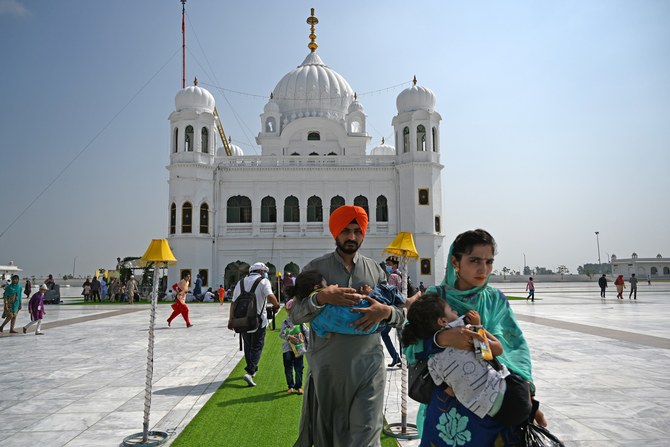
Sikh pilgrims arrive to take part in a religious ritual on the occasion of the 481st death anniversary of Baba Guru Nanak Dev Ji, the founder of Sikhism, at the Gurdwara Darbar Sahib in Kartarpur near the India-Pakistan border on September 22, 2020. (AFP)
Short Url
Updated 23 September 2020
Follow

Virus fears stop Indian Sikhs visiting Pakistan site for festival 

  • Creation of the Kartarpur Corridor marked a rare example of cooperation between the nuclear-armed neighbors 
  • Hundreds of Pakistani Sikhs visited the Gurdwara Darbar Sahib to commemorate the 481st anniversary of his death 

Kartarpur, Pakistan: Coronavirus fears meant a historic travel corridor created last year to let Indian Sikhs visit a holy shrine in northeast Pakistan remained closed Tuesday on one of the faith's most sacred days.
Hundreds of Pakistani Sikhs visited the Gurdwara Darbar Sahib, a huge temple in Kartarpur marking the grave of Sikhism's founder Guru Nanak, to commemorate the 481st anniversary of his death.
This year would have been the first time Indian Sikhs could have crossed visa-free into Pakistan to mark the anniversary at the site, located just four kilometres (two miles) inside the country, after a special crossing was opened in November 2019.
The creation of the Kartarpur Corridor marked a rare example of cooperation between the nuclear-armed rivals, who have fought three wars since independence from Britain in 1947.
Worshippers sang holy hymns from Sikh scripture, prayed and bowed before the Guru Granth Sahib, the Sikh holy book.
Some lamented the closing of the new crossing.
"This corridor is not only an opportunity of pilgrimage for our Indian cousins but also an opportunity to come and meet us, which otherwise is quite difficult", said 25-year-old science teacher Komal Mehra.
India, with about 89,000 coronavirus deaths, is the world's third-worst affected country after the United States and Brazil and has imposed a range of travel restrictions.
When Pakistan was carved out of colonial India at the end of British rule in 1947, Kartarpur ended up on the western side of the border, while most of the region's Sikhs remained on the other side.
The gurdwara at Kartarpur is so close to the India-Pakistan frontier that its magnificent white dome and four cupolas can be seen from across the border.
For up to 30 million Sikhs around the world, the shrine is one of their holiest sites. 


Pakistan’s Mahnoor Omer named among TIME’s ‘Women of the Year’ for 2026

Updated 01 March 2026
Follow

Pakistan’s Mahnoor Omer named among TIME’s ‘Women of the Year’ for 2026

  • Omer moved a Pakistani court against the so-called ‘period tax’ in Sept. 2025 which has since sparked a national debate
  • Taxes on sanitary pads in Pakistan can add up to 40 percent to retail price, UNICEF says only around 12 percent women use such products

ISLAMABAD: Pakistani women’s rights activist Mahnoor Omer, who fought against taxes on menstrual products, has been named among the TIME magazine’s ‘Women of the Year’ for 2026.

Omer’s efforts have been recognized alongside 16 activists, artists, athletes and businesswomen in the TIME’s Women of the Year 2026 list, including Olympic gold medalist Sydney McLaughlin-Levrone and Oscar-nominated filmmaker Chloe Zhao.

Dissatisfied with the efforts to educate Pakistani girls about sexual violence, Omer founded the Noor Foundation at the age of 14 and held her own workshops with village girls about everything from climate change to menstruation, according to the TIME magazine.

Two years later, a conversation with a domestic worker about the price of pads made her realize that not everyone could afford these essentials. She moved a court against the so-called “period tax” in Sept. 2025 and the case has sparked a national debate on the subject, considered a taboo by many in Pakistan, since its first hearing late last year.

“A decade and one law degree after her interest in activism was sparked, Omer, now 25, is putting her passion and expertise to work in the name of gender equity,” TIME wrote about Omer on its website.

Taxes imposed on sanitary products in Pakistan can add up to 40 percent to the retail price. UNICEF estimates just 12 percent of women in the country use commercially produced pads or tampons. The alternative, using cloth, risks health impacts including rashes and infections, and can make it impossible for girls to attend school while menstruating.

Omer’s suit, which awaits the government response, has sparked a national discussion. She says she spoke about menstruation to her father and male cousins, who thanked her for standing up for their daughters.
The 25-year-old, who is currently enrolled in a master’s degree in gender, peace, and security at the London School of Economics, sees this case as just the first of many.

“I’m not free until every woman is free,” she was quoted as saying by TIME. “I want to leave no stones unturned in terms of what I can do with the next few decades, as a lawyer for the women in my country and gender minorities in general.”