East Mediterranean states formally establish Egypt-based gas forum

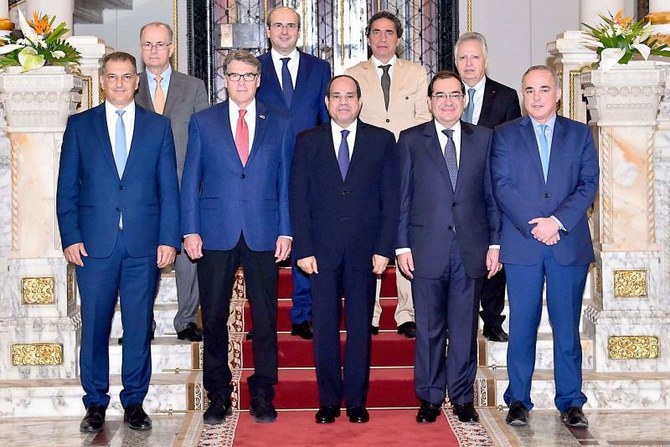
Egyptian President Abdel Fattah El-Sisi, center, with US, Israeli and Egyptian ministers during the Eastern Mediterranean Gas Forum, Cairo, July 25, 2019. (AFP)
Short Url
Updated 22 September 2020
Follow

East Mediterranean states formally establish Egypt-based gas forum

  • Egypt, Israel, Greece, Cyprus, Italy and Jordan established the East Mediterranean Gas Forum (EMGF) as an intergovernmental organization in a virtual ceremony hosted by Cairo
  • The group unites regional rivals of Turkey, which has been locked in a bitter dispute with European Union members Greece and Cyprus over gas drilling rights in the region

CAIRO: Six states signed a charter for an Egypt-based energy forum on Tuesday, giving formal status to a group that seeks to promote natural gas exports from the eastern Mediterranean and that Israel hopes will strengthen ties with Arab neighbors.
Egypt, Israel, Greece, Cyprus, Italy and Jordan established the East Mediterranean Gas Forum (EMGF) as an intergovernmental organization in a virtual ceremony hosted by Cairo.
The group unites regional rivals of Turkey, which has been locked in a bitter dispute with European Union members Greece and Cyprus over gas drilling rights in the region.
The Palestinian Authority is also part of the forum, Israeli Energy Minister Yuval Steinitz said in a statement.
France has applied to join, with the United States and European Union requesting observer status.
For Israel, the forum “brings regional cooperation with Arab and European countries, the first of its kind in history, with contracts to export (Israeli) gas to Jordan and Egypt worth $30 billion, and that is just the beginning,” added Steinitz.
Egypt began importing Israeli gas at the start of this year, for possible re-export to Europe or Asia.
The 2015 discovery of the giant offshore Zohr field had unlocked interest in Egypt’s energy market and encouraged Cairo to promote itself as a regional hub.
However, regional politics, infrastructure and transport costs, and rivalry between Turkey and eastern Mediterranean neighbors, complicate prospects for exploiting and transporting gas from the region.


Gaza fuel running short after Israel closes borders amid Iran war

Gaza is wholly ‌dependent on fuel ‌brought in by trucks from Israel ​and ‌Egypt.
Updated 57 min 46 sec ago
Follow

Gaza fuel running short after Israel closes borders amid Iran war

  • Israel’s military closed all Gaza border crossings on Saturday after announcing air strikes on Iran carried out jointly with the US
  • Israeli authorities say the crossings cannot be operated safely during war

CAIRO/JERUSALEM: Gaza is rapidly running out of its limited fuel supply and stocks of food staples may become tight, officials say, after Israel blocked the ​entry of fuel and goods into the war-shattered territory, citing fighting with Iran.
Israel’s military closed all Gaza border crossings on Saturday after announcing air strikes on Iran carried out jointly with the United States. Israeli authorities say the crossings cannot be operated safely during war and have not said how long they would be shut.
Few days’ worth of supplies
Gaza is wholly ‌dependent on fuel ‌brought in by trucks from Israel ​and ‌Egypt ⁠and a ​lack ⁠of fresh supplies would put hospital operations at risk and threaten water and sanitation services, local officials say. Most Palestinians in Gaza are internally displaced after Israel’s two-year war with Hamas militants.
“I expect we have maybe a couple of days’ running time,” said United Nations official Karuna Herrmann, who directs fuel distribution in Gaza.
Amjad ⁠Al-Shawa, a Palestinian aid leader in Gaza, ‌who works with the UN and NGOs, ‌estimated fuel supplies could last three or ​four days, while stocks ‌of vegetables, flour, and other essentials could also soon run out ‌if the crossings remain shut.
Reuters was unable to independently verify those estimates.
Israel’s COGAT military agency, which controls access to Gaza, said that enough food had been delivered to the territory since the start of ‌an October truce to provide for the population.
“(The) existing stock is expected to suffice for ⁠an extended period,” ⁠COGAT said, without elaborating. It declined to comment on potential fuel shortages.
The truce was part of broader US-backed plan to end the war that involves reopening the Rafah border crossing with Egypt, increasing the flow of aid into the enclave, and rebuilding it.
Hamada Abu Laila, a displaced Palestinian in Gaza, said the closures were stoking fear of a return of famine, which gripped parts of the enclave last year after Israel blocked aid deliveries for 11 weeks.
“Why is it our fault, in ​Gaza, with regional wars ​between Israel, Iran, and America? It is not our fault,” Abu Laila said.