

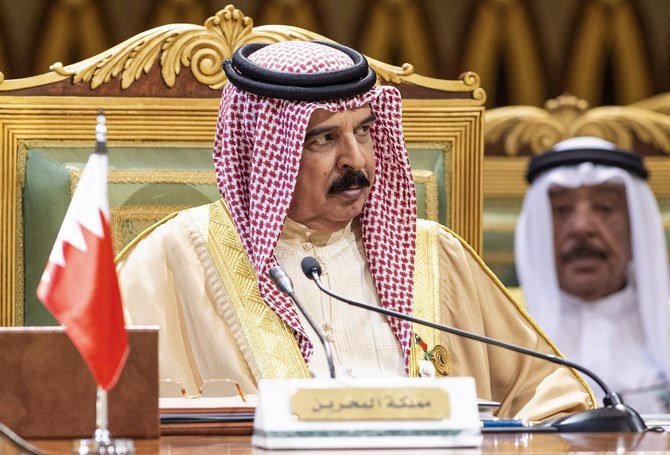
King Hamad: Bahrain committed to independent Palestinian state

King Hamad said Bahrain's position on the Palestinian issue was "firm and permanent." (AFP/File)
Short Url
Updated 21 September 2020
Follow

King Hamad: Bahrain committed to independent Palestinian state

  • King says Bahrain is commitment to achieving a two-state solution

RIYADH: King Hamad said on Monday Bahrain is committed to an independent Palestinian state with East Jerusalem as its capital, in accordance with the Arab peace initiative.

The king was speaking after Bahrain, along with the UAE, signed agreements with Israel last week to normalize relations.

The king said Manama’s position on the Palestinian issue was firm and permanent and that Bahrain is commitment to achieving a two-state solution, “Our steps toward peace and prosperity are for the benefit of all” and “are not directed against any entity or forces,” King Hamad said. “They are in everyone’s interest and aim for good neighborliness.”

He said Bahrain signed the Abraham Accords with Israel “on the basis of Bahrain’s vision of establishing comprehensive peace and considering it a strategic option to advance the peace and stability process in the Middle East region, which contributes to strengthening international peace and security.”

In a statement after a cabinet meeting, the king said he was proud of the broad Arab and international support of Bahrain’s move.

Foreign Minister Abdullatif bin Rashid Al-Zayani  presented a report to the council of ministers on the signing ceremony between Bahrain, the UAE and Israel that was hosted by Donald Trump.

At the end of the meeting, King Hamad congratulated Saudi Arabia, its king, government and people on the 90th National Day.


How foreign-backed drones are fueling atrocities in Sudan and prolonging conflict

Updated 3 sec ago
Follow

How foreign-backed drones are fueling atrocities in Sudan and prolonging conflict

  • New evidence suggests the RSF has developed a significant drone capability supplied through foreign channels
  • Investigators and aid groups say drone strikes are driving a surge in civilian casualties and damaging infrastructure
RIYADH: On Feb. 19, three aid workers were killed and four others wounded when a convoy carrying food and humanitarian supplies in Sudan’s South Kordofan state was struck by a drone.

The Sudan Doctors Network condemned the attack as “a blatant violation of international humanitarian law.” Yet such incidents are not isolated.

A growing body of evidence suggests they are part of a broader pattern, as the beleaguered rebel Rapid Support Forces increasingly deploy drones — often against defenseless civilians — while reportedly benefiting from financial and military backing linked to Abu Dhabi.

The pattern has been visible in recent weeks. On Feb. 15, a drone strike on a market in Sudari, North Kordofan, reportedly killed 28 civilians and wounded 13. Another strike hit Al-Mazmoun Hospital in Sennar state, killing three more.

The following day, a drone attack on a shelter for internally displaced people in Al-Sunut killed 26 refugees, including 15 children. Two primary schools in Dilling, South Kordofan, were also hit, though no injuries were reported.

On Feb. 23, a drone strike caused major damage at Kordofan University in El-Obeid. No one was injured, but only by chance.

Humanitarian organizations say the toll is mounting rapidly.

Doctors Without Borders, or MSF, said that in the first two weeks of February, it treated 167 patients suffering from “penetrating injuries to their thorax and abdomen, multiple limb fractures, head injuries and drone shrapnel.”

“Recent incidents reveal a disturbing pattern in the conduct of the war in Sudan,” said Esperanza Santos, MSF head of emergencies, in a statement on Feb. 20.

“Drone strikes are not limited to military targets, (they are) sometimes with multiple follow-up strikes on the same location, and are causing devastating harm,” she added. “Civilians, including children, are being killed or severely injured in blatant disregard of international humanitarian law.”

International investigators have reached similar conclusions. On Feb. 17, the Independent International Fact-Finding Mission for the Sudan told the UN Human Rights Council that mass killings and related atrocities by the RSF in and around El-Fasher on or around Oct. 26 and 27 “are indicators of a genocidal path.”

Those atrocities followed an 18-month siege marked by repeated attacks on civilians and infrastructure, including the use of drones and heavy weapons in populated areas, the mission said in its report.

One of the deadliest incidents came on Sept. 19, 2025, when a drone strike on Al-Safiya Mosque during dawn prayers killed about 70 people, including 11 children.

As the tide turns against rebel forces, a war that has reportedly killed as many as 400,000 Sudanese over the past three years might have ended by now if not for the steady flow of sophisticated weapons into the rebels’ hands.

Experts say there is overwhelming evidence that the source of that weaponry is Abu Dhabi.

“There’s no other explanation,” said Nathaniel Raymond, executive director of Yale School of Public Health’s Humanitarian Research Lab. “Before, these people had Enfield rifles, AK-47s, camels and pickup trucks. Now they have a tier-one capability.”

That capability includes Chinese-made delta-wing “suicide” drones with a range of up to 1,700 km, packed with explosives and guided via satellite links.

The lab uses open-source and remote-sensing data, including satellite imagery and thermal sensor data, to produce evidence and analysis for US government agencies and international organizations, including the UN.

“These are very sophisticated loitering munitions,” Raymond said. “They require a ground-control station, launchers and a satellite uplink.”

The RSF “has built a specific, large-scale launching capability for deltas, and they are primarily using them now in a certain approach because they’re losing,” he added. “And that entire rig — the people operating it, the comms, the launchers, the munitions — is all dependent on UAE support.”

Evidence gathered by the lab supports that assessment. Satellite imagery in September showed large numbers of long-range delta-wing drones and launchers at Nyala Airport in southwestern Sudan, about 250 km from the border with Chad.

Raymond said evidence that the weapons originated from the UAE is “forensically probative.”

He said: “We track flights into Nyala all the time. They appear to be coming from bases (in neighboring countries) where the last known flight into those bases was from Abu Dhabi; then, they go ‘ghost,’ their transponder is turned off, and they fly into Nyala between 1 a.m. and 3 a.m.”

Operators controlling the drones via satellite links could be located anywhere, he added, and were likely Colombian mercenaries paid for by the UAE.

The lab sounded the alarm in September, warning that the RSF was assembling a “large-scale suicide drone fleet for launch in Nyala.”

On Sept. 29, imagery collected by the lab identified at least 43 drones which had not been visible in photographs taken three days earlier.

The lab warned that, with a range of anything from 1,500 km to 2,000 km, “the entirety of Sudan is assessed within range” of the weapons and “the presence of this combination of UAVs (unmanned aerial vehicles) in the position observed should be considered a sign of imminent attack.”

The alert added: “These UAVs represent a clear and present danger to civilians, critical infrastructure, and humanitarian aid access.”

In gathering intelligence, Yale’s lab utilizes what it calls “data fusion methodology,” analyzing a combination of open-source data and remote sensing, including satellite imagery and thermal sensor data.

Drones are not the only Chinese-made major weapons system the UAE appears to be supplying to the RSF.

“The first weapon we tracked there was an AH4 artillery piece,” said Raymond, “and that was a critical tell, because the only people who had that version of the gun was the UAE.”

Raymond’s unit investigated when, in the fall of 2024, the Zamzam refugee camp in Sudan’s Darfur region began to come under accurate artillery fire. Using satellite imagery, “we went on a gun hunt, and one of our people found a couple of AH4s, parked in the middle of nowhere, in range of El-Fasher and in range of Zamzam.

“The kids getting killed in Zamzam by the bombardment were being hit by the AH4. It had a very unique pull ring on the front of its barrel and a vehicle and so the AH4 was the first weapon we found that was only in the UAE stable.”

In January 2024, a UN-appointed panel of experts on Sudan presented a report to the Security Council which identified Chad as the main corridor through which arms were reaching the RSF — and named Abu Dhabi as the source of the shipments.

“Various flight-tracking experts,” read the report, “have observed a heavy rotation of cargo planes coming from Abu Dhabi International Airport to Amdjarass Airport in eastern Chad, with stops in regional countries such as Kenya, Rwanda and Uganda.”

The UAE claimed the cargo planes had a humanitarian purpose, “in particular to establish a field hospital in Amdjarass for Sudanese refugees,” but “according to information gathered by the panel from sources in Chad and Darfur, the allegations were credible.”

According to these sources, several times a week weapons and ammunition were unloaded from aircraft arriving at Amdjarass, loaded onto trucks and ferried in armed convoys to the Darfur border. From there, the supplies were taken to the RSF’s base in Zurug, North Darfur.

Two months later, in May 2025, an investigation by Amnesty International concluded that “sophisticated Chinese weaponry, re-exported by the United Arab Emirates, has been captured in Khartoum, as well as used in Darfur, in a blatant breach of the existing UN arms embargo.”

Analysis of photographs and videos shot in the aftermath of an RSF drone attack near Al-Malha in North Darfur on the night of March 9, 2025, in which 13 people were killed, revealed the use by the RSF of weaponry including Chinese-made GB50A guided bombs and 155 mm AH4 artillery pieces.

These weapons are made by the state-owned China North Industries Group Corporation Limited (Norinco) and had been “almost certainly exported to Sudan by the UAE.”

The GB50A is designed to be dropped from a drone, such as the Wing Loong series of unmanned aerial vehicles, also made in China and used by the UAE Air Force.

Brian Castner, head of crisis research at Amnesty International, said it was “shameful that the UN Security Council is failing to implement the existing arms embargo on Darfur, and not heeding calls to extend it to all of Sudan.”

He added: “Civilians are being killed and injured because of global inaction, while the UAE continues to flout the embargo.

“The UAE must halt its arms transfers to the RSF immediately. Until they do, all international arms transfer to the UAE must also stop.”

The problem, said Andreas Krieg, a senior lecturer at the School of Security Studies at King’s College London seconded to the UK Royal College of Defence Studies, is that “Abu Dhabi has been acting with impunity for the past 15 years” and European powers in particular have been reluctant to cross it.

The Emiratis “have made themselves indispensable in global flows of logistics networks and financial and investment networks,” he said.

“Certainly in the UK we have now become a beggar state, where we’re begging for inward investment to maintain our prosperity, and the UAE are using this as a carrot to get their way.

“Abu Dhabi is an immensely Machiavellian, transactional actor. They’ve embedded themselves as a hub in global networks, and you can’t bypass them anymore.”

This leverage has given Abu Dhabi a sense of impunity which, combined with “a degree of plausible deniability,” has allowed it to pursue what Krieg calls “drone statecraft” in Sudan.

Without the supply of drones and other sophisticated weaponry from Abu Dhabi, “the RSF wouldn’t have been able to maintain that pressure that they have and would have never made the territorial gains they’ve made over the past six months or so.”

In Sudan, Abu Dhabi has effectively “leveled the playing field” and “we’re now in a war of attrition, a stalemate.”

As the Janjaweed militia, “(some) 20 years ago, the RSF was a militia on horseback; now it is running its own air wing, supported by Latin American contractors and mercenaries.

“On the surface, it doesn’t look like the Emiratis are involved in it. But when you look where the money is coming from, where the companies are registered, you see it all goes back to the UAE.”