Taj Mahal reopens even as India coronavirus cases soar

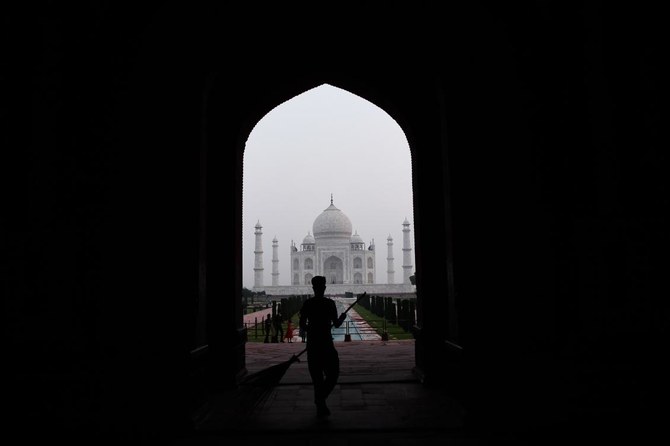
The Taj Mahal reopens to visitors on September 21 in a symbolic business-as-usual gesture, even as India looks set to overtake the US as the global leader in coronavirus infections. (AFP)
Short Url
Updated 21 September 2020
Follow

Taj Mahal reopens even as India coronavirus cases soar

  • India, home to 1.3 billion people and some of the world’s most crowded cities, has recorded more than 5.4 million Covid-19 cases
  • Taj Mahal usually draws seven million visitors a year, but has been closed since March

AGRA: India’s famed Taj Mahal and some schools reopened on Monday as authorities pressed ahead with kickstarting the nation’s coronavirus-battered economy despite soaring infection numbers.
India, home to 1.3 billion people and some of the world’s most crowded cities, has recorded more than 5.4 million Covid-19 cases, second only to the United States which it could overtake soon.
But after a strict lockdown in March that devastated the livelihoods of tens of millions of people, Prime Minister Narendra Modi is reluctant to copy some other nations and tighten the screw on activity again.
Instead in recent months his government has eased more and more restrictions including on many train routes, domestic flights, markets, restaurants — and now, visiting the Taj Mahal.
“So many people lost their job during the lockdown. People have suffered a lot and it is time the country opens up fully,” said bank official Ayub Sheikh, 35, visiting the Taj with his wife and baby daughter.
“We are not afraid of the virus. If it has to infect us, it will,” Sheikh told AFP. “Not many people are dying now. I don’t think it is going to go away soon. We have to get used to it now.”
The jaw-dropping white-marble mausoleum in Agra south of New Delhi is India’s most popular tourist site. It usually draws seven million visitors a year, but has been closed since March.
Officials said strict social distancing rules were in place and visitors were not allowed to touch the marble. The famous bench where visitors sit for a photo — most memorably Princess Diana in 1992 — has been specially laminated so that it can be regularly sanitised without damage.
Early on Monday a couple of hundred of visitors were inside. Security personnel were reminding everyone to wear masks once photos have been clicked. Daily visitor numbers have been capped at 5,000 — a quarter the normal rate.
“Coronavirus is there in every country,” Spanish visitor Ainhoa Parra told AFP. “We are taking all the safety measures that we can. We have to be careful but if we have to get infected we will.”
“So many livelihoods depend on the Taj. It’s great to be back in business,” said local official Satish Joshi.

Elsewhere in India, particularly in rural areas where infections are soaring, anecdotal evidence suggests that government guidelines on avoiding the virus are more often ignored than adhered to.
“I think, not just in India but all over the world, fatigue with extreme measures that were taken to restrict the growth of the coronavirus is setting in,” said Gautam Menon, professor of physics and biology at Ashoka University, predicting that infections will keep rising as a result.
Many experts say that even though India is testing more than a million people per day, this is still not enough and the true number of cases may be much higher than officially reported.
The same goes for deaths, which currently stand at more than 86,000, with many fatalities not properly recorded even in normal times in one of the world’s worst-funded health care systems.
There is however some resistance to Modi’s unlocking of the world’s second-most populated country, which saw its economy contract by almost a quarter between April and June.
Schools were allowed to resume Monday on a voluntary basis for students aged 14 to 17, but most Indian states have said it is still too soon.
In those states where they can open, schools themselves refused to open and parents are wary of sending their children in.
In one rural school in the northeastern state of Assam for instance, out of 400 students only eight showed up on Monday morning.
“I am prepared for my son to lose an academic year by not going to school rather than risk sending him,” said Nupur Bhattacharya, the mother of a nine-year-old boy in the southern city of Bangalore.


Buddhist monks head to DC to finish a ‘Walk for Peace’ that captivated millions

Updated 7 sec ago
Follow

Buddhist monks head to DC to finish a ‘Walk for Peace’ that captivated millions

WASHINGTON: A group of Buddhist monks is set to reach Washington, D.C., on foot Tuesday, capping a trek from Texas that has captivated the country.
The monks in their saffron robes have become fixtures on social media, along with their rescue dog Aloka.
They walk to advocate for peace. That simple message has resonated across the US as a welcome respite from conflict and political divisions. Thousands have gathered along Southern roadsides to watch the monks’ quiet, single-file procession that began in late October.
“My hope is, when this walk ends, the people we met will continue practicing mindfulness and find peace,” said the Venerable Bhikkhu Pannakara, the group’s soft-spoken leader who has taught about mindfulness at stops along the way.
The monks plan to mark the last days of their Walk for Peace with outdoor appearances at Washington National Cathedral on Tuesday and the Lincoln Memorial on Wednesday.
“Their long journey and gentle witness invite us all to deepen our commitment to compassion and the work of peace in our communities,” said Washington Episcopal Bishop Mariann Budde, who will help host an interfaith reception for the monks at the cathedral.
The monks have been surprised to see their message transcend ideologies. Millions have followed them online, and crowds have greeted them at numerous venues, from a church in Opelika, Alabama, to City Hall in Richmond, Virginia.
Mark Duykers, a retired mechanical engineer who practices mindfulness, said he and his wife will drive 550 miles (885 kilometers) from Ann Arbor, Michigan, to Washington to see the monks.
“In these divisive times, we saw entire towns in the Bible Belt coming out for these monks — having no idea of what Buddhism is — but being uplifted and moved by it,” he said. “That’s inspirational.”
Nineteen monks began the 2,300-mile (3,700 kilometer) journey from the Huong Dao Vipassana Bhavana Center in Fort Worth on Oct. 26, 2025. They came from Theravada Buddhist monasteries around the globe, led by Pannakara, who is vice president of the Fort Worth temple.
While in the US capital, they plan to submit a request to lawmakers to declare Vesak — Buddha’s birthday — a national holiday. But, Pannakara and others have emphasized that is not the walk’s goal.
Long Si Dong, a spokesperson for the temple, said the walk is neither a political movement nor is it focused on advocacy or legislation.
“It’s a spiritual offering — an invitation to live peace through everyday actions, mindful steps and open hearts,” he said. “We believe when peace is cultivated within, it naturally ripples outward into society.”
The trek has had its perils, and local law enforcement officers have provided security. In November outside Houston, the monks were walking on the side of a highway when their escort vehicle was hit by a truck. Two monks were injured; one had his leg amputated.
Some of the monks, including Pannakara, have walked barefoot or in socks for most of the journey to feel the ground directly and be present in the moment. As they have pressed on through snow and cold, they’ve at times donned winter boots.
Peace walks are a cherished tradition in Theravada Buddhism. Pannakara first encountered Aloka, an Indian Pariah dog whose name means “divine light” in Sanskrit, during a 112-day journey across India in 2022.
The monks practice and teach Vipassana meditation, an ancient Indian technique taught by the Buddha as core to attaining enlightenment. It focuses on the mind-body connection, observing breath and physical sensations to understand reality, impermanence and suffering.
On Tuesday, the monks will complete 108 days of walking. It’s a sacred number in Buddhism, Hinduism and Jainism. It represents spiritual completion, cosmic order and the wholeness of existence.
The monks’ return trip should be less arduous. After an appearance at Maryland’s Capitol, a bus will take them back to Texas, where they expect to arrive in downtown Fort Worth early on Saturday.
From there, the monks will walk together again, traversing 6 miles (9.6 kilometers) to the temple where their trip began.